Canada surtax remission is about to become the most important line on your customs paperwork. On 25 August 2026, the Department of Finance announced counter-tariffs on U.S. goods covering $27.6 billion in imports, taking effect 8 September 2026 — five days from today. If you import American-origin inputs into Canada, the surtax lands on your next entry whether or not your pricing can absorb it. Canada surtax remission is the mechanism that gives some of that money back, and most importers who qualify never claim it because the relief has to be coded on the declaration, not requested afterwards by phone.
This guide walks through who qualifies for Canada surtax remission, the exact CBSA authority codes, and what to file before the counter-tariffs bite.
What is Canada surtax remission, and why does it matter before 8 September?
A surtax is a duty applied on top of the normal tariff. Remission is the legal forgiveness of that surtax for specified goods, importers or uses. In Canada, surtax remission runs through Orders in Council administered by the Canada Border Services Agency, and the relief is claimed at the time of accounting rather than granted case-by-case at the border.
The counter-tariffs taking effect on 8 September 2026
Finance Canada published the product list on 25 August 2026. Rates of 15%, 25% and 50% apply, with each product matched to the corresponding U.S. rate. The operative document is the tariff-line list itself, so verify your own 8-digit classifications against it rather than relying on any category summary.
| Rate band | Representative categories on the published list | What to check |
|---|---|---|
| 50% | Dairy (milk, cream, whey, cheese), natural honey, molasses, baker’s mixes and doughs, beauty and personal care preparations, plastic floor coverings, tableware and bags, wood charcoal, plywood and laminated wood, wood pulp and paper, certain textiles and clothing, glass containers, steel ingots and flat-rolled products | Your exact 8-digit HS line, not the category name |
| 25% | Certain cheeses (fresh, grated, processed, blue-veined), sawn softwood (pine, fir, spruce, hemlock), certain kraft and coated papers, toilet tissue and tissue products, carpets and textile floor coverings, certain wood products | Whether a near-identical line sits in the 50% band |
| In transit | Countermeasures do not apply to U.S. goods already in transit to Canada on the day they come into force | Proof of the date the goods began transit |
Why surtax remission is the only broad relief valve
There is no CUSMA exemption to fall back on — the counter-tariffs apply to U.S.-origin goods precisely because they are U.S.-origin. That leaves three options: pay the surtax, restructure sourcing, or claim remission where the law already allows it. For most Canadian manufacturers and packers, the third is the one available in the next five days. Our breakdown of the Canada counter-tariff list update covers what moved between the draft and final lists.
Which goods qualify for Canada surtax remission?
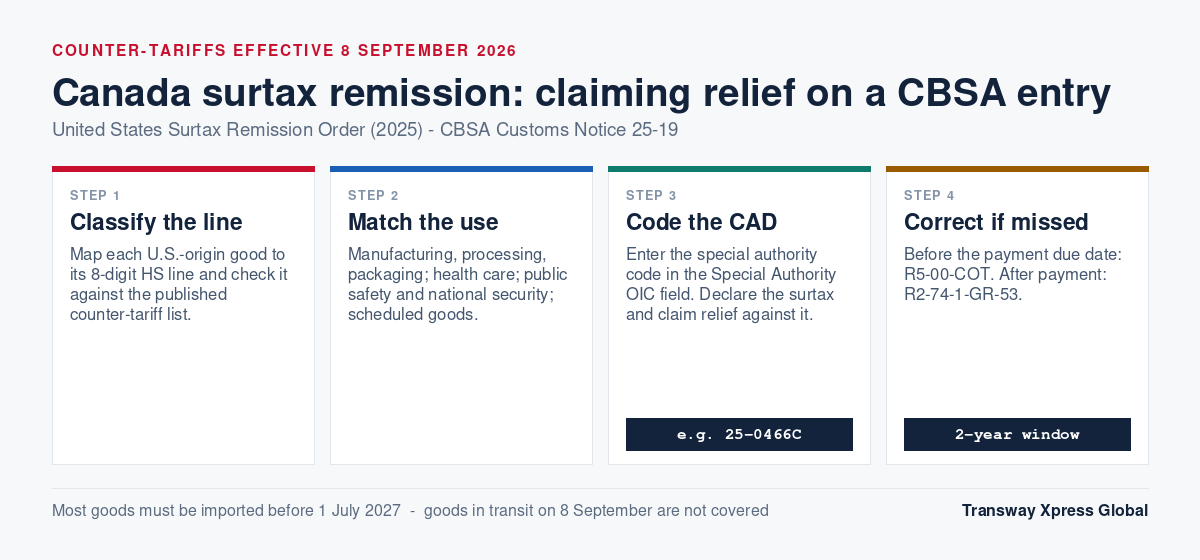
The United States Surtax Remission Order (2025), explained in CBSA Customs Notice 25-19, is the standing instrument. It relieves surtax on goods used in Canadian manufacturing and processing, and on goods supporting health care, public safety and national security.
The standing categories under the Surtax Remission Order (2025)
- Public health, public safety and national security — goods for hospitals, health research organisations, firefighting services, law enforcement, the Department of National Defence and the Canadian Forces.
- Health care — goods for medically necessary services at hospitals, clinics, laboratories and long-term care facilities, plus blood, tissue and organ providers and health authorities.
- Manufacturing, processing and packaging — goods imported for use in Canadian manufacturing, processing of any good, agricultural production, or food and beverage packaging. The Order defines processing to include adjustment, assembly or modification of the goods.
- Steel and aluminum for vehicles and aerospace — goods for motor vehicle manufacture, or aircraft and spacecraft production and parts.
- Scheduled goods — Schedules 1 through 6 list specific goods by tariff classification with their own eligibility windows.
Canada surtax remission authority codes at a glance
Each category has its own special authority code. Using the wrong one is the most common reason a Canada surtax remission claim is reassessed later.
| Category | Special authority code |
|---|---|
| Public health, public safety, national security | 25-0466A |
| Health care | 25-0466B |
| Manufacture, processing, packaging | 25-0466C |
| Aircraft, spacecraft, motor vehicles and parts | 25-0466S01 |
| Schedule 1 goods | 25-0466D |
| Schedule 2 goods | 25-0466M |
| Schedule 4 goods | 25-0466Q01 |
| Motor vehicles (Schedule 5) | 25-0466N |
| Schedule 6 goods | 25-0466T01 |
Schedule 3 items run from 25-0466E through 25-0466P02 and Schedule 4.1 items from 25-0466R01 through 25-0466R23; the specific code depends on the item, so read the notice against your classification rather than guessing.
The eligibility windows that catch people out
Most goods must be imported before 1 July 2027. Schedule 2 steel and aluminum goods had to be imported before 1 February 2026. Goods under the vehicle and aerospace category apply to imports on or after 1 February 2026 and before 1 July 2027. Schedule-specific dates vary by line. A claim outside its window fails on the date alone, no matter how well the use is documented.
How do you claim Canada surtax remission on a CBSA declaration?
This is the step that separates importers who get relief from importers who merely qualify for it.
Coding the Commercial Accounting Document
Enter the relevant special authority code in the Special Authority OIC field on the Commercial Accounting Document. The surtax must still be declared alongside the remission claim — you are not omitting the surtax, you are declaring it and claiming relief against it in the same accounting. If you are still working through CARM mechanics, our guide to CARM requirements for non-resident importers covers the account structure this sits inside.
Corrections and refunds after payment
Claims can be submitted within two years after the date of importation, so a missed code on 8 September is recoverable. Corrections before the CAD payment due date use reason code R5-00-COT. After payment, adjustments use reason code R2-74-1-GR-53, and non-commercial adjustments use Form B2G. Two conditions apply throughout: no other surtax relief may have been granted on the same good, and you must hold documentation substantiating the qualifying use for CBSA inspection.
What documentation actually has to exist
For the manufacturing and processing category, the burden is showing the good entered a qualifying activity. That means production records, bills of material, or packing records tying the imported line to the finished output — not a general statement that your company manufactures. Getting the commercial invoice fields right at origin makes this reconciliation far cheaper later.
How do you request remission for goods that aren’t on the list?
If your goods fall outside the standing Order, Finance Canada operates a separate request framework, and it remains open to assess requests for exceptional relief.
The two circumstances Finance will consider
Per the Department of Finance, remission is considered in two situations: to address cases where goods used as inputs cannot be sourced domestically, either nationally or regionally, or reasonably from non-U.S. sources; and to address, case by case, other exceptional circumstances that could have severe adverse impacts on the Canadian economy. The department states it will only grant remission where it is required to address exceptional and compelling circumstances that, from a public policy perspective, outweigh the primary rationale behind applying the tariffs. That is a high bar, deliberately.
What your submission must contain
- Company details — business number, corporate structure, location and operations.
- Product description with the 8-digit tariff classification.
- Import volumes and values, supported by customs documentation.
- Evidence you cannot source from Canadian or non-U.S. suppliers.
- Manufacturing cost breakdown, where applicable.
- Competitive impact analysis.
- A detailed justification of the exceptional circumstances.
- Supporting documentation — letters, studies, market data.
Only companies registered in Canada may submit. Requests go to [email protected] with the subject line “U.S. Remission”. Confidential information is protected; non-confidential details allow Finance to consult domestic producers. The full criteria are published on the Department of Finance remission process page.
What Canada surtax remission does not cover
Section 338 duties on the U.S. side
Canadian remission relieves Canadian surtax. It does nothing for the U.S. duties running in the other direction. Section 338 additional duties took effect at 12:01 a.m. Eastern on 22 August 2026 under headings 9903.03.12 through 9903.03.14, at an additional 50% ad valorem on top of existing duties. If you ship into the United States as well as import from it, you are managing two separate regimes with two separate relief mechanisms. Our overview of US–Canada tariffs in 2026 maps both directions.
CUSMA is not a shield
A CUSMA claim does not exempt covered goods from Section 338 duties — the duties apply regardless of whether a good qualifies for preferential treatment. It is also worth stating plainly, because we are asked constantly: CUSMA preference applies to goods that originate in North America. Goods manufactured in India, China or anywhere outside the region do not become CUSMA-originating by transiting a Canadian or U.S. warehouse. Landed cost for those flows has to be modelled on MFN rates plus any applicable surtax — our landed cost calculation guide shows the arithmetic.
Deferral is a different tool
Where remission does not apply, duty deferral sometimes does — particularly for goods that will be re-exported rather than consumed in Canada. See our comparison of duty deferral programs in Canada and the US for where each tool fits.
Your Canada surtax remission checklist before 8 September
| # | Action | Owner |
|---|---|---|
| 1 | Pull every U.S.-origin line you imported in the last 90 days and map it to the 8-digit classification | Customs / finance |
| 2 | Flag which of those lines appear on the 8 September counter-tariff list and at which rate | Customs |
| 3 | For each flagged line, test it against the five standing remission categories | Customs / broker |
| 4 | Confirm the eligibility window — most goods must be imported before 1 July 2027 | Customs |
| 5 | Give your broker the correct special authority code per line, in writing, before the first post-8-September entry | Importer |
| 6 | Identify shipments already in transit on 8 September and preserve proof of transit date | Logistics |
| 7 | Stand up the production or packing records that substantiate qualifying use | Operations |
| 8 | For non-listed goods with no alternative source, start the Finance submission now | Leadership |
| 9 | Diarise a 90-day review to catch missed codes inside the two-year correction window | Finance |
How Transway Xpress Global solves this
The failure is operational, not legal
Most of the failure in surtax relief is operational. The goods qualify; the code never reaches the entry, or the records that prove qualifying use live in three systems that do not reconcile. That is a fulfillment and data problem before it is a customs problem.
Transway Xpress Global runs cross-border fulfillment out of warehouses in Oakville and Etobicoke, Ontario and Buffalo, New York, with an office in Pendleton, Indiana, backed by our trucking parent Transway Transport, operating out of Oakville since 2014. Because we handle D2C and B2B fulfillment, Amazon FBA prep, warehousing, order and inventory management, cross-border shipping and returns under one roof, the inbound record and the outbound record sit in the same place — which is exactly what a remission claim needs when CBSA asks you to substantiate use two years later.
Practically, that means we can tell you which SKUs crossed on which date and into which downstream activity — and if you are restructuring flows to reduce U.S.-origin exposure, hold inventory on whichever side of the border your duty position favours.
Summary
What to take away
Counter-tariffs of up to 50% land on 8 September 2026 across $27.6 billion of U.S. imports. Canada surtax remission under the Surtax Remission Order (2025) already relieves the surtax for manufacturing, processing, packaging, health care, public safety and national security uses — but only if the correct special authority code is entered on the Commercial Accounting Document, and only within the published eligibility windows. Goods outside the Order need a Finance Canada submission with real evidence that no non-U.S. source exists. You have five days to get codes into your broker’s hands, and two years to correct what you miss. Use both.
Frequently asked questions
What is Canada surtax remission?
Canada surtax remission is the forgiveness of surtax otherwise payable on imported goods, granted through Orders in Council and administered by CBSA. The United States Surtax Remission Order (2025) relieves surtax on goods used in Canadian manufacturing, processing, agricultural production and food or beverage packaging, and on goods supporting health care, public safety and national security. Relief is claimed by entering a special authority code on the Commercial Accounting Document at the time of accounting — it is not applied automatically, and it is not requested informally at the border.
How do I claim surtax remission on a CBSA entry?
Enter the applicable special authority code in the Special Authority OIC field on the Commercial Accounting Document, while still declaring the surtax itself. For example, goods for manufacturing, processing or packaging use code 25-0466C. Keep documentation proving the qualifying use available for CBSA inspection. If you miss the code, you can correct it: before the CAD payment due date using reason code R5-00-COT, and after payment using reason code R2-74-1-GR-53, within two years of the date of importation.
Do the 8 September 2026 counter-tariffs apply to goods already in transit?
No. The Department of Finance states that Canada’s countermeasures do not apply to U.S. goods that are in transit to Canada on the day they come into force. That makes the transit date evidentially important. Preserve bills of lading, carrier manifests and departure records for anything that left the United States before 8 September 2026 but arrives after it, because that documentation is what supports the position if the entry is later reviewed.
Does a CUSMA claim protect my goods from these tariffs?
No, in both directions. On the U.S. side, Section 338 additional duties apply regardless of whether a good qualifies for USMCA preferential treatment — origin does not exempt covered goods. On the Canadian side, the counter-tariffs target U.S.-origin goods specifically, so CUSMA origin is the trigger rather than the shield. Separately, CUSMA preference only ever applies to goods originating in North America; goods made in India or elsewhere overseas do not become CUSMA-originating by passing through a Canadian or U.S. warehouse.
How long does a Finance Canada remission request take?
The Department of Finance does not publish a service standard for these decisions, and outcomes are case by case, so treat the timeline as open-ended and do not build a pricing plan around approval. The practical implication is to file early and pay in the meantime. Because CBSA allows remission claims within two years after the date of importation, a later approval can still be applied to entries already accounted for — provided you have kept the classification, valuation and use documentation intact.
Facing a surtax exposure you cannot price in? Transway Xpress Global helps cross-border brands restructure inbound flows, tighten customs documentation, and hold inventory on the right side of the border. Book a consultation and we will map your U.S.-origin lines against the 8 September counter-tariff list before it takes effect.