Duty deferral programs have gone from a niche customs tactic to a core inventory decision for anyone moving goods across the Canada–US border. When the United States indefinitely suspended the $800 de minimis exemption for all non-postal shipments on 24 June 2026, the old workaround — ship small parcels from a Canadian warehouse and let each one clear duty-free — stopped working. Every commercial shipment now needs an informal or formal entry, and duty is payable up front. That single change makes when you pay duty as important as how much you pay. Duty deferral programs answer the timing question: they let you hold imported inventory without paying duty until the goods actually enter the domestic market, or skip the duty entirely if the goods leave again.
This guide compares the Canadian and American options side by side, shows which one fits which selling model, and flags the CUSMA restriction that quietly disqualifies a lot of the savings brands assume they will get.
What Are Duty Deferral Programs?
Duty deferral programs are government-administered schemes that postpone, relieve or refund the duties and taxes normally payable the moment imported goods cross the border. They exist because customs authorities recognize that goods passing through a country — rather than being consumed in it — should not carry the same duty burden as goods sold domestically.
Deferral, Relief and Refund Are Three Different Mechanics
The three mechanics get lumped together, but they behave differently on your balance sheet. Deferral means the duty is never assessed while the goods sit in an approved facility; you pay only on the portion you withdraw for domestic sale. Relief means duty is waived at import on the condition that you re-export within a set window. Refund, better known as drawback, means you pay duty at import and claim it back after export. Deferral protects cash flow best; drawback protects it worst, because your money sits with the government in the meantime.
Why 2026 Changed the Math on Duty Deferral
Two shifts made duty deferral programs worth revisiting. First, the de minimis suspension removed the ability to drip low-value parcels into the US duty-free, so importers are once again holding duty-paid inventory in bulk. Second, elevated tariff rates mean the working capital tied up in a single container is materially larger than it was two years ago. If you are still modelling your costs on pre-2026 assumptions, start with our guide to calculating landed cost and our breakdown of what the end of de minimis means for your brand.
How Do Canada’s Duty Deferral Programs Work?
The Canada Border Services Agency groups its options under a single Duty Deferral Program with three components. Each suits a different pattern of trade.
Customs Bonded Warehouse
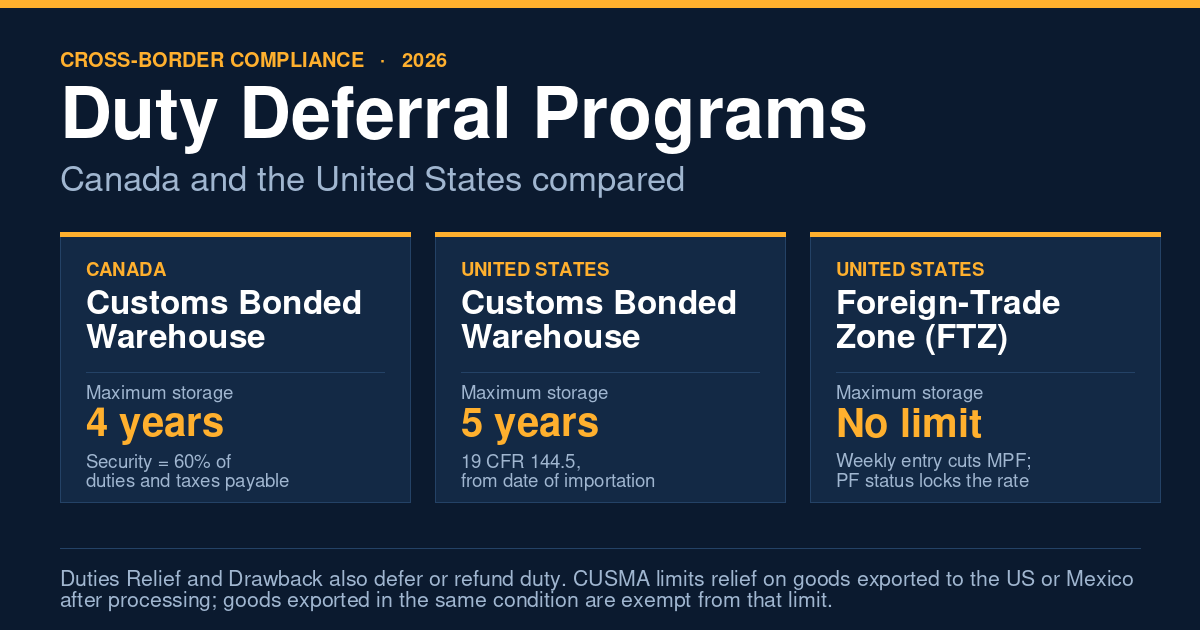
A customs bonded warehouse is a privately operated, CBSA-licensed facility where imported goods sit without duties or GST being assessed. You pay only on the portion released into the Canadian market; anything exported leaves duty-free. Imported commercial goods must be removed within four years of entering Canada, with extensions available on approval. Operators must post security equal to at least 60% of the maximum total duties and taxes payable at any one time. Permitted handling is deliberately limited to minor manipulation — marking, labelling and repackaging — so a bonded warehouse is a holding and distribution tool, not a production centre. Full details are published by the CBSA customs bonded warehouse program.
Duties Relief Program
The Duties Relief Program suits importers who know at the outset that the goods are leaving again. Rather than deferring inside a licensed facility, CBSA relieves the duty at import on the condition that the goods are exported within four years of the original release date. Relief covers customs duties, anti-dumping and countervailing duties, and excise taxes — but it does not cover GST/HST, which remains payable. This is the option most often used by brands that consolidate inventory in Ontario and then push the majority of it onward to the United States.
Duty Drawback Program
Drawback is the retrospective option. You pay duty at import, sell or ship the goods onward, then file to recover what you paid on the exported portion. It requires no licence and no facility approval, which makes it the lowest-friction entry point into duty deferral programs. The trade-off is cash flow: the duty leaves your account and comes back months later.
How Do US Duty Deferral Options Compare?
The United States offers two structurally different routes, and the gap between them is wider than most brands expect.
Customs Bonded Warehouse (19 CFR 144.5)
A US customs bonded warehouse defers duty, taxes and fees while goods remain in the facility. Under 19 CFR 144.5, merchandise must not remain in a bonded warehouse beyond five years from the date of importation, though a Center director may grant a longer period for good cause. Permitted operations are limited to manipulation such as sorting, cleaning and repacking. Setup is comparatively light, with approval typically running about three to four months.
Foreign-Trade Zones
A foreign-trade zone is the more powerful and more demanding option. Goods can remain in an FTZ indefinitely — there is no storage clock at all. Manufacturing and assembly are permitted with the right approvals, though those permissions have narrowed for goods entering under recent tariff actions. Two FTZ-only features matter financially. Privileged Foreign status locks in the duty rate applicable at the time of admission, which protects you if rates rise but locks you out of savings if they fall. Weekly entry consolidates a week of shipments into a single customs entry, which caps the merchandise processing fee. For FY 2026 the MPF is 0.3464% ad valorem, with a minimum of $33.58 and a maximum of $651.50 per formal entry, so any importer filing more than 52 entries a year sees real savings from consolidation.
| Dimension | Canadian Bonded Warehouse | US Bonded Warehouse | US Foreign-Trade Zone |
|---|---|---|---|
| Maximum storage | 4 years from entry into Canada | 5 years from date of importation | No time limit |
| Duty treatment | Deferred until released for Canadian consumption | Deferred until withdrawn for consumption | Deferred until entered for consumption |
| Sales tax | GST deferred alongside duty | Not applicable at federal level | Not applicable at federal level |
| Permitted handling | Marking, labelling, repackaging | Sorting, cleaning, repacking | Manipulation plus manufacturing and assembly with approval |
| Security or bond | At least 60% of maximum duties and taxes payable | Customs bond required | Zone operator bond and activation |
| Entry consolidation | Not applicable | Not available | Weekly entry caps merchandise processing fee |
| Duty rate lock | Rate applied on release | Rate applied on withdrawal | Privileged Foreign status locks rate at admission |
| Typical setup time | Licence application to CBSA | About 3–4 months | About 3–8 months depending on complexity |
Which Duty Deferral Route Fits Your Cross-Border Model?
The right answer depends far less on your product than on where your orders actually ship from and how long inventory sits.
Match the Program to the Flow
| Your situation | Likely best fit | Why |
|---|---|---|
| Import to Canada, sell mostly in Canada | Customs bonded warehouse | Duty and GST deferred until each release; you pay as you sell |
| Import to Canada, re-export most volume to the US | Duties Relief Program | No duty paid at import provided goods leave within four years |
| Occasional exports, low volume, no facility change | Duty Drawback Program | No licence needed; recover duty after the fact |
| High US entry volume, long inventory dwell | Foreign-trade zone | No storage limit and weekly entry caps the MPF |
| Bulk US inventory held under 5 years, simple handling | US bonded warehouse | Lower setup burden than an FTZ for the same deferral benefit |
| Fast-moving D2C with 30–60 day turns | Often none of the above | Deferral savings rarely offset program overhead at short dwell times |
The CUSMA Restriction Most Sellers Miss
This is where assumptions get expensive. Under CUSMA, Canadian drawback and duties relief on non-originating goods exported to the United States or Mexico are capped at the lesser of the duty paid on import into Canada or the duty paid when the finished product entered the other CUSMA country. You cannot claim the full Canadian duty back if the US duty was lower.
Critically, several categories are exempt from that cap and receive full relief: goods exported in the same condition as imported, CUSMA-originating goods, goods exported to non-CUSMA countries, and deemed exports. Same-condition treatment survives minor operations such as cleaning, packaging, dilution or trimming — which covers most e-commerce inventory that is simply stored and shipped. If you are transforming goods in Canada, the cap applies. Note that CUSMA preferential treatment itself depends on North American origin; goods manufactured in India, China or the EU do not become duty-free under CUSMA merely by passing through Canada. Our guide to CUSMA rules of origin covers where that line falls.
Duty Deferral Readiness Checklist
Before you approach CBSA, CBP or a customs broker, work through the following. Most rejected applications fail on record-keeping, not eligibility.
What to Confirm Before You Apply
| Item | Requirement | Why it matters |
|---|---|---|
| Inventory dwell time | Average days from receipt to shipment | Under 60 days, deferral overhead usually exceeds the benefit |
| Duty rate exposure | Weighted average duty rate across your catalogue | Low-duty goods rarely justify a bonded program |
| Export ratio | Share of imported units that leave the country again | Drives the choice between deferral and relief |
| Origin documentation | Certification of origin for every SKU | Determines whether CUSMA caps your relief |
| Lot traceability | Ability to trace each unit from entry to export | Mandatory for drawback and relief audits |
| Security capacity | Bond or security equal to program requirements | Canadian bonded warehouses require at least 60% coverage |
| Handling scope | List of operations performed on the goods | Processing beyond minor manipulation changes your options |
| Broker alignment | Confirmed entry type and filing responsibility | Informal and formal entries carry different data requirements |
How Transway Xpress Global Supports Duty Deferral Programs
Warehousing on Both Sides of the Border
Transway Xpress Global operates fulfillment warehouses in Oakville and Etobicoke, Ontario, and in Buffalo, New York, with an office in Pendleton, Indiana. These are conventional fulfillment centres, not bonded warehouses or foreign-trade zones — and for most e-commerce brands, that distinction matters less than the structure it enables.
Holding inventory on both sides of the border achieves much of what duty deferral programs are designed to deliver, without the licensing overhead. You import into each market only what that market will sell, so duty is paid once, on the right side, at the right time. Cross-border replenishment moves in consolidated freight through our parent company Transway Transport, an Oakville-based trucking operation running since 2014, rather than in the parcel-by-parcel flows that the de minimis suspension made expensive. Where a bonded or zone solution genuinely fits, we work alongside your customs broker so the fulfillment side — receiving, order and inventory management, FBA prep, returns and custom packaging — stays aligned with the entry strategy.
If you are still deciding where inventory should sit, our comparison of US versus Canadian warehousing and our fulfillment partner checklist are the right starting points.
Key Takeaways
What to Do Next
Duty deferral programs reward inventory that sits still and punishes programs adopted without the numbers behind them. Start by measuring dwell time and weighted duty rate; if inventory turns in under two months or your duty exposure is minimal, the administrative burden will outrun the benefit. If you are holding bulk stock for months, or re-exporting a meaningful share of what you import, one of the four programs above will pay for itself. Either way, decide before your next purchase order, not after the container lands. For the wider picture on structuring cross-border inventory, see our complete cross-border fulfillment guide and our explainer on avoiding surprise customs fees.
Frequently Asked Questions
What are duty deferral programs?
Duty deferral programs are customs schemes that let importers postpone, waive or reclaim the duties and taxes normally payable when goods cross the border. In Canada, CBSA administers three components: customs bonded warehouses, the Duties Relief Program and the Duty Drawback Program. In the United States, importers use customs bonded warehouses or foreign-trade zones. The common principle is that goods which are stored, re-exported or not yet sold domestically should not carry the full duty burden of goods entering the market immediately.
How long can goods stay in a bonded warehouse?
It depends which side of the border you are on. In Canada, imported commercial goods must be removed from a customs bonded warehouse within four years of entering the country, though CBSA can approve extensions. In the United States, 19 CFR 144.5 sets the limit at five years from the date of importation, with longer periods available if the importer files a request and shows good cause. A US foreign-trade zone has no storage time limit at all, which is one of its main advantages over a bonded warehouse.
Does the Duties Relief Program cover GST?
No. Canada’s Duties Relief Program relieves customs duties, anti-dumping and countervailing duties, and excise taxes at the time of importation, but GST/HST is explicitly excluded and remains payable. This is a common budgeting error. A customs bonded warehouse behaves differently: because the goods have not been released for Canadian consumption, both duty and GST are deferred until the goods leave the facility for the domestic market.
What is the difference between an FTZ and a bonded warehouse?
A bonded warehouse defers duty on stored goods for up to five years and permits only limited handling such as sorting, cleaning and repacking. A foreign-trade zone has no storage time limit, allows manufacturing and assembly with approval, permits weekly entry filing that caps the merchandise processing fee, and offers Privileged Foreign status to lock the duty rate at admission. An FTZ delivers more, but takes longer to establish and carries heavier compliance obligations.
Do duty deferral programs still make sense after the de minimis suspension?
For many importers, more than before. Since 24 June 2026 the $800 de minimis exemption has been indefinitely suspended for all non-postal modes, so low-value shipments now require informal or formal entry and duty is payable on arrival. That pushes brands back toward bulk imports and duty-paid inventory, which is exactly the pattern duty deferral programs are built for. The qualifier is dwell time: if stock turns quickly, the program overhead may still outweigh the cash-flow gain.
Not sure which route fits your volumes, duty exposure and turn rate? Book a consultation with Transway Xpress Global and we will map your cross-border inventory against the programs that actually apply to your goods.