Shipping to Europe from Canada stopped being routine on 1 July 2026, and most Canadian brands only found out when their parcels were refused at the counter. On that date the European Union abolished the duty relief on consignments worth €150 or less and replaced it with a flat €3 customs duty, and Canada Post responded by suspending parcel acceptance to nine EU countries — France and Germany among them. Those suspensions are still in force as this is published. If you sell into the EU from a Canadian warehouse, you are now 103 days into a regime that changed your landed cost, your carrier options and your checkout promise all at once, and you are heading into peak season with nine of your largest European markets closed to the post.
What changed for shipping to Europe from Canada on 1 July 2026
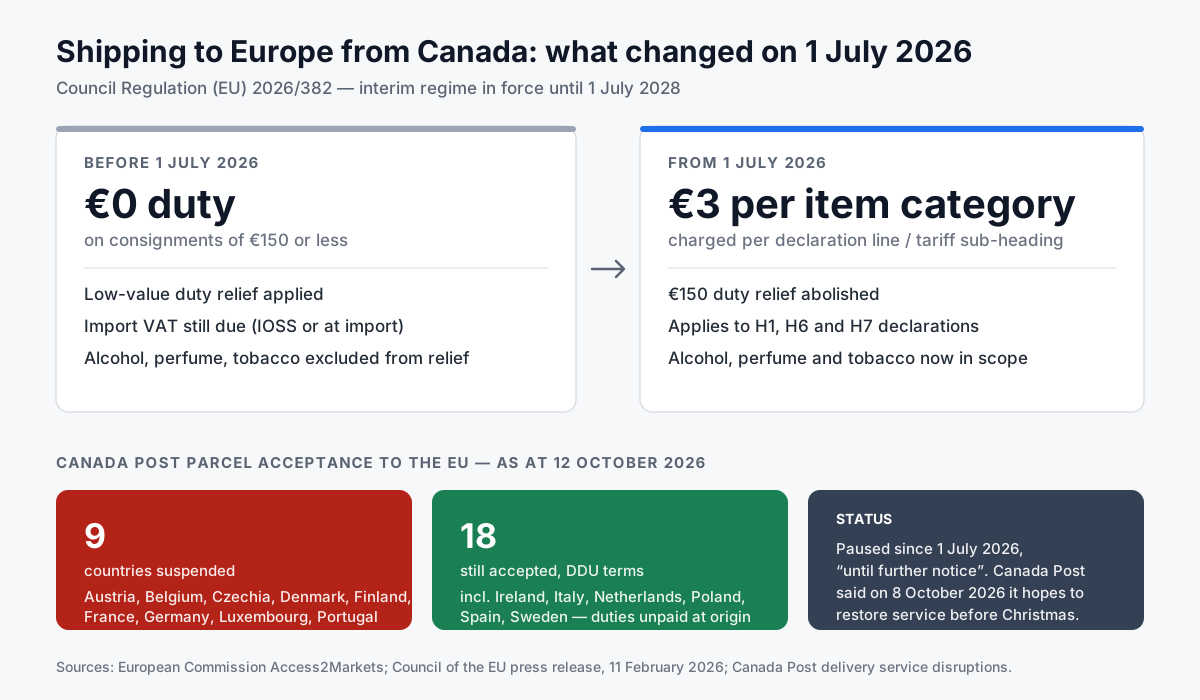
The change is narrow in wording and wide in effect. It comes from Council Regulation (EU) 2026/382, which the Council of the European Union gave final approval on 11 February 2026 and which took effect on 1 July 2026.
The €150 duty relief is gone
Until 1 July 2026, a consignment with an intrinsic value of €150 or less entered the EU free of customs duty. Import VAT was still due — through the Import One-Stop Shop (IOSS), the special arrangements, or collected at the border — but duty was not. That relief has been abolished. For anyone shipping to Europe from Canada, that one change reset the economics of every low-value EU order. Every B2C distance sale below the old threshold now attracts duty, which means the commercial decision you made about EU pricing before July is out of date.
The €3 flat duty and how it is actually applied
In place of normal tariff classification, the EU is charging a temporary flat duty of €3. The detail that catches sellers out is the unit of charge: the duty is applied per declaration line — per tariff sub-heading — not per parcel and not per unit. A single H6 or H7 declaration line holding several identical items carries one €3 charge. A parcel containing three different product categories carries three. Under H1 declarations, the charge lands on each line.
Three further points matter for anyone shipping to Europe from Canada:
- The duty applies regardless of your VAT route. IOSS, special arrangements and standard import VAT are all in scope.
- It applies across H1, H6 and H7 declaration types, so there is no declaration format that avoids it.
- Goods that were previously excluded from low-value relief — alcohol, perfume and tobacco — are now inside the regime.
The regime is explicitly interim. It runs until 1 July 2028, the date the EU Customs Data Hub is expected to be operational, after which normal tariffs by classification take over. The Council has said the flat duty may be extended if that infrastructure is not ready.
| Dimension | Before 1 July 2026 | From 1 July 2026 |
|---|---|---|
| Customs duty on consignments ≤ €150 | None — low-value relief applied | €3 flat duty |
| Unit the duty is charged on | Not applicable | Per declaration line / tariff sub-heading |
| Import VAT | Due via IOSS, special arrangements or at import | Unchanged — still due |
| Declaration types affected | Not applicable | H1, H6 and H7 |
| Alcohol, perfume, tobacco | Excluded from relief | In scope of the €3 duty |
| Duration | Standing relief | Interim to 1 July 2028, extendable |
| Legal instrument | Prior low-value relief | Council Regulation (EU) 2026/382 |
Which EU destinations Canada Post has paused
The regulation created a data and collection problem for postal operators, which must now capture item-level detail and account for duty on traffic that previously moved without either. Canada Post’s answer was to stop accepting parcels for the destinations it could not serve compliantly.
The nine suspended countries
Parcel acceptance is suspended “until further notice” for Austria, Belgium, the Czech Republic, Denmark, Finland, France, Germany, Luxembourg and Portugal. Letter mail is unaffected. For a Canadian D2C brand, that list is not a tail — France and Germany alone are among the largest e-commerce markets in Europe.
The 18 destinations still moving, on DDU terms
Canada Post is still accepting parcels for Bulgaria, Croatia, Cyprus, Estonia, Greece, Hungary, Ireland, Italy, Latvia, Lithuania, Malta, the Netherlands, Poland, Romania, Slovakia, Slovenia, Spain and Sweden — but on a Delivered Duties Unpaid basis. DDU means the duty and VAT are collected from your customer before the parcel is released. That is a materially different customer experience from the one your checkout probably promises.
| Status | Destinations | What it means for your order |
|---|---|---|
| Suspended | Austria, Belgium, Czech Republic, Denmark, Finland, France, Germany, Luxembourg, Portugal | Cannot be posted from Canada at all; needs a commercial carrier |
| Accepted, DDU | Bulgaria, Croatia, Cyprus, Estonia, Greece, Hungary, Ireland, Italy, Latvia, Lithuania, Malta, Netherlands, Poland, Romania, Slovakia, Slovenia, Spain, Sweden | Moves, but your customer is billed duty and VAT before release |
| Letter mail, all EU | All 27 member states | Unaffected by the parcel suspension |
On 8 October 2026 Canada Post said it is working on solutions to resume personal and business shipping to the EU ahead of the Christmas season. It has not committed to a restoration date. Plan your peak on the assumption that the nine remain closed, and treat any restoration as upside.
What the pause actually costs a Canadian brand in peak season
Cart abandonment at the border, not at the checkout
The expensive failure here is not the €3. It is the DDU surprise on the 18 countries that are still open. A customer who paid at checkout and is then asked for duty and VAT by a delivery agent before release will often refuse the parcel. You then absorb the outbound cost, the return leg and the lost sale. The €3 duty is small; an undeliverable parcel crossing the Atlantic twice is not. A refused parcel shipping from Canada to Europe earns nothing and costs you both legs.
Why the nine suspensions hit hardest
For the suspended nine there is no postal option at any price, so every order must move on a commercial carrier. That resets your cost base rather than nudging it. Every order shipping from Canada to those nine European markets now needs a commercial carrier. If your pricing has not been rebuilt since July, it is wrong.
Your options for shipping to Europe from Canada right now
Move the suspended nine to commercial carriers
Integrators and consolidators continue to serve all 27 member states and can file the declarations the post cannot. Expect a higher unit cost and build it into your EU pricing rather than discovering it on the invoice. Compare quoted service levels against what you actually promise at checkout, not against the postal rates you used in June. Our Canada shipping rates comparison for 2026 is a useful starting frame for how carriers differ, even though its focus is domestic and transborder.
Switch your EU orders to a duty-paid term
If you are shipping to Europe from Canada on DDU today, you are exporting a billing problem to your customer. Quoting and collecting duty and VAT at checkout — a DDP-style arrangement — removes the refusal risk entirely. The trade-off is that you must calculate correctly before the order ships. Our guides on DDP versus DAP shipping terms and how to calculate landed cost set out the arithmetic and who bears which charge.
Register for IOSS if you have not already
IOSS does not exempt you from the €3 duty — nothing does — but it remains the cleanest route for the VAT side of a low-value B2C sale into the EU, and it keeps the VAT element out of the delivery-agent conversation. If you are shipping to Europe from Canada under IOSS today, the duty is still owed and must be accounted for separately.
Reconsider where the inventory sits
If EU volume justifies it, the structural answer is to stop sending single parcels across the Atlantic and instead move stock in bulk to a node closer to the customer. The same logic already applies to your US demand, and it is the reason most brands serving North America hold inventory on both sides of the border rather than shipping every order from one warehouse. Most brands shipping to Europe from Canada at volume stop sending single parcels across the ocean. Our cross-border e-commerce fulfillment guide covers how that decision is usually made.
Compliance checklist before your next EU shipment
- Check the destination against Canada Post’s current suspended list before you quote a postal service — the list has changed more than once since July.
- Rebuild every rate you quote for shipping to Europe from Canada. Any rate table written before 1 July 2026 understates your cost on all 27 member states.
- Count your declaration lines, not your parcels. A multi-category parcel carries €3 per tariff sub-heading, so consolidating distinct categories into one shipment does not consolidate the duty.
- Decide DDP or DDU per market, and make your checkout say the same thing. Silent DDU is what produces refusals.
- Confirm your IOSS registration and that your VAT treatment matches the declaration your carrier files.
- Tighten your commercial invoice data — accurate descriptions, HS codes and intrinsic values per line. Item-level data is the requirement that closed the postal lane in the first place. Our field-by-field commercial invoice guide covers what each field must carry.
- Set a returns path for the EU before peak, not during it. Refused DDU parcels become returns whether you planned for them or not — see our notes on cross-border returns.
- Do not assume the US position is the same. The United States suspended its own de minimis exemption on a separate track, with separate rules; we cover that in the end of de minimis and in the newer CBP low-value shipments rule.
How Transway Xpress Global solves this
Brands shipping to Europe from Canada come to us for the North American half of the problem. Transway Xpress Global is a North American fulfillment operation. We run warehouses in Oakville and Etobicoke, Ontario and in Buffalo, New York, with an office in Pendleton, Indiana, and we are part of Transway Transport, an Oakville trucking company operating since 2014. Our services are D2C and B2B fulfillment, Amazon FBA prep, warehousing, order and inventory management, cross-border shipping, returns and custom packaging.
What that means in the context of this change is specific, and worth being plain about. We are not an EU fulfillment network, and EU-bound parcels from Canada need a commercial carrier for the suspended nine regardless of who picks and packs them. Where we do change the outcome is upstream: clean, line-level commercial invoice data from the pick-and-pack stage, so the item-level detail the EU now demands exists before the parcel reaches a carrier rather than being reconstructed afterwards; and inventory positioning across our Ontario and Buffalo nodes, so your North American demand is served locally instead of competing for the same shipping budget as your European orders.
For brands whose EU volume is growing, the useful conversation is usually about which demand should be served from which node and what that does to total landed cost — not about finding a cheaper way to post a single parcel to Frankfurt. That conversation is what our consultation is for.
What to watch between now and Christmas
Three things matter for brands shipping to Europe from Canada. First, whether Canada Post restores any of the nine suspended destinations — it said on 8 October 2026 that it hopes to before the holiday rush, but has set no date. Second, whether the EU extends the flat duty past 1 July 2028, which it has reserved the right to do if the Customs Data Hub is not operational. Third, your own refusal rate on the 18 DDU destinations, which is the number that tells you whether your checkout and your delivery terms actually agree.
Frequently asked questions
What changed about shipping to Europe from Canada in 2026?
On 1 July 2026 the EU abolished customs duty relief on consignments with an intrinsic value of €150 or less and replaced it with a flat €3 duty, under Council Regulation (EU) 2026/382. Canada Post then suspended parcel acceptance to nine EU countries — Austria, Belgium, the Czech Republic, Denmark, Finland, France, Germany, Luxembourg and Portugal — because of the new duty and item-level data requirements. Those suspensions remain in force. Letter mail is unaffected, and 18 other EU destinations are still accepted on a Delivered Duties Unpaid basis.
Is the €3 EU duty charged per parcel or per item?
Neither, strictly. It is charged per declaration line — that is, per tariff sub-heading. Several identical items grouped on one H6 or H7 line attract a single €3 charge, while a parcel holding three different product categories attracts three. Under H1 declarations the duty applies to each line. This is the detail that most often surprises sellers shipping to Europe from Canada. The practical lesson is that consolidating distinct product categories into one shipment does not reduce the duty, so count your lines rather than your boxes when you price.
Can I still ship to France or Germany from Canada?
Yes, but not through Canada Post. Shipping to France or Germany from Canada is still possible, just not by post. Both are on the suspended list, so parcels to France and Germany must move with a commercial carrier that can file the required declarations. Integrators and consolidators continue to serve all 27 member states. Expect a higher unit cost than the postal rate you were paying before July 2026, and rebuild your EU pricing accordingly rather than absorbing the difference silently on each order.
Does registering for IOSS avoid the €3 customs duty?
No. Brands shipping to Europe from Canada still need IOSS, but it does not touch the duty. The duty applies regardless of your VAT route — IOSS, the special arrangements and standard import VAT are all in scope, as are all three declaration types. IOSS deals with the VAT side of a low-value B2C sale and is still worth having, because it keeps VAT out of the delivery-agent conversation and simplifies your reporting. But the €3 duty has to be accounted for separately, and no VAT registration removes it.
How long will the €3 EU parcel duty last?
The flat duty is an interim measure running until 1 July 2028, the date the EU Customs Data Hub is expected to be operational. After that, goods entering the EU are to be charged normal customs tariffs based on classification rather than a flat rate. The Council has reserved the right to extend the €3 regime if that infrastructure is not ready in time, so plan your shipping from Canada to Europe on the basis that it runs at least that long, and treat 1 July 2028 as a review point rather than a guaranteed end date.
Get your EU and North American routing right before peak
If you are shipping to Europe from Canada this quarter, the two decisions that matter are which carrier carries the suspended nine and whether your EU orders move duty-paid or duty-unpaid. Both change your landed cost, and both are easier to fix now than in December. If you would like a second pair of eyes on how your inventory is positioned across Canada and the United States — and what that means for the orders you are sending overseas — book a consultation with Transway Xpress Global.
Sources: European Commission, Access2Markets — EU applies €3 customs duty per item on low-value e-commerce consignments; Council of the European Union, 11 February 2026; Canada Post, Delivery service disruptions.