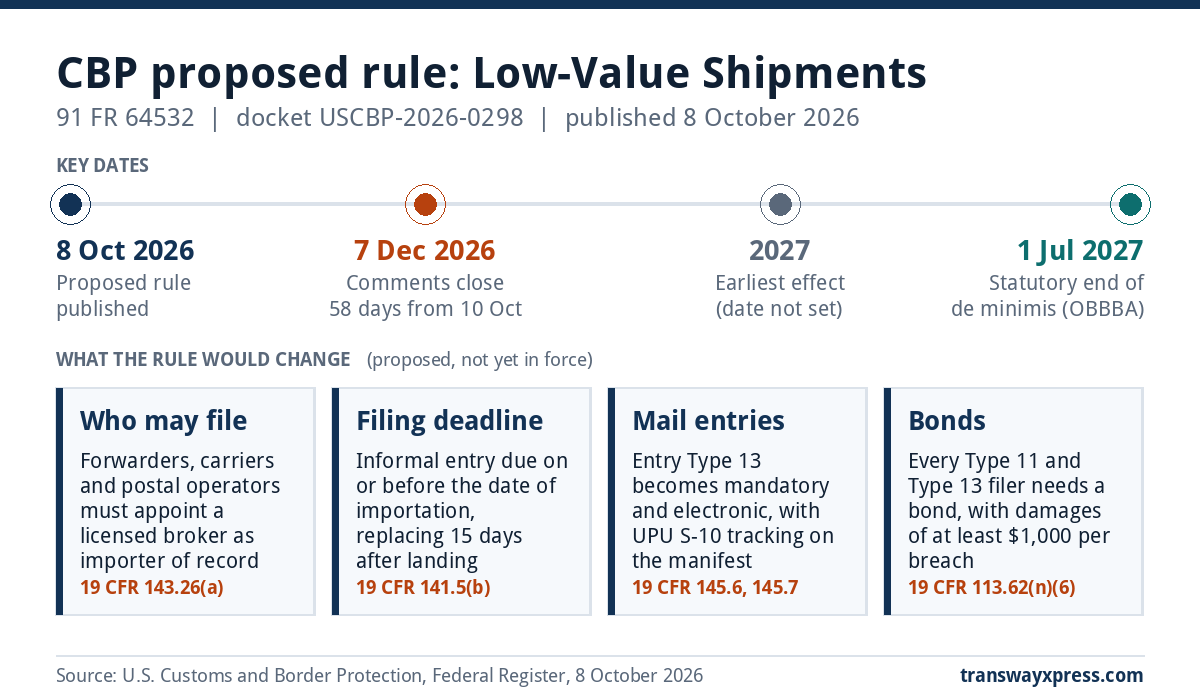
U.S. Customs and Border Protection has put the entire low-value entry process back on the table. The low value shipments rule, published as a notice of proposed rulemaking on 8 October 2026 at 91 FR 64532, would rewrite how every shipment worth $2,500 or less enters the United States. If you sell into the United States from Canada, from India or from anywhere else, the low value shipments rule matters to you for one blunt reason: your freight forwarder, your carrier and your postal operator would lose the right to act as importer of record on your parcels unless they appoint a licensed customs broker. Comments close on 7 December 2026, which leaves 58 days from today. Nothing in the proposal is in force yet, and that is precisely why this is the window to act.
What does CBP’s low value shipments rule propose?
The proposal amends five parts of the customs regulations at once: 19 CFR Parts 113, 128, 141, 143 and 145. Taken together, the changes move informal entry from a lightly documented, paper-tolerant process to an electronic, bonded and broker-gated one. CBP frames the purpose as revenue protection and interdiction of illicit goods. The practical effect for a cross-border seller is that a shipment which used to clear on thin data now needs a classified filing, a bond behind it and a party with the legal standing to make entry.
The identifiers you need to track the low value shipments rule
- Document: Low-Value Shipments, notice of proposed rulemaking
- Agency: U.S. Customs and Border Protection, Department of Homeland Security
- Citation: 91 FR 64532, published 8 October 2026
- Docket: USCBP-2026-0298 | RIN: 1685-AA38
- Comments due: on or before 7 December 2026
What is not changing
The $2,500 informal entry ceiling stays where it is. Bona fide gifts under 19 U.S.C. 1321(a)(2)(A) keep their existing entry procedures under 19 CFR 128.24(f), and the duty-exemption conditions at 19 U.S.C. 1321(a)(2)(A) and (B) are unchanged. The proposal is about who files, when they file, what they transmit and what secures it, not about the value threshold itself.
Who can still make entry on a low-value shipment?
This is the change most likely to disrupt an existing cross-border lane, because it reaches parties who are not importers at all in the commercial sense. The rule reaches every consignee named on low-value shipments, not only the brands whose logos are on the parcels.
Forwarders, carriers and postal operators
Under the proposed amendment to 19 CFR 143.26(a), a consignee who is not the owner or purchaser of the goods, and CBP names foreign postal operators, the United States Postal Service, freight forwarders and carriers, would have to appoint a licensed customs broker to act as importer of record on shipments valued at $2,500 or less, unless the exception at 143.26(b) applies. Arrangements where a forwarder simply puts itself on the entry would end. If you have never had to think about the line between the two roles, our guide to freight forwarder versus customs broker sets out what each one is actually licensed to do.
Owners, purchasers and your own IOR number
If you are the owner or purchaser of the goods, you can still make entry in your own name. That makes a clean, current importer of record file more valuable than it was a month ago, and CBP has already been voiding stale IOR numbers. See our note on importer of record number enforcement for what CBP checks on Form 5106.
What changes for Entry Type 11 informal entries?
Entry moves to the date of importation
Today an informal entry is timely if it is filed within 15 calendar days after the goods land. A new 19 CFR 141.5(b) would require entry to be filed upon or prior to the date of importation, using the definition of that date at 19 CFR 101.1. That is not a tightening of a deadline; it is the removal of a buffer that most low-value lanes are built around. Filing would also have to be electronic, meaning the electronic equivalent of CBP Forms 3461 and 7501 transmitted through a CBP-authorised EDI system. CBP notes that paper was already marginal: between 1 September 2025 and 31 May 2026, paper accounted for 0.14 per cent of Type 11 entries, or 73,534 out of 52,450,418.
The $250 Chapter 99 cap disappears
Informal entry is currently closed to goods valued above $250 that fall in Chapter 99, Subchapters III and IV of the HTSUS, the subchapters that carry Section 232 and similar measures. CBP proposes to remove that cap from 19 CFR 143.21(a) and (c), with conforming changes at 141.82(d) and 143.23(d), so goods above $250 and up to $2,500 could use informal entry even when an additional duty applies. This one cuts in the seller’s favour. It does not reduce the duty owed; it only widens which entry type can carry it.
Before and after: the low value shipments rule at a glance
| Dimension | Today | Under the proposed rule |
|---|---|---|
| Informal entry filing deadline | Within 15 calendar days after landing | Upon or before the date of importation |
| Filing method | Electronic or paper | Electronic only, via a CBP-authorised EDI system |
| Non-owner consignee as IOR | Permitted in many cases | Must appoint a licensed customs broker |
| Chapter 99 Subch. III and IV goods | Informal entry capped at $250 | Cap removed up to $2,500 |
| Mail shipments of $2,500 or less | Postal informal entry under 19 CFR 145.12(b) | Mandatory electronic Entry Type 13 |
| Bond on informal entries | Not generally required | Basic importation and entry bond required |
| Unentered mail | Handled under existing postal procedures | Deemed abandoned after 15 days |
| Formal entry demands | Case by case | Blanket, by importer, category or seller |
How to read the table
The left column is the law as it stands on 10 October 2026. The right column is a proposal. Treat it as a planning scenario with a 7 December comment deadline attached, not as a compliance date. Everything in the right column depends on a final rule that does not yet exist, which is why the value of this table today is planning rather than compliance.
What would Entry Type 13 require for mail?
Entry Type 13 is not new to this proposal. CBP began testing it on 22 September 2026, and we covered the test and its compliance milestones in our piece on Entry Type 13 mail entries. What the low value shipments rule does is propose to make the full process permanent and mandatory, replacing the postal informal entry process at 19 CFR 145.12(b).
The data CBP wants on every mail entry
An Entry Type 13 filing would carry every Type 11 data element plus three additions:
- Final Deliver-To Party, including address, where it differs from the ultimate consignee shown on CBP Form 7501. This element is also proposed for Type 11.
- Shipper or sender identity and address.
- The UPU S-10 tracking number. Under a new 19 CFR 145.7, the carrier would also have to report that number on the inward manifest. Carrier reporting was optional under the test.
Filers could self-file in ACE or use a licensed broker. If your product data is thin, with vague descriptions, missing values and no consistent sender record, this is the point where it fails. Our commercial invoice field-by-field guide covers the data discipline this assumes.
Fifteen days, then abandonment
A new 19 CFR 145.6 would deem mail valued at $2,500 or less voluntarily abandoned if it is not timely and properly entered within 15 days beginning on the date of importation. USPS would then dispose of it under its own procedures, which may include destruction or return to sender. For a D2C brand, an abandoned parcel is not a delayed delivery; it is a lost unit, a refund and a support ticket.
What bonds and penalties would apply?
Who needs a bond
Every Entry Type 11 and Entry Type 13 filer would need a basic importation and entry bond under 19 CFR 113.62, either a single transaction bond or a continuous bond. A new 19 CFR 143.29 would bar release of shipments requiring Forms 3461 and 7501 without one. For a seller shipping steady volume, a continuous bond is the only workable answer; single transaction bonds on thousands of parcels are an administrative dead end.
The $1,000 liquidated damages floor
CBP proposes to amend 19 CFR 113.62(n) and add a new (n)(6) setting liquidated damages at a minimum of $1,000 per breach of the listed bond conditions. For most breaches the amount would be the greater of the value of the merchandise or $1,000. For restricted or prohibited merchandise, and for alcoholic beverages, the proposal keeps the three-times-value formula, subject to the same $1,000 floor. A $40 parcel that breaches a bond condition would therefore carry a $1,000 exposure. That is the number to put in front of whoever owns your landed cost model.
Blanket formal entry
Separately, an amended 19 CFR 143.22 would let CBP require formal entry on a blanket basis, by importer of record, by type or category of merchandise, or for goods from a specific manufacturer or seller, rather than only shipment by shipment. A single quality problem in your lane could move your whole catalogue to formal entry. That discretion would reach shipments of any value, not only the low-value parcels this rule is aimed at.
Your action list before 7 December 2026
- By 24 October 2026 — confirm in writing who is named as importer of record on your U.S. low-value entries today. If it is a forwarder, a carrier or a postal operator rather than you, that arrangement is the one the proposal targets.
- By 7 November 2026 — ask your broker for a continuous bond quote sized to your projected annual duty, and model the cost against single transaction bonds at your parcel volume.
- By 14 November 2026 — audit your item data for the Type 13 elements: shipper identity and address, final deliver-to party, and S-10 tracking capture from your carrier.
- By 21 November 2026 — test whether your systems can produce an entry-ready file before goods arrive rather than up to 15 days after. This is the hardest operational change in the proposal.
- By 7 December 2026 — file a comment on docket USCBP-2026-0298 at regulations.gov if any of this breaks a lane you depend on. Comment periods on customs rules are the cheapest influence available to a small seller, and this one closes 58 days from today.
- Ongoing — watch for the final rule. CBP’s cost tables begin in 2027, described as the year the rule would take effect, but the proposal does not name an effective date.
How Transway Xpress Global Solves This
Transway Xpress Global runs fulfillment from warehouses in Oakville and Etobicoke, Ontario and in Buffalo, New York, with an office in Pendleton, Indiana, backed by our trucking parent Transway Transport, which has operated out of Oakville since 2014. That footprint is the structural answer to a rule that penalises parcel-by-parcel border crossings: inventory positioned in Buffalo is already in the United States, so U.S. orders ship domestically instead of generating an informal entry per order. One planned commercial shipment carries the value that would otherwise arrive as hundreds of separate low-value shipments under this rule.
For brands that must keep shipping cross-border, our team works to your importer of record arrangement rather than substituting our own. We prepare the data an electronic informal entry needs, including classification-ready descriptions, declared values, shipper and consignee records and tracking capture, and hand it to your customs broker in a form they can file. For Amazon sellers, FBA prep, labelling and inbound routing happen at our Ontario and Buffalo sites, so the entry that matters is a planned commercial shipment into a fulfillment centre rather than thousands of individual filings.
Where a Canadian or Indian brand feels this first
Canadian brands feel it in D2C parcels crossing south every day. Indian brands feel it earlier in the chain, because goods moving from India into North America cross a border before they ever reach a customer, and the rule changes who may enter those shipments and when. One correction worth stating plainly: CUSMA preferential treatment applies to goods that originate in North America, so India-origin goods do not become duty-free by routing through Canada. What a Canadian or U.S. warehouse does change is the number of entries and the party making them. Our guides to cross-border e-commerce fulfillment and to Amazon FBA prep in Canada for Indian brands work through both routes.
Summary
What is confirmed and what is not
Confirmed: CBP published the low value shipments rule on 8 October 2026 at 91 FR 64532 under docket USCBP-2026-0298, and comments must be received on or before 7 December 2026. Confirmed: the proposal would require a licensed broker as importer of record for non-owner consignees, move informal entry filing to the date of importation, make Entry Type 13 mandatory for mail, require a bond on Type 11 and Type 13 entries with a $1,000 liquidated damages floor, remove the $250 Chapter 99 cap and deem unentered mail abandoned after 15 days.
Not confirmed: the effective date. The proposal does not state one. Also unconfirmed is the final shape of any of these requirements, because this is a proposal and the comment period is the reason it is one. Separately, and already law rather than proposal, the de minimis exemption has been suspended since CBP’s interim final rules published 24 June 2026, and the One Big Beautiful Bill Act, enacted 4 July 2025, terminates it by statute on 1 July 2027. Our explainer on the end of de minimis covers that backdrop. CBP’s own regulatory impact analysis puts the net cost of this proposal at roughly $9.3 billion in present value over 2026 to 2035 at a 3 per cent discount rate, or roughly $7.7 billion at 7 per cent, in 2026 dollars.
Frequently Asked Questions
Is the low value shipments rule in effect now?
No. It is a notice of proposed rulemaking published on 8 October 2026 at 91 FR 64532. Comments are due on or before 7 December 2026, and CBP has not published a final rule or named an effective date. The cost tables in the proposal begin in 2027, described as the year the rule would take effect, but that is a planning assumption rather than a date you can diarise. Nothing in the proposal changes your obligations today. What has already changed, and is law, is the suspension of de minimis and the live Entry Type 13 test that began on 22 September 2026.
Does the low value shipments rule mean I must hire a customs broker?
Only if the party making entry is not the owner or purchaser of the goods. Under the proposed 19 CFR 143.26(a), a foreign postal operator, USPS, a freight forwarder or a carrier acting as consignee would have to appoint a licensed customs broker as importer of record on shipments of $2,500 or less. If you are the owner or purchaser and you make entry in your own name, you can continue to do so, though you would still need a bond and the ability to file electronically before arrival.
What is the $2,500 informal entry threshold?
Informal entry is the simplified customs entry process for shipments valued at $2,500 or less, filed as Entry Type 11. The proposal does not change that ceiling. It changes how informal entries are filed, meaning electronically, before importation and under a bond, and it removes the separate $250 limit that currently blocks informal entry for goods in Chapter 99, Subchapters III and IV of the HTSUS, such as goods carrying Section 232 duties.
How many days are left to comment on docket USCBP-2026-0298?
Fifty-eight days from 10 October 2026. Comments must be received on or before 7 December 2026 and are submitted through the Federal eRulemaking Portal at regulations.gov under docket number USCBP-2026-0298. If the proposal would break a lane your business depends on, particularly the filing-before-arrival requirement or the bond mandate on low-value parcels, a short and specific comment describing the operational impact carries more weight than a general objection.
What happens to a mail parcel that is not entered in time?
Under a proposed new 19 CFR 145.6, mail valued at $2,500 or less that is not timely and properly entered within 15 days beginning on the date of importation would be deemed voluntarily abandoned. USPS would then dispose of it under its own procedures, which may include destruction or return to the sender. For a D2C seller that means a lost unit and a refund, so the entry process and the data behind it need to be reliable before the rule is finalised, not after.
Sources: U.S. Customs and Border Protection, Low-Value Shipments, 91 FR 64532 (8 October 2026), and CBP Trade.
If this proposal touches a lane you depend on, the useful next step is to map where your entries are made today and what would change if your forwarder could no longer act as importer of record. Book a consultation with Transway Xpress Global and we will walk through your current entry structure, your bond position and whether U.S.-side inventory would take the pressure off your border crossings.