GST on imported goods is the line on a Canadian customs entry that foreign sellers budget for least accurately. Duty gets the attention — classification, origin, trade agreements — while the 5% federal tax applies to almost every commercial shipment crossing the border, calculated on a base larger than your invoice. For a brand shipping into Ontario from India or the United States, that gap shows up as a cash-flow surprise on the first entry and a margin problem by the hundredth. This guide covers how the tax is calculated, who is on the hook, when the provincial portion applies, and how much a registered importer gets back.
What Is GST on Imported Goods in Canada?
Canada applies its federal sales tax at the border, not only at retail. It is assessed when the shipment is accounted for, on the person who imports it, and collected through the customs entry rather than a sales-tax return.
GST on Imported Goods: The Short Answer
CBSA states plainly that “the GST (5%) is payable on most goods at the time of importation under Part IX, Division III of the Excise Tax Act.” Three things follow from that sentence, and each one catches sellers out.
- It is payable at importation, not when your end customer buys. Your inventory is taxed before it earns a dollar.
- It applies to most imported goods, so the default assumption should be that tax applies and the exemption is the thing you have to prove. If your imported goods are tax exempt, CBSA requires you to quote the exemption code on your import documentation.
- It is separate from duty. A shipment can be duty-free under a trade agreement and still be fully taxable.
Who CBSA Treats as the Importer
The tax follows the importer of record — whoever is named on the entry as accounting for the goods, not necessarily the party that owns them or pays the freight. If you sell on delivered terms and put your own company on the entry, the liability is yours. If your terms make the Canadian customer the importer, the liability moves to them, along with the right to recover it.
Make that choice deliberately rather than inheriting whatever your forwarder set up. Our breakdown of DDP versus DAP shipping terms covers how the Incoterm you quote decides who carries it, and non-resident companies planning to act as importer of record should start with CARM requirements for non-resident importers, since CBSA requires its own registration and financial security before you can account for commercial shipments at all.
How Is the Tax Calculated at the Border?
The rate is simple. The base is not. The tax is charged not on your invoice value but on a constructed figure called the value for tax, which sits on top of the customs valuation.
Value for Duty Comes First
Every commercial entry starts with a value for duty determined under the Customs Act. CBSA’s memorandum on the subject sets out that the value of imported goods, for the purpose of determining the tax liability, is the total of the value for duty plus federal duties and taxes other than the GST itself. Duty is calculated first; the tax is then calculated on the duty-inclusive figure.
So the tax base moves whenever the duty moves: any tariff action that raises assessed duty raises the tax charged on top of it. And if the value for duty is built wrong, every figure downstream is wrong — our guide to customs valuation rules in Canada covers the additions and deductions that belong in that calculation.
CBSA’s Own Worked Example
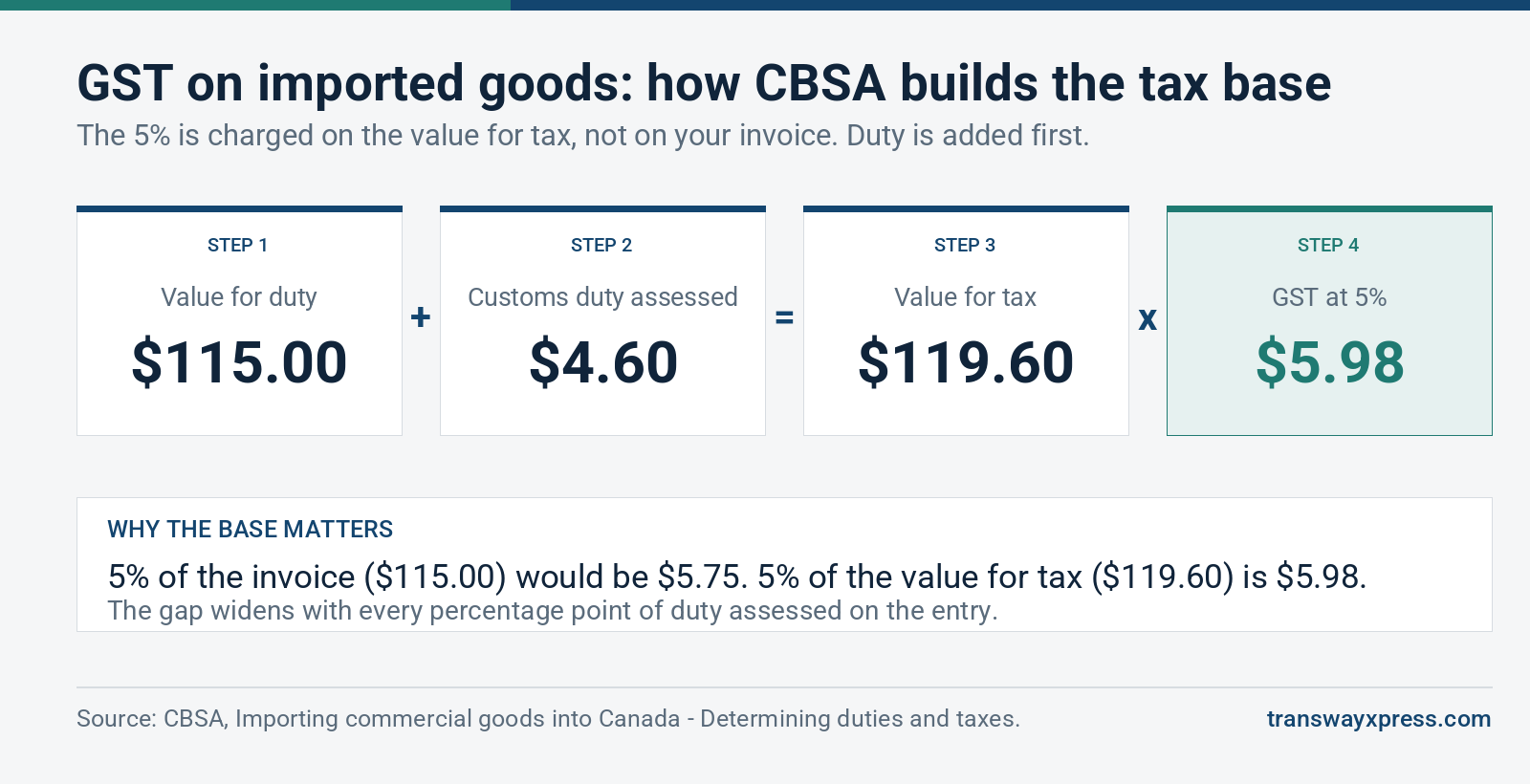
CBSA publishes a worked example that shows the stacking clearly.
| Step | Component | Amount (CAD) |
|---|---|---|
| 1 | Value for duty | $115.00 |
| 2 | Customs duty assessed | $4.60 |
| 3 | Value for tax (step 1 + step 2) | $119.60 |
| 4 | GST at 5% of the value for tax | $5.98 |
| 5 | Total payable to CBSA (steps 2 + 4) | $10.58 |
Note step 4. Five per cent of the $115.00 invoice would be $5.75; five per cent of the duty-inclusive $119.60 is $5.98. Trivial on one shipment, material across a year of volume, and it grows with every percentage point of duty. Some products also attract excise tax on top: CBSA lists automobile air conditioners at $100 per unit, with excise duty applying separately to tobacco and some alcohol products.
That is the order of operations to encode in any landed-cost model. Our walkthrough of how to calculate landed cost for cross-border e-commerce assembles the full stack, and the figures only work if the commercial invoice declares value, currency and terms of sale accurately.
When Does HST Apply Instead of Just GST?
Five provinces replaced their provincial sales tax with a harmonized tax bundling the federal and provincial portions into one rate. Whether the border collects that rate or only the federal 5% depends on what kind of import it is — one of the most commonly misread rules in Canadian importing.
Commercial Imports and the Federal Portion
On commercial shipments, the border collects the 5% federal portion. The provincial component of the harmonized tax is not generally collected by CBSA on commercially imported goods; it is dealt with through the importer’s own sales-tax reporting on the eventual supply to the Canadian customer. A commercial pallet entering a fulfillment centre in Oakville is therefore assessed at 5% at the border, even though Ontario’s combined rate is 13%.
Non-Commercial Imports and Participating Provinces
Casual imports work differently. CBSA’s memorandum confirms the agency collects the harmonized tax on taxable non-commercial goods imported by a person considered a resident of a participating province for tax purposes. That is why a Canadian consumer’s parcel from abroad can be assessed at the full provincial rate while your commercial inbound freight is assessed at 5% — and why direct-to-consumer parcel programs and bulk inbound freight need separate models rather than one blended rate.
The combined rates published by the Canada Revenue Agency are below. They decide what you charge Canadian customers.
| Province or territory | Combined GST/HST rate | Type |
|---|---|---|
| Alberta | 5% | GST only |
| British Columbia | 5% | GST only |
| Manitoba | 5% | GST only |
| New Brunswick | 15% | HST |
| Newfoundland and Labrador | 15% | HST |
| Northwest Territories | 5% | GST only |
| Nova Scotia | 14% | HST |
| Nunavut | 5% | GST only |
| Ontario | 13% | HST |
| Prince Edward Island | 15% | HST |
| Quebec | 5% | GST only |
| Saskatchewan | 5% | GST only |
| Yukon | 5% | GST only |
Provinces showing 5% administer their own provincial sales tax separately, so the figures above are the federal and harmonized portion only.
Can You Recover What You Pay at the Border?
For most commercial importers this is a timing cost, not a permanent one. Tax paid on imported goods used in a commercial activity is generally recoverable by a registrant through the input tax credit mechanism on its sales-tax return. The money goes out at the border and comes back on the return.
Registration Is What Unlocks Recovery
Recovery depends on being registered. An unregistered foreign seller that pays tax on imported goods at the border has no return to claim it on, which turns a recoverable timing cost into a permanent cost of goods. Whether your business must register, and whether voluntary registration makes sense, depends on revenue and structure — the CRA sets those rules, so confirm them with a Canadian tax adviser before committing to an import structure.
The entitlement also has to be documented. You claim against the entry, so entry records must be retrievable, accurate and tied to the legal entity claiming the credit.
What Happens When CBSA Re-Determines Your Entry
Entries get corrected, both up and down. Where a re-determination increases duties and taxes, CBSA collects the additional amount along with the tax on it. Where it produces an overpayment, treatment splits by registration status: a registered importer may claim a rebate only if an input tax credit has not already been claimed on the same amount, while an importer not registered for the tax is refunded by the CRA once CBSA approves the re-determination.
The trap is accidental double-dipping: if finance has taken the credit and your broker then files a rebate on the same entry, you have claimed the same money twice, which is exactly what an audit looks for. Programs that defer or relieve duty change the arithmetic too — see duty deferral programs in Canada and the US for where that applies.
What About Low-Value Courier Shipments?
Small parcels have their own thresholds, and they are narrower than most sellers assume.
The CUSMA Courier Thresholds
Under CUSMA, Canada applies a de minimis threshold for courier shipments from the United States or Mexico of at least CAD $150 for customs duties and CAD $40 for taxes. CBSA attaches three conditions that decide whether a parcel qualifies:
- Courier only. The shipment must be transported by courier. Postal shipments from the US or Mexico fall outside this treatment.
- Last point of commerce, not origin. Imported goods do not have to originate in a CUSMA country, but they must have entered commerce in the United States or Mexico before being shipped to Canada.
- Everything else is excluded. If the imported goods last entered commerce in a country other than the US or Mexico, they are not entitled to the CUSMA de minimis benefits.
Where the Thresholds Do Not Help
Read those conditions against a real supply chain and the limits are obvious. A parcel shipped direct from a factory in India to a Canadian consumer never entered commerce in the US or Mexico, so the courier de minimis does not apply. The same imported goods, landed first into a North American facility and distributed domestically, are a different fact pattern.
This is also where an expensive misreading needs stating directly. CUSMA is a North American agreement, and a CUSMA preference claim is available only for imported goods that qualify as North American in origin under its rules. Goods made in India do not become duty-free by transiting North America, and the courier threshold above is a low-value facilitation measure, not an origin-based exemption. Brands shipping from India should plan against the actual duty and clearance rules for India to Canada rather than CUSMA rates.
Thresholds here keep moving. The collapse of the US $800 de minimis rule reset direct parcel economics, and CBSA has adjusted its courier programs in parallel, including the courier low value shipment air carrier rules.
Your Import Tax Compliance Checklist
Work through these before your next entry rather than after your next audit.
Before the First Shipment
- Decide who is importer of record and confirm the Incoterm on your purchase orders matches that decision.
- If you will act as importer of record as a non-resident, complete CARM registration and post the required financial security.
- Confirm your Canadian sales-tax registration position with a tax adviser, and establish whether border tax will be recoverable for your structure.
- Build a landed-cost model that calculates duty first and the tax on the duty-inclusive figure, not on the invoice.
- Identify any tax-exempt imported goods in your catalogue and record the exemption codes your entries will need to quote.
On Every Entry
- Check that the declared value for duty is complete and in Canadian funds, supported by the vendor invoice.
- Verify the duty and tax lines separately — a duty-free classification does not mean a tax-free entry.
- Reconcile what the broker remitted against your own records monthly, not annually.
- Track re-determinations and match each against credits already claimed, so a rebate is never filed twice on the same amount.
How Transway Xpress Global Solves This
Most of the money lost on border tax is lost to structure, not rates. The 5% is not negotiable. What is negotiable is whether your imported goods cross once or twice, which entity accounts for them, and whether the paperwork supports the recovery you are entitled to.
Transway Xpress Global runs warehouses in Oakville and Etobicoke, Ontario and in Buffalo, New York, with an office in Pendleton, Indiana, backed by our trucking parent Transway Transport, which has operated out of Oakville since 2014. That footprint matters for one reason: a brand serving both countries can hold inventory on the side of the border where its customers are, instead of moving every order across and taking a tax and duty event on each crossing. Canadian demand ships from Ontario; US demand ships from Buffalo or Indiana.
Around that we handle D2C and B2B fulfillment, Amazon FBA prep, warehousing, order and inventory management, cross-border shipping, returns and custom packaging, so entry paperwork, inventory records and shipping data stay in one system. If you are weighing where to hold stock, our overview of e-commerce fulfillment in Canada sets out the options, and B2B fulfillment in Canada covers how retail orders differ from parcel flow.
Summary
Canada’s 5% federal tax applies to most imported goods at the time of importation, calculated on the value for duty plus assessed duties rather than on your invoice. Commercial entries are assessed the federal portion at the border; the harmonized provincial portion is collected at the border on taxable non-commercial imports by residents of participating provinces. Registered importers generally recover border tax through input tax credits, so registration status is what separates a timing cost from a permanent one. Courier de minimis relief is narrow, conditioned on courier transport and on the imported goods having entered commerce in the US or Mexico.
What to Do This Week
Pull your last ten entries and check three figures on each: the declared value for duty, the tax assessed, and whether that amount was ever claimed. If you cannot answer the third from your own records, close that gap first.
Frequently Asked Questions
How much is GST on imported goods in Canada?
The federal rate is 5%, payable on most imported goods at the time of importation under Part IX, Division III of the Excise Tax Act, and CBSA calculates it on the value for tax, which is the value for duty plus federal duties and taxes other than the tax itself. In CBSA’s published example, a value for duty of $115.00 plus $4.60 of customs duty gives a value for tax of $119.60, and 5% of that is $5.98.
Do I pay HST or only GST when I import commercially?
Commercial shipments are assessed the 5% federal portion at the border. The provincial component of the harmonized tax is not generally collected by CBSA on commercially imported goods; it is handled through your own sales-tax reporting on the supply to your Canadian customer. CBSA does collect the harmonized tax on taxable non-commercial goods imported by a person considered a resident of a participating province, which is why consumer parcels and commercial freight should be modelled separately.
Can a non-resident company recover the tax it pays at the border?
Generally only if it is registered. Tax paid on imported goods used in a commercial activity is recoverable by a registrant through input tax credits claimed on a sales-tax return. Without registration there is no return to claim against, so the amount becomes a permanent cost of goods rather than a timing difference. Confirm your registration position with a Canadian tax adviser before setting up your import flow.
Does duty-free under a trade agreement mean tax-free?
No. Duty and tax are separate determinations on the same entry. Imported goods can qualify for a zero duty rate under a trade agreement and still be fully taxable at importation, because the 5% applies to most goods regardless of tariff treatment. The only thing that removes the tax is an actual exemption, and where imported goods are tax exempt CBSA requires the exemption code to be quoted on the import documentation.
Do CUSMA de minimis thresholds apply to goods made in India?
Not by virtue of being Indian goods. Canada’s courier de minimis under CUSMA — at least CAD $150 for duties and CAD $40 for taxes — turns on where the imported goods last entered commerce, not where they were made. The shipment must travel by courier and must have entered commerce in the United States or Mexico, so a parcel sent direct from India to a Canadian buyer does not meet that condition. Separately, a CUSMA origin preference is available only to imported goods that qualify as North American under its rules of origin, so Indian-made goods cannot claim CUSMA duty rates.
Border tax is not where margin is won, but it is where margin quietly leaks. If you want someone to look at how your entries, inventory placement and recovery position fit together, book a consultation with Transway Xpress Global and we will walk your current flow with you.
Sources: CBSA, Importing commercial goods into Canada — Determining duties and taxes; CBSA Memorandum D13-2-5, Customs Valuation: Effects of the Goods and Services Tax; CBSA, CUSMA: Overview of key changes affecting imports; Canada Revenue Agency, GST/HST calculator (and rates). This article is general information, not tax advice.