Every returned parcel that crossed into Canada after 8 September 2026 now carries a surtax line nobody was collecting six months ago — and until last week there was no documented way to claim it back on a casual entry. That changed on 1 October 2026, when the CBSA updated Customs Notice 25-26 to set out exactly how surtax is handled inside the Casual Refund Program Canada operates through its CREDITS system. If you sell D2C into Canada, or you clear parcels for brands that do, the money sitting in your returns pile just became recoverable — and the filing rules around it come with an Administrative Monetary Penalty attached if you get the batching wrong.
Here is what the notice actually says, which of the two refund routes applies to you, and what you need to fix in your returns workflow this week.
What changed in the Casual Refund Program on 1 October 2026?
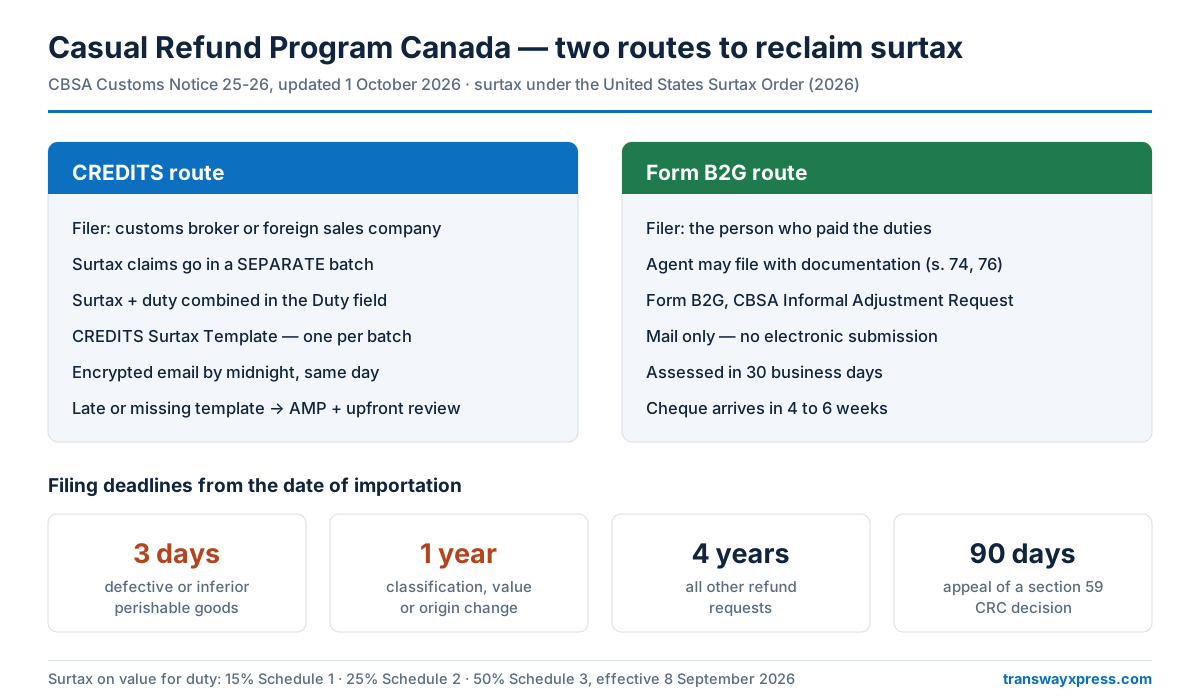
The CBSA’s Customs Notice 25-26 was first issued on 11 July 2025 and was last updated on 1 October 2026. The update does one thing: it tells participants in the Casual Refund Electronic Data Interchange Transaction System — CREDITS — how to file a refund claim on an entry where surtax was paid at importation.
Before the update, surtax had no defined handling inside CREDITS. Brokers filing batches of casual refund claims had no instruction on where a surtax amount belonged, so the surtax portion either went unclaimed or went in as a duty figure that could not be reconciled.
Casual Refund Program Canada: who the notice applies to
CREDITS is the electronic channel used by customs brokers and foreign sales companies that file casual refund claims in volume — the refunds owed on non-commercial importations, which is the category most D2C parcels fall into when the Canadian consumer is the importer of record. If your brand’s parcels clear through a broker’s CLVS stream, your returns almost certainly flow through CREDITS whether you have ever heard the acronym or not.
Everyone else — a brand filing on its own behalf, a consumer, or an authorized agent — uses the paper route covered below.
The four rules the update imposes
Per Customs Notice 25-26, participants may submit refund claims where surtax was paid at importation, provided all other program requirements are met. Four operational rules attach to that:
- Separate batch. Claims with surtax must be provided in a separate batch and not included with other claims.
- Combined Duty field. Combine the surtax and duty amounts and enter the total in the Duty field.
- CREDITS Surtax Template, one per batch. Submit the template by encrypted email to the CBSA Assessment and Licensing Unit using the broker reconciliation password. The subject line must carry “CREDITS Surtax”, the batch number, and the name of the broker and foreign sales company.
- Same-day midnight deadline. The template must arrive by midnight of the same day that the batches were transmitted.
Miss the template and the consequence is not a rejected claim. Non-receipt is treated as non-compliance: the CBSA issues an Administrative Monetary Penalty and places the participant on upfront review, where every subsequent batch is manually examined before it moves.
How much surtax is sitting in your returns pile?
The United States Surtax Order (2026) took effect on 8 September 2026 under Customs Notice 26-23. It applies three tiers to goods originating in the United States, calculated on the value for duty: 15% for Schedule 1 goods, 25% for Schedule 2, and 50% for Schedule 3. Which schedule a product falls into is determined by its classification, and US origin is established under the CUSMA marking rules.
Two details make the exposure larger than the headline rate. First, the surtax is applied to value for duty before taxes. Second, GST/HST is then applied on top of the surtax amount — so the tax base itself grows. If you are not sure how your declared value is being built, our guide to customs valuation rules in Canada walks through what the CBSA adds to value for duty.
Surtax recoverable per CAD 1,000 of value for duty
The table below applies the published rates to a flat CAD 1,000 value for duty. It is an illustration of the arithmetic, not a quote — your actual figure depends on your classification and declared value.
| Schedule | Surtax rate | Surtax on CAD 1,000 VFD | Across a 100-unit return batch |
|---|---|---|---|
| Schedule 1 | 15% | CAD 150 | CAD 15,000 |
| Schedule 2 | 25% | CAD 250 | CAD 25,000 |
| Schedule 3 | 50% | CAD 500 | CAD 50,000 |
| Plus GST/HST | applied on the surtax amount | Additional, rate varies by province | Additional |
For a brand running a 15% return rate on Schedule 3 goods, the unclaimed surtax alone can exceed the gross margin on the units that sold.
Which refund route applies to your returns?
There are two. They have different filers, different mechanics, and very different speeds.
| Dimension | CREDITS route | Form B2G route |
|---|---|---|
| Who files | Customs broker or foreign sales company enrolled in CREDITS | The person who paid the duties, or an authorized agent with documentation |
| Channel | Electronic batch transmission plus encrypted email template | Mail only — claims cannot be accepted electronically |
| Volume suited to | High-volume, repeating parcel returns | One-off or low-volume claims |
| Surtax handling | Separate batch; surtax plus duty combined in the Duty field | Declared with the claim and supporting evidence |
| Where it goes | CBSA Assessment and Licensing Unit | The Casual Refund Centre matching the importer’s postal code |
| Penalty exposure | AMP plus upfront review if the template is late or missing | Claim rejected or returned for missing documents |
| Processing time | Batch-dependent | 30 business days from receipt of all required information |
Route 1 — CREDITS, if you clear through a participating broker
If your parcels move through a broker’s casual stream, the fix is a conversation, not a form. Ask three questions: are you enrolled in CREDITS, are surtax claims batched separately as of 1 October, and who sends the CREDITS Surtax Template. A vague answer to the third puts your claims — and the broker’s compliance standing — at risk.
Route 2 — Form B2G, if you or your customer paid directly
The paper route runs on Form B2G, the CBSA Informal Adjustment Request. Under sections 74 and 76 of the Customs Act, only the person who paid the duties is entitled to a refund, though an authorized agent may submit on that person’s behalf with proper documentation. That single sentence is where most brand-led claims fail: if the Canadian consumer was the importer of record and paid the duty and surtax, the brand cannot simply claim it back in its own name.
What goes with the claim: a signed B2G (secure digital signatures are accepted), a copy of the customs accounting document, and the supporting evidence. The accounting document differs by stream — Form BSF715 for travellers, Form E14 for postal, and the courier receipt carrying the B3 transaction number for courier shipments. Then the evidence itself: damage reports, credit notes, carrier statements, invoices, or certificates of origin, depending on what you are claiming.
Refundable amounts include duties, GST/HST and provincial taxes, plus SIMA levies where they apply. Claims go to the Casual Refund Centre that corresponds to the importer’s address, and everything travels by mail — the CBSA does not accept these claims electronically at this time.
What deadlines apply to a casual refund claim?
The windows are not uniform, and the shortest one is extremely short.
| Claim type | Deadline from date of importation | Practical note |
|---|---|---|
| Defective or inferior perishable goods | 3 days | Effectively same-week; build it into receiving, not into month-end |
| Tariff classification, value or origin redetermination | 1 year | Covers most surtax disputes — schedule placement is a classification question |
| All other refund requests | 4 years | Generous, but the evidence decays faster than the deadline |
| Appeal of a Casual Refund Centre decision | 90 days from the section 59 decision | Counted from the decision, not from importation |
Why the one-year window matters more than the four-year one
Most surtax recoveries turn on whether a good was correctly placed in Schedule 1, 2 or 3 — which is a classification question, and classification redeterminations carry the one-year limit, not the four-year one. The earliest entries subject to the United States Surtax Order (2026) were accounted for on 8 September 2026. Their one-year window closes on 8 September 2027, which is 337 days from today. That sounds comfortable until you account for the original accounting document, the carrier receipt and the return evidence you need per unit, plus the 30 business days of processing before a cheque is cut and the 4 to 6 weeks it then takes to arrive by mail.
Returns compliance checklist for cross-border brands
Before the parcel ships
- Confirm which surtax schedule each SKU falls into, and record it against the SKU — not against the shipment.
- Decide who is importer of record. If the Canadian consumer is, your ability to recover duty and surtax depends on agent authorization you do not have yet.
- Make sure declared value matches what you would defend in a redetermination. See our breakdown of how to calculate landed cost if your value build is inherited from a template.
- Check your surtax declaration is being filed correctly in the first place — our guide to Canada surtax declaration codes covers the codes and rates under Customs Notice 26-23.
After the customer returns it
- Retain the original customs accounting document for every inbound parcel — BSF715, E14 or the courier receipt with the B3 transaction number. Without it there is no claim.
- Capture the return evidence at receiving: credit note, damage report or carrier statement, dated.
- Separate surtax-bearing claims from everything else before they reach your broker, so the separate-batch rule is not discovered at transmission time.
- Diarize the one-year classification window per entry date, not per quarter.
- Check whether remission applies before you file a refund — relief at entry beats a refund after it. Our notes on Canada surtax remission and counter-tariff relief set out the special authority codes.
Worth knowing: not every US-origin good carries the surtax. Customs Notice 26-23 exempts goods in transit before 8 September 2026, non-residents’ personal baggage, ships’ stores that are not diverted, goods returning with Canadians that were previously duty-paid, and Import for Re-Export Program goods. Check the exemptions before you file — a refund claim on an entry that should never have been surtaxed is a declaration correction, not a casual refund.
How Transway Xpress Global solves this
Returns documented at receiving, not reconstructed at year-end
Most brands lose surtax recoveries at receiving, not at filing. The accounting document is thrown away with the outer box, the credit note is issued in the storefront but never dated against the entry, and by the time finance asks about recoverable duty the evidence trail is gone. The fix is operational, and it sits with whoever physically opens the returned parcel.
Transway Xpress Global runs D2C and B2B fulfillment from warehouses in Oakville and Etobicoke, Ontario, and Buffalo, New York, with returns processing handled at the point of receipt. That means the customs accounting document, the return reason and the condition evidence are captured on the same scan, against the same entry, in a form your broker can batch. Our cross-border shipping and customs workflows are built around the CBSA streams these claims depend on — including the CLVS channel most parcel volume moves through, which we cover in our note on the courier low value shipment air carrier rule.
We also handle Amazon FBA prep, warehousing, order and inventory management, and custom packaging, so returns feed back into sellable inventory rather than sitting in quarantine while the refund window closes. Our cross-border returns guide is the place to start.
Summary
The three things to action this week
The 1 October 2026 update to Customs Notice 25-26 closed a gap: surtax paid at importation is now claimable through the Casual Refund Program Canada runs via CREDITS — separate batch, combined Duty field, template by midnight or an AMP follows. Outside CREDITS, Form B2G remains the route.
- Ask your broker, in writing, whether surtax claims are being batched separately and who sends the CREDITS Surtax Template.
- Audit your returns receiving process for retention of the customs accounting document.
- Diarize 8 September 2027 — 337 days out — as the first hard close on classification-based surtax recoveries.
Frequently asked questions
What is the Casual Refund Program in Canada?
It is the CBSA channel for refunding duties and taxes paid on non-commercial importations — the category most D2C parcels fall into when the Canadian consumer is the importer of record. Claims are filed either electronically by brokers and foreign sales companies enrolled in CREDITS, the Casual Refund Electronic Data Interchange Transaction System, or on paper using Form B2G, the CBSA Informal Adjustment Request. Refundable amounts include duties, GST/HST, provincial taxes and SIMA levies where they apply.
Can you reclaim the US surtax on a returned parcel?
Yes. As of the 1 October 2026 update to Customs Notice 25-26, CREDITS participants may submit refund claims where surtax was paid at importation, provided all other program requirements are met. Those claims must be transmitted in a separate batch from non-surtax claims, with the surtax and duty amounts combined into the Duty field, and accompanied by a CREDITS Surtax Template sent by encrypted email before midnight of the transmission day.
How long do you have to file a casual refund claim?
Four years from the date of original importation for most refund requests, one year for a tariff classification, value or origin redetermination, and three days for defective or inferior perishable goods. An appeal of a Casual Refund Centre decision must be filed within 90 days of the section 59 decision. Because surtax schedule placement is a classification question, the one-year limit is the one that usually governs a surtax recovery.
Who is allowed to claim the refund — the brand or the customer?
Under sections 74 and 76 of the Customs Act, only the person who paid the duties is entitled to a refund. If your Canadian customer was the importer of record and paid the duty, GST and surtax, the refund is theirs — not your brand’s. An authorized agent may submit the claim on that person’s behalf, but only with proper documentation in place. Brands that want to recover these amounts need the authorization built into the returns flow before the parcel ships.
How much is the Canadian surtax on US goods, and what is it calculated on?
The United States Surtax Order (2026), effective 8 September 2026, applies 15% to Schedule 1 goods, 25% to Schedule 2 and 50% to Schedule 3, calculated on the value for duty before taxes. GST/HST is then applied on top of the surtax amount, so the tax base grows with the surtax. US origin is determined under the CUSMA marking rules. Note that CUSMA covers North-American-origin goods only — goods made elsewhere and shipped through the United States do not qualify.
Primary sources: CBSA Customs Notice 25-26, CBSA Customs Notice 26-23, and CBSA guidance on submitting a refund claim.
Not sure how much duty and surtax is trapped in your returns? Transway Xpress Global receives, inspects and documents cross-border returns at our Ontario and Buffalo warehouses so the evidence exists when the claim is filed. Book a consultation and we will walk through your returns stream and where the recoverable amounts are being lost.