The CUSMA joint review 2027 comment docket opened on 2 October 2026, and it is the most consequential trade consultation currently open to any brand moving goods between Canada and the United States. The Office of the United States Trade Representative is asking importers, exporters and fulfillment operators what is working under the agreement and what is not — and the window closes at 11:59 p.m. EST on 12 January 2027, exactly 100 days from today. The CUSMA joint review 2027 docket is not a tariff change. It is the formal record that will shape whether the agreement continues past 2036, and whether preferential duty treatment stays available to the North-American-origin goods your landed-cost model depends on. If your supply chain touches Ontario, Buffalo or a cross-border Amazon channel, you have a seat at this table.
What Is the CUSMA Joint Review 2027?
The Canada–United States–Mexico Agreement — CUSMA in Canada, USMCA in the United States — carries a built-in expiry mechanism that most sellers have never had to think about. Article 34.7.1 states that the agreement terminates 16 years after entry into force, which USTR confirms is 1 July 2036, “unless each Party confirms that it wishes to continue the Agreement for a new 16-year term.” The joint review is the meeting where that confirmation is supposed to happen, and the CUSMA joint review 2027 cycle is the next one on the calendar.
The 2036 Clock That Drives It
Entry into force was 1 July 2020. The 16-year term therefore runs to 1 July 2036. Confirmation is not automatic and not passive: all three Parties must actively say yes. Silence from any one of them leaves the termination date standing. For a fulfillment operator, that single clause is the difference between a duty-free North American trading bloc and three separate tariff schedules, which is why the joint review deserves your attention in 2027.
Why the Review Is Now Annual
The first joint review took place on 1 July 2026. According to the USTR notice, the United States did not confirm an extension at that meeting. The consequence is written into the agreement: “the Commission will meet to conduct a joint review annually until each of the three Parties confirms its wish to extend the term.” That is why there is a joint review in 2027 at all, and why there will likely be another joint review in 2028. The agreement is no longer on a 16-year autopilot — it is on a yearly renewal cycle, and each cycle comes with a public comment docket.
What USTR Opened on 2 October 2026
USTR announced the consultation in a press release dated 2 October 2026 and filed the corresponding Federal Register notice the same day, scheduled for publication on 5 October 2026. The legal driver behind the 2027 joint review is Section 611 of the USMCA Implementation Act (19 U.S.C. 4611), which requires USTR to give the public “an opportunity for the presentation of views relating to the operation of the USMCA” before the Commission meets.
Two Dockets, One Deadline
The joint review consultation has two separate submission channels, and confusing them is the easiest way to lose your place in the 2027 proceeding:
- Docket USTR-2026-0595 — written comments on the operation of the agreement.
- Docket USTR-2026-0596 — requests to appear at the public hearing, which must include a summary of your intended testimony.
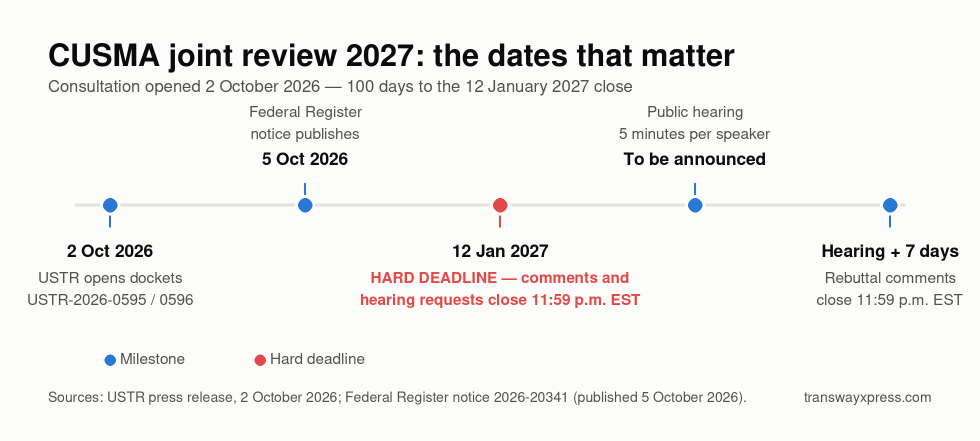
Both close at the same moment: 11:59 p.m. EST on 12 January 2027. Submissions go through the portal at comments.ustr.gov. The hearing date and location have not been set; USTR states that details “will be published to USTR’s website.” Oral remarks at the hearing are limited to five minutes, and post-hearing rebuttal comments are due seven calendar days after the last day of the hearing, at 11:59 p.m. EST.
The Dates That Matter
| Date | What happens | What you do |
|---|---|---|
| 1 July 2020 | Agreement enters into force; 16-year term begins | Context only |
| 1 July 2026 | First joint review held; US did not confirm extension | Context only |
| 2 October 2026 | USTR opens dockets USTR-2026-0595 and USTR-2026-0596 | Start drafting; assign an owner |
| 5 October 2026 | Federal Register notice publishes | Read the notice in full |
| 12 January 2027, 11:59 p.m. EST | Written comments and hearing requests close | File both; keep the receipt |
| To be announced | Public hearing; five minutes per speaker | Watch ustr.gov for the date |
| Hearing + 7 calendar days, 11:59 p.m. EST | Post-hearing rebuttal comments close | Respond to opposing testimony |
| 1 July 2036 | Agreement terminates unless each Party confirms a new term | The reason any of this matters |
Why This Matters for Cross-Border E-commerce
A joint review docket feels remote next to a rate change that hits your next entry. It is not. The joint review record is what trade negotiators cite when they decide which irritants to fix and which sectors to defend, and e-commerce fulfillment is chronically under-represented in these files compared with autos, dairy and steel. Every annual review builds on the one before it, so a thin 2027 record is a thin starting point for 2028.
Preferential Duty Treatment Is the Thing at Stake
CUSMA preference is what lets qualifying North-American-origin goods cross between Canada and the United States without most-favoured-nation duty. If you sell into both markets from a single pool of inventory, that preference is embedded in every landed-cost calculation you run. Our landed cost guide walks through where preference sits in the stack, and the country of origin marking rules cover the documentation that proves it.
What CUSMA Does Not Cover
Two misconceptions cost sellers real money, and both are worth stating plainly in any joint review submission you file in 2027.
First, CUSMA preference applies only to goods that qualify as North-American-origin under the agreement’s rules of origin. Goods manufactured in India and shipped to Canada or the United States do not become CUSMA-originating because they clear through a Canadian warehouse. They are dutiable on their own origin, and our India to Canada customs clearance guide sets out what actually applies. The India–Canada CEPA negotiations are a separate track entirely.
Second, CUSMA origin is not a shield against every US measure. Section 338 duties on certain Canadian goods apply even to goods that originate under the agreement — preference does not exempt them. The joint review cannot undo a Section 338 action, so keep the two separate in 2027. If that scope touches your catalogue, read our coverage of the Section 338 import ban and the broader US–Canada tariff picture alongside this review.
Who Should Actually File
You have something useful to say to this docket if any of the following is true: you hold inventory on both sides of the border; you claim CUSMA preference on commercial entries; you have been caught by a rule-of-origin determination you thought was settled; you ship direct-to-consumer parcels across the border at volume; or you have absorbed surtax or counter-tariff cost that a remission order did not reach. The counter-tariff relief position is a concrete example of the kind of operational detail that negotiators do not see unless an operator writes it down.
Submission Checklist for the CUSMA Joint Review 2027
Treat your joint review submission like a compliance filing, not a letter to the editor. A specific, evidenced two-page submission outperforms a ten-page position paper.
- Assign an owner this week. One named person, with the 12 January 2027 deadline in their calendar and a reminder at 15 December 2026.
- Decide whether you want to testify. If yes, you must file under docket USTR-2026-0596 with a testimony summary by the same 12 January 2027 cut-off. There is no later window.
- Pull your own numbers. Entry counts, preference claim rates, rejected claims, duty paid by HS chapter. Unsourced assertions carry no weight; your own entry data does.
- Name the specific provision. Cite the chapter, annex or rule of origin you are addressing rather than describing a general frustration.
- Separate the agreement from the unilateral measures. Section 232, Section 301 and Section 338 actions are not CUSMA provisions. Mixing them weakens the submission.
- State the remedy you want. Negotiators act on drafted asks, not on diagnoses.
- Check the confidentiality rules in the notice before you attach entry-level data. Read the Federal Register notice’s business-confidential instructions rather than assuming.
- Keep the submission receipt. You will need it if you later file rebuttal comments.
- Diarize the rebuttal window. It opens only once the hearing concludes and closes seven calendar days later.
How Transway Xpress Global Solves This
Transway Xpress Global runs warehouses in Oakville and Etobicoke, Ontario, and in Buffalo, New York, with an office in Pendleton, Indiana. We grew out of Transway Transport, an Oakville trucking company operating since 2014, so the cross-border leg is not something we subcontract and hope about. That footprint is the reason the joint review is operationally relevant to our clients in 2027 rather than abstract.
The practical value during a year of annual reviews is optionality. Holding inventory in both Ontario and New York means a brand can serve Canadian and American demand from the nearer pool instead of sending every order across the border and absorbing whatever the duty position turns out to be that quarter. Our services cover D2C and B2B fulfillment, Amazon FBA prep, warehousing, order and inventory management, cross-border shipping, returns and custom packaging — see eCommerce fulfillment in Canada and the cross-border fulfillment guide for how the two sides fit together.
We also keep the paperwork side current, because preference claims live or die on documentation. Origin declarations, commercial invoice fields and marking requirements all have to line up before a claim survives review. What we do not do is predict the outcome of the joint review or any trade negotiation. We make sure a client’s inventory placement and documentation hold up whichever way the 2027 review goes.
What to Do Between Now and 12 January 2027
The joint review consultation is open and the 2027 deadline is 100 days out as of 4 October 2026. The work splits into three windows.
Your Dated CUSMA Joint Review 2027 Action List
- By 17 October 2026: read the Federal Register notice in full, confirm which of the two dockets apply to you, and name an internal owner.
- By 14 November 2026: pull 12 months of entry data, preference claim rates and rejected claims; identify the two or three provisions that cost you most.
- By 12 December 2026: circulate a draft submission internally and have your customs broker or trade counsel review the provision citations.
- By 5 January 2027: file. Do not aim for the deadline itself — portal problems on the last day are your problem, not USTR’s.
- 12 January 2027, 11:59 p.m. EST: hard close for written comments and hearing requests under both dockets.
- Ongoing: watch ustr.gov for the hearing date, then diarize the rebuttal deadline at seven calendar days after the hearing’s last day.
Frequently Asked Questions
What is the CUSMA joint review 2027?
It is the annual review of the operation of the Canada–United States–Mexico Agreement that USTR is now consulting on, after the first joint review on 1 July 2026 ended without the United States confirming a 16-year extension. Under the agreement, the Commission meets annually until all three Parties confirm they wish to extend the term. USTR opened the public comment dockets on 2 October 2026, with submissions due 11:59 p.m. EST on 12 January 2027.
When is the deadline to comment on the joint review?
11:59 p.m. EST on 12 January 2027, for both written comments under docket USTR-2026-0595 and requests to appear at the public hearing under docket USTR-2026-0596. A hearing request must include a summary of your testimony. Post-hearing rebuttal comments are due seven calendar days after the final day of the hearing, also at 11:59 p.m. EST. The hearing date itself had not been announced when USTR issued the notice.
Does CUSMA expire in 2036?
Article 34.7.1 provides that the agreement terminates 16 years after entry into force — 1 July 2036 — unless each Party confirms it wishes to continue for a new 16-year term. Termination is the default and continuation requires active confirmation from all three. Because the United States did not confirm an extension at the first joint review, the confirmation question returns to the table annually rather than being settled once.
Do goods made in India qualify for CUSMA preference?
No. CUSMA preference applies only to goods meeting the agreement’s rules of origin for North America. Goods manufactured in India do not become CUSMA-originating by passing through a Canadian or American fulfillment centre — they are assessed on their actual origin, under the applicable tariff treatment and any trade remedy measures in force. Routing inventory through a Canadian warehouse changes your delivery speed and freight cost, not the origin of the goods.
Should a small Amazon seller bother filing a comment?
Yes, if the agreement touches your cost base. Submissions from small operators are scarce in joint review dockets, which means a short, specific filing backed by your own entry data carries disproportionate weight. The cost is a few hours of work against a provision that governs duty treatment for years. If you have no distinct position, following the record and the hearing schedule is still worth the calendar entry.
Get Your Cross-Border Position Reviewed
If you are unsure whether your inventory placement, origin documentation or duty exposure would hold up through the 2027 joint review and the annual reviews after it, that is a conversation worth having before January. Book a consultation and we will walk through your current cross-border flow, where preference is being claimed, and what moving stock closer to demand would change.
Primary sources: USTR press release, 2 October 2026 and the Federal Register notice (2026-20341).