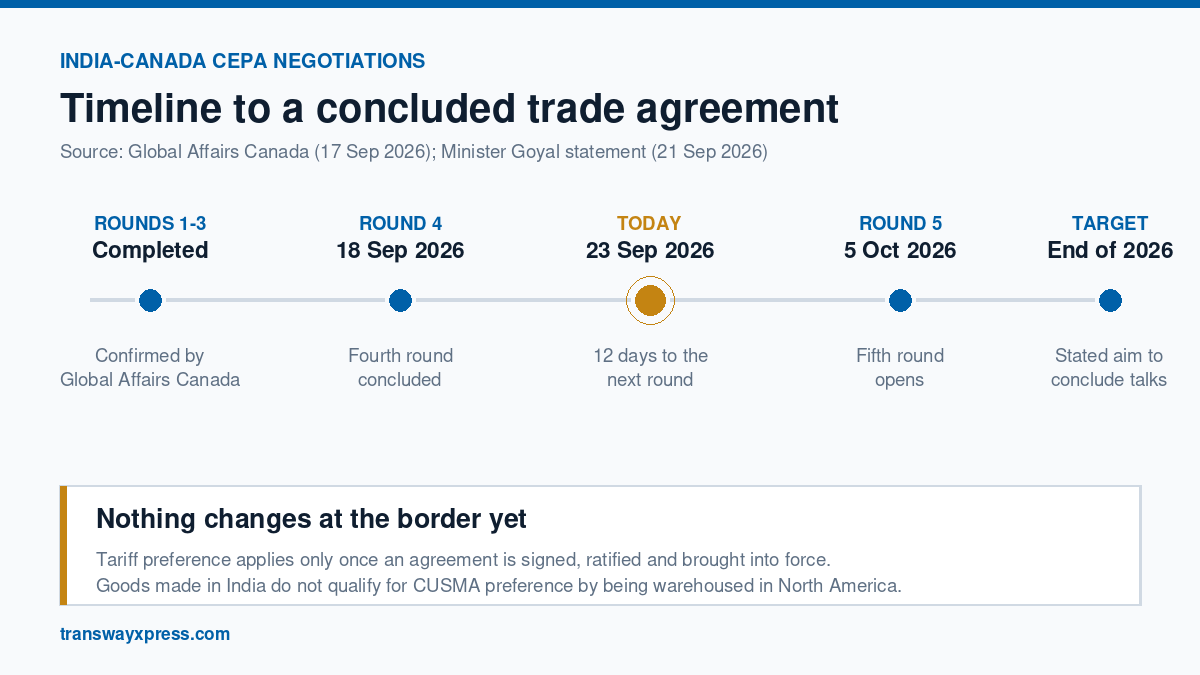
The India Canada trade agreement under negotiation as a Comprehensive Economic Partnership Agreement (CEPA) moved again this month, and the calendar now has a firm date on it. Global Affairs Canada confirmed on 17 September 2026 that three rounds of talks with India were complete and a fourth was under way, with both capitals aiming to conclude by the end of 2026. Commerce and Industry Minister Piyush Goyal said on 21 September that the fourth round had closed on 18 September and the fifth begins 5 October 2026. If you sell into Canada from a supplier in India, that is twelve days away — and nothing about your duty position changes until a text is signed, ratified and brought into force.
What the India Canada trade agreement talks changed this month
Two things happened in four days, and only one was a formal government announcement.
The fourth round closed, the fifth opens 5 October
Global Affairs Canada published a news release on 17 September 2026 confirming that Minister of International Trade Maninder Sidhu was travelling to advance negotiations with several partners, and that three rounds of CEPA talks with India had concluded with a fourth in progress. The release restated the shared objective of closing the file by the end of this year.
Four days later, Minister Goyal said the fourth round had wrapped on 18 September and the fifth would open on 5 October. He described the coming ninety days as “a very defining period” for the relationship between the two countries. Read plainly: negotiators are compressing a schedule that normally runs for years, and the political will to land an India Canada trade agreement before 31 December is now stated on both sides.
Why the next 90 days carry weight
Ottawa’s own figures set the stakes. Global Affairs Canada puts two-way goods and services commerce with India at $30.4 billion in 2025, of which $13.6 billion was merchandise, and states a goal of doubling the two-way total to $70 billion annually by 2030. Goyal has named pharmaceuticals, iron and steel, seafood, cotton garments, electronic goods and chemicals among the leading categories moving one way, and pulses, gemstones, coal, fertilizers, paper and crude petroleum the other.
For a direct-to-consumer brand, the mechanics matter more than the headline numbers. A concluded pact changes tariff lines, origin rules and — often the most valuable part — predictability. None of that is available on 5 October. Lead time is: get classification, origin evidence and importer structure in order now, and you can act on day one instead of spending six weeks catching up.
What a concluded CEPA would change for your landed cost
It is worth separating a negotiation milestone from a rate change at the border, because most commentary blurs the two.
Preference is prospective, not retroactive
Tariff preferences take effect on the date an implementing instrument says they do. Nothing refunds duty you paid on a shipment cleared before entry into force. Inventory you land in October, November or December will be assessed under the rules in place on the date of accounting. Building a Q4 plan around a rate that does not yet exist is how brands end up with a cash-flow hole in January.
Rules of origin decide who actually benefits
Preferential access is never granted to a country in the abstract. It is granted to goods that satisfy a specified origin test and are backed by the proof the customs administration demands. A finished good assembled from inputs sourced in three other places may or may not qualify, depending on the tariff shift or regional value content rule negotiated for that HS heading. Start the evidence trail now — bills of materials, supplier declarations, production records — and you will be ready to claim on the first eligible entry rather than the fortieth.
| Dimension | Could change if CEPA concludes | Stays the same either way |
|---|---|---|
| Duty rate on qualifying goods | Potentially reduced or eliminated on negotiated lines, often phased | Duty is assessed on value for duty, on the date of accounting |
| Proof of origin | A new certification format and record-keeping obligation | You need a defensible bill of materials and supplier evidence |
| GST/HST | Not affected — consumption tax sits outside tariff policy | Payable on import regardless of preference |
| Importer of record | Unchanged | A non-resident importer needs a business number and CARM registration |
| Classification (HS code) | Unchanged — preference attaches to a code you must get right | Misclassification remains the top source of reassessment |
How goods made in India are treated at the Canadian border today
Until an implementing instrument exists, shipments clear under the framework already in the Customs Tariff. Three points cover most of what a seller needs.
Most-favoured-nation treatment is the default
Absent an applicable preference, imports are assessed at the most-favoured-nation rate for their classification. Rates vary enormously by heading — many industrial and electronic goods carry no duty at all, while apparel, footwear and certain foods sit materially higher. That spread is why classification work pays for itself: the gap between two plausible headings on one product can be several points of margin. Our landed cost guide shows how duty, tax, freight and fulfilment stack into a single per-unit number.
Unilateral preference programs are separate from any negotiated pact
Ottawa also operates unilateral schemes: the General Preferential Tariff, the General Preferential Tariff Plus, the Least Developed Country Tariff and the Commonwealth Caribbean Countries Tariff. The Canada Border Services Agency set out the current architecture, the beneficiary lists and the revised direct-shipment and apparel origin rules in Customs Notice 24-41, in force 1 January 2025. Eligibility is code-specific and country-specific, so check your own headings against the notice rather than assuming. These are unilateral grants; they exist independently of the trade agreement India and Canada are negotiating and are not a preview of it.
CUSMA is not a route for goods manufactured in India
This one costs real money. CUSMA confers preference only on goods originating in North America under its rules. A product manufactured in India does not become CUSMA-originating because it was warehoused in Ontario, repacked in Buffalo or shipped from a US address. Moving through a North American facility is not substantial transformation, and a preference claim on that basis is a false declaration with penalty exposure attached. Our guide to country of origin marking rules covers how origin is determined and declared on both sides of the border.
| Route | Open to goods made in India? | What it requires |
|---|---|---|
| Most-favoured-nation rate | Yes — the default | Correct HS classification and value for duty |
| Unilateral preference (GPT and related) | Only if the heading and country are listed | Beneficiary eligibility, origin rule, direct shipment evidence |
| CUSMA preference | No | North American origin — warehousing does not create it |
| A concluded CEPA | Not yet — no instrument is in force | Signature, ratification and implementation first |
| Duty drawback or deferral | Situation-dependent | Program enrolment and documented re-export or manufacturing use |
Does the Canada-US tariff fight touch your shipments?
Most sellers we speak with are watching two stories at once. They intersect in exactly one place worth understanding.
Section 338 duties and the 29 September exclusion
On the American side, Proclamations 11062 and 11065 were signed 8 September 2026 and published in the Federal Register on 14 September. Proclamation 11065 modified the scope of goods carrying a 50 per cent ad valorem duty effective 12:01 a.m. eastern time on 15 September, and specifies that the duty applies in addition to duties imposed under Section 232. Proclamation 11062 converts certain Canadian products to an outright import exclusion effective 12:01 a.m. eastern time on 29 September 2026; goods imported but not entered for consumption before that moment remain subject to the 50 per cent rate rather than the exclusion. The White House fact sheet describes the excluded categories as certain Canadian alcoholic beverages and dairy products, among others. These duties reach covered goods whether or not they qualify as originating under CUSMA, so a preference claim is no shield. We covered the mechanics in our post on the Section 338 import exclusion.
Canada’s surtax reaches US-origin goods, not Indian ones
Canada’s counter-measures took effect at 12:01 a.m. on 8 September 2026, applying surtaxes of 15, 25 and 50 per cent across roughly $27.6 billion of imports. The Department of Finance defines the covered universe as goods originating in the United States — those eligible to be marked as a good of the US. A consignment manufactured in India and imported directly falls outside that scope. Filing the correct declaration codes still matters, which is why we published a walkthrough of the surtax declaration codes on the CAD.
Where routing through a US warehouse gets risky
Here is the intersection. Origin travels with the good, not with the last address it sat at. Storing Indian-made inventory in a US facility does not make it American, so Canadian surtaxes on US-origin goods should not attach — but your paperwork has to say so clearly. Invoices that name a US shipper without stating the country of manufacture invite the wrong assessment, a detention, or a reassessment months later. State the country of manufacture on every line and make sure your broker is working from the same file you are.
Your pre-October checklist
Twelve days is enough to do the preparation that turns a future preference into an actual saving. Work through this before the fifth round opens.
- Lock your classification. Get a binding ruling or documented broker opinion for every meaningful SKU. Preference attaches to a code — if the code is wrong, everything downstream is wrong.
- Build the origin file now. Bill of materials, supplier declarations, production records and costing for each finished good. Any preference claim will rest on this evidence.
- Map your current duty exposure. Calculate per-unit duty by SKU today. Without a baseline you cannot measure what a negotiated outcome is worth.
- Confirm your importer structure. Non-resident importers need a business number and a live CARM account with financial security. Our CARM requirements guide covers registration.
- Audit your commercial invoices. Every line needs a description, HS code, value and country of manufacture. Our field-by-field invoice guide shows what a clean document looks like.
- Check product compliance separately. Bilingual labelling and category-specific rules are unaffected by tariff talks and will stop a shipment just as effectively as a duty dispute.
- Pressure-test Q4 against today’s rates. Assume no change before 31 December. If the plan only works with a preference, it is not a plan.
- Decide where inventory sits. Serving buyers from the right node is a bigger lever than a few points of duty. Our India to Canada customs clearance guide and our single-partner 4PL guide both address placement.
How Transway Xpress Global Solves This
Transway Xpress Global runs fulfilment out of Oakville and Etobicoke in Ontario and Buffalo, New York, with an office in Pendleton, Indiana, and trucking capability through our parent company Transway Transport, operating from Oakville since 2014. That footprint exists for a reason: brands importing from Asia need somewhere to land inventory that can serve buyers on both sides of the border without duplicating the whole operation.
For a brand shipping out of India, the practical work is documentation discipline more than anything exotic. We handle receiving, inspection, Amazon FBA prep, D2C and B2B pick and pack, inventory and order management, returns and custom packaging — and we make sure the country of manufacture is stated correctly on every consignment so origin questions never become a detention. When a pact does land, the brands positioned to claim preference on their first eligible entry will be the ones whose classification and origin files were already in order.
One partner across two markets
Splitting warehousing between an Ontario provider and an American one means two integrations, two inventory pictures and two sets of assumptions about origin. One operator across both nodes keeps the record consistent, which matters when a customs administration asks you to reconstruct how a unit reached a buyer. Compare service models in our overview of ecommerce fulfilment in Canada, or look at our pricing packages.
What to watch between now and year-end
A negotiation can accelerate, stall or produce a narrower outcome than either side described. Plan for the operational work you control and treat the rest as upside.
Three signals worth tracking
First, whether the 5 October round produces a joint statement naming closed chapters — the clearest indicator of real progress toward an India Canada trade agreement. Second, whether either government publishes a text or a summary of outcomes, which is when classification-level analysis becomes possible. Third, the implementation lag: even a signed pact requires domestic ratification and an order bringing tariff changes into force, and that gap is routinely measured in months.
Between now and then, nothing at the border changes for you. The rate you pay in December will be the rate that applies in December.
Frequently Asked Questions
When will the India Canada trade agreement take effect?
No date exists yet, because no text has been concluded. Global Affairs Canada stated on 17 September 2026 that both sides aim to finish negotiating with India by the end of 2026, and Minister Goyal confirmed the fifth round opens 5 October 2026. Concluding talks is not the same as entry into force: a signed pact still requires legal scrubbing, domestic ratification and an implementing order before any preferential rate can be claimed at the border. Plan your Q4 and early-2027 costing on the rates in effect today.
Can I claim CUSMA preference on products manufactured in India?
No. CUSMA preference applies only to goods that originate in North America under its rules of origin. Warehousing, repacking or shipping from a facility in Ontario, New York or Mexico does not confer originating status on a good made elsewhere, because none of those activities amounts to substantial transformation. Claiming preference you are not entitled to is a false declaration that exposes you to reassessment, interest and penalties. Declare the actual country of manufacture and claim only the treatment your goods genuinely qualify for.
Do Canada’s surtaxes on American goods apply to my shipment from India?
Not if the goods are manufactured in India and imported directly into Canada. The Department of Finance defines the covered universe as goods originating in the United States — those eligible to be marked as a good of the US. Products made elsewhere fall outside that scope. The practical risk is documentary rather than legal: if your invoice shows a US shipper and omits the country of manufacture, the entry can be assessed incorrectly. State the manufacturing country on every line and keep the supporting evidence available.
What is the difference between CEPA and the General Preferential Tariff?
A Comprehensive Economic Partnership Agreement is a negotiated, reciprocal instrument: both parties grant concessions and both are bound. The General Preferential Tariff is a unilateral program Ottawa operates for developing-country imports, which it can amend or withdraw on its own initiative. They are separate legal routes with separate origin rules and separate proof requirements, and eligibility under one tells you nothing about eligibility under the other. CBSA Customs Notice 24-41 sets out the current unilateral framework.
What should I do in the twelve days before the next round?
Concentrate on work that pays off regardless of outcome. Confirm HS classification for your highest-volume SKUs, assemble origin evidence for each finished good, calculate your current per-unit duty so you have a baseline, verify your CARM registration and financial security, and audit your commercial invoices for country-of-manufacture accuracy. Brands that finish this groundwork can claim preference on their first eligible entry instead of spending weeks reconstructing records after the fact.
Shipping from India into Canada or the United States, and want your classification, origin evidence and inventory placement reviewed before the next round? Book a consultation with Transway Xpress Global and we will walk through your SKUs, your current duty exposure and where your inventory should sit across our Ontario and Buffalo facilities.