The FedEx 2027 rate increase is now published, and it lands on 4 January 2027 — 97 days from today. Standard list rates for U.S., U.S. export and U.S. import package services rise an average of 5.9%, but the FedEx 2027 rate increase is not a single event and the average is not what most cross-border parcels will actually pay. Three separate dates carry three separate sets of changes, and several of the surcharges that D2C brands trigger most often — residential delivery, extended delivery areas, additional handling, oversize — climb faster than the headline. If you ship parcels from a Canadian or U.S. fulfillment centre to consumers, your cost per order in January is a function of your surcharge mix, not the average.
What the FedEx 2027 rate increase actually changes
FedEx published its 2027 schedule in September 2026. The changes are documented on the carrier’s own rate change page and in its 2027 surcharge and fee schedule, which is where every figure in this article comes from.
The 5.9% headline, and what it covers
FedEx states that “package standard list rates for U.S., U.S. export, and U.S. import services will increase an average of 5.9%.” The same increase applies to FedEx Ground Economy, FedEx Ground Multiweight, FedEx International Premium and FedEx International Priority DirectDistribution, and to the minimum rates for U.S. and international package services.
Two words in that sentence matter to a fulfillment operator. The first is average: an average across every service, zone and weight break is not a rate any single shipment pays. The second is list: if you ship on a negotiated agreement, your discount is applied against a base that has just moved, so a 5.9% list movement does not translate to a 5.9% invoice movement in either direction until you model it against your own lane mix.
Three effective dates, not one
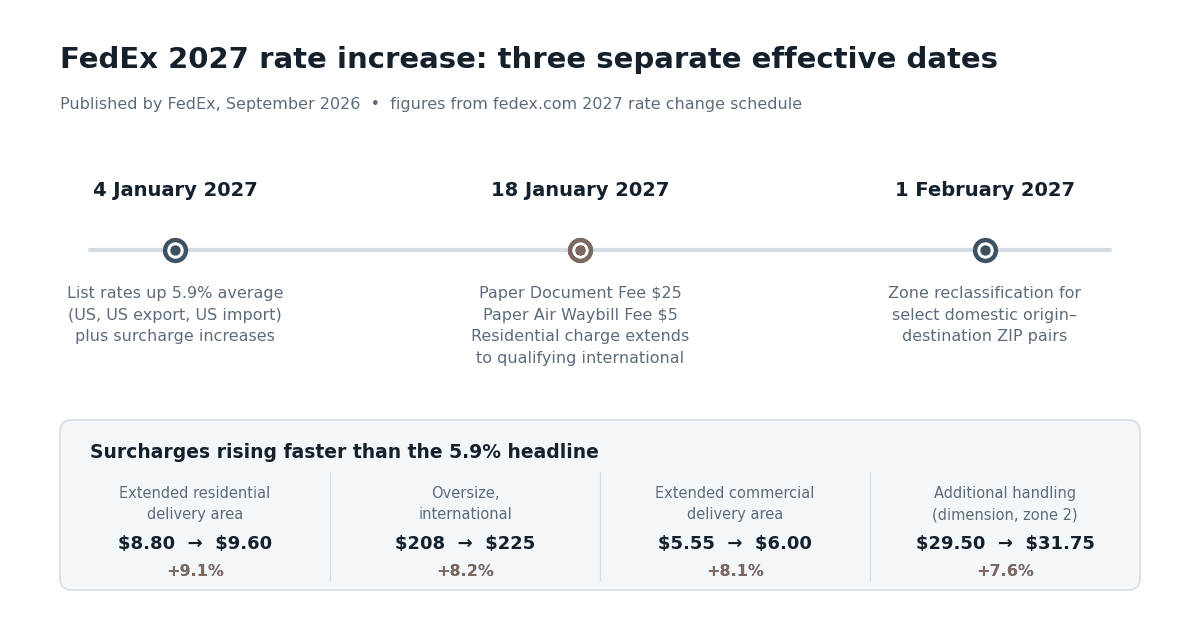
Treating this as one January event is the most common planning error. The schedule splits across three dates, and the middle one is the one that reaches international shipments.
| Effective date | What changes | Days from 29 September 2026 |
|---|---|---|
| 4 January 2027 | List rates up an average of 5.9%; surcharge and fee increases; updated delivery and pickup area postal code lists | 97 |
| 18 January 2027 | Paper Document Fee of $25 per shipment; Paper Air Waybill Fee of $5 per shipment; Residential Delivery Charge applied to qualifying international shipments | 111 |
| 1 February 2027 | Zone reclassification for select domestic origin–destination postal code pairs | 125 |
Which surcharges rise, and by how much
The surcharge schedule is where the 2027 increase stops being an average and becomes a line on your invoice. Every figure below is taken directly from the carrier’s published 2027 surcharge and fee schedule, and every percentage is calculated from those two published amounts.
Residential and delivery area surcharges
Direct-to-consumer volume is residential volume by definition, so these are the accessorials that scale with order count rather than with parcel count in a lane.
| Surcharge (U.S. package services) | 2026 | 2027 | Change |
|---|---|---|---|
| Residential Delivery Charge | $6.95 | $7.35 | +5.8% |
| Delivery Area Surcharge — residential | $6.60 | $7.00 | +6.1% |
| Delivery Area Surcharge — extended residential | $8.80 | $9.60 | +9.1% |
| Delivery Area Surcharge — commercial | $4.45 | $4.70 | +5.6% |
| Delivery Area Surcharge — extended commercial | $5.55 | $6.00 | +8.1% |
| Delivery Area Surcharge — remote | $16.75 | $17.75 | +6.0% |
| Alaska package services | $46.00 | $48.75 | +6.0% |
| Hawaii package services | $16.25 | $17.50 | +7.7% |
The extended tiers are the story. Extended residential rises 9.1% and extended commercial 8.1%, against a 5.9% headline. A brand whose customer base skews rural, or whose catalogue sells disproportionately outside metropolitan postal codes, is absorbing an increase roughly half again as large as the average it was told about.
Handling, oversize and correction fees
The second cluster is triggered by what the parcel is, not where it goes. These apply to bulky, heavy or poorly packaged goods, and they are largely controllable through packaging and data hygiene.
| Charge | 2026 | 2027 | Change |
|---|---|---|---|
| Additional Handling — dimension (U.S., zone 2) | $29.50 | $31.75 | +7.6% |
| Additional Handling — weight (U.S., zone 2) | $46.00 | $49.50 | +7.6% |
| Additional Handling — packaging (U.S., zone 2) | $26.50 | $28.50 | +7.5% |
| Oversize — international package services | $208.00 | $225.00 | +8.2% |
| Oversize — U.S. package services (zone 2) | $255.00 | $270.00 | +5.9% |
| Address Correction (U.S. and international) | $25.50 | $27.00 | +5.9% |
| Unauthorized — international package services | $700.00 | $750.00 | +7.1% |
| Unauthorized — international express freight | $1,400.00 | $1,500.00 | +7.1% |
An address correction at $27 is not catastrophic once. Across a few thousand orders with imperfect checkout validation, it is a budget line. The same logic applies to additional handling: a carton three centimetres over a dimension threshold does not cost you 7.6% more, it costs you $31.75 more, every single time.
Why the FedEx 2027 rate increase hits cross-border brands hardest
A domestic shipper absorbs one change. A brand moving goods between Canada and the United States absorbs the same change plus three structural ones, and the FedEx 2027 rate increase is unusually front-loaded against exactly that profile.
The residential charge crosses the border
From 18 January 2027, FedEx applies the Residential Delivery Charge to qualifying international shipments. Until now, a Canadian brand shipping a parcel to a U.S. consumer could model international delivery without that specific accessorial. From that date it becomes part of the calculation, on top of duties and any applicable surtax. If you have not rebuilt your landed cost model since the tariff changes of 2026, this is a second reason to do it now rather than in January.
Paper documents become a $25 line item
Also from 18 January 2027, a Paper Document Fee of $25 per shipment applies where trade documents are not submitted electronically, and a Paper Air Waybill Fee of $5 per shipment applies to manual paper airbills on U.S. domestic and export shipments. For a brand still printing commercial invoices and taping them to cartons, that is $25 per cross-border shipment for a workflow that electronic trade documents remove entirely. It is the single cheapest item on this list to eliminate, and the one most often left until it appears on an invoice.
Zone reclassification can move a lane without warning
On 1 February 2027, zone classifications change for selected domestic origin–destination postal code pairs, and the delivery and pickup area postal code lists are updated on 4 January. A lane that is zone 4 today can be zone 5 in February with no change to your operation at all. Brands running a single national warehouse are most exposed, because every order travels the full distance; the structural answer is inventory placement, which is why U.S. fulfillment for Canadian brands tends to pay for itself at volumes lower than most founders expect.
What FedEx Canada has and has not announced
This is the question Canadian operators ask first, and the honest answer is that the two schedules are not published on the same clock.
What the 2026 Canadian schedule tells you
FedEx Canada’s rate change page was last updated on 4 September 2026 and still sets out the 2026 changes, which took effect on 5 January 2026. It carries no 2027 announcement. For reference, that Canadian 2026 schedule moved the Additional Handling surcharge for international package services from $24.90 to $25.80 per package on dimension, the Address Correction fee from $16.95 to $17.60 per shipment, and the Oversize charge for international package services from $109.50 to $114.00 per package.
Two practical conclusions follow. First, do not assume the U.S. figures above apply to a parcel tendered in Canada — they are a different schedule in a different currency. Second, the Canadian schedule has historically landed in early January, so plan on a comparable announcement and budget for a mid-single-digit movement rather than waiting for certainty you will not get until close to the date.
Your 97-day action checklist before 4 January 2027
Ninety-seven days is enough to change packaging, renegotiate, and move inventory. It is not enough to do all three in December.
Before the end of October
| Action | Why it matters | Target date |
|---|---|---|
| Pull 12 months of invoices and total accessorials separately from base rates | Tells you whether you are an average-exposed or surcharge-exposed shipper | Mid-October 2026 |
| Count how many orders hit extended residential or remote delivery areas | These tiers rise 6.0–9.1%, well above the headline | Mid-October 2026 |
| Audit cartons against additional handling dimension and weight thresholds | Each breach costs $31.75 or $49.50 per parcel from January | End of October 2026 |
| Switch all cross-border trade documents to electronic submission | Avoids the $25 Paper Document Fee from 18 January 2027 | End of October 2026 |
November and December
- Re-run your rate card with the 2027 surcharge figures applied to last year’s actual order mix, not to a representative parcel.
- Take the result into your carrier conversation before the end of November — agreements are far harder to move in January.
- Tighten address validation at checkout; every prevented correction is $27 saved.
- Review packaging specifications and dimensional weight, since the 2027 schedule raises all three additional handling triggers by roughly 7.5%.
- Model whether splitting inventory across a second location changes enough zones to offset the increase.
- Confirm your peak-season plan separately; the Amazon FBA Q4 deadlines fall before any of this takes effect.
How Transway Xpress Global solves this
Rate increases are absorbed in two places: the agreement, and the network. Most brands spend their energy on the first and leave the second untouched, which is why a 5.9% list movement so often becomes a larger invoice movement.
Fewer zones, fewer surcharges
Transway Xpress Global operates warehouses in Oakville and Etobicoke, Ontario, and in Buffalo, New York, with an office in Pendleton, Indiana, and trucking capability through our parent company Transway Transport, operating from Oakville since 2014. That footprint exists for one reason: placing inventory on the correct side of the border shortens the zone a parcel travels and removes the international accessorials it would otherwise attract. A Canadian brand serving U.S. customers from Buffalo is running domestic U.S. parcels, not international ones — which takes the new international residential charge and the paper document exposure off the table entirely.
We handle D2C and B2B fulfillment, Amazon FBA prep, warehousing, order and inventory management, cross-border shipping, returns and custom packaging. Packaging matters more than it sounds here: redesigning a carton to clear an additional handling threshold is frequently the highest-return change a brand can make before January. Our eCommerce fulfillment in Canada and cross-border fulfillment teams model both sides of that decision together, and you can sanity-check a lane yourself with our shipping rate calculator.
Summary
The 2027 schedule rewards brands that look past the average and price their own surcharge mix.
The short version
List rates move 5.9% on 4 January 2027. Residential and extended delivery area surcharges move faster, up to 9.1%. Additional handling rises about 7.5% across all three triggers. On 18 January the Residential Delivery Charge reaches qualifying international shipments and paper documentation starts costing $25 per shipment. On 1 February selected lanes change zone. FedEx Canada has not yet published a 2027 schedule. You have 97 days, and the three cheapest wins — electronic trade documents, carton dimensions and address validation — are all operational rather than commercial.
Frequently asked questions
How much is the FedEx 2027 rate increase?
FedEx states that package standard list rates for U.S., U.S. export and U.S. import services rise an average of 5.9%, effective 4 January 2027. That average covers every service, zone and weight break, so it is not the figure any individual shipment pays. Several surcharges rise faster: extended residential delivery area moves from $8.80 to $9.60, a 9.1% increase, and the three additional handling triggers each rise about 7.5%. Model the increase against your own order mix rather than the published average.
When does the FedEx 2027 rate increase take effect?
There are three dates. List rates and most surcharge increases take effect on 4 January 2027, along with updated delivery and pickup area postal code lists. On 18 January 2027 the Paper Document Fee of $25 per shipment and the Paper Air Waybill Fee of $5 per shipment begin, and the Residential Delivery Charge is applied to qualifying international shipments. On 1 February 2027 zone classifications change for selected domestic origin–destination postal code pairs.
Does the increase apply to shipments from Canada?
The 5.9% figure applies to U.S., U.S. export and U.S. import package services. FedEx Canada publishes a separate rate change schedule; as of its last update on 4 September 2026 it covered the 2026 changes effective 5 January 2026 and carried no 2027 announcement. Canadian shippers should budget for a comparable early-January announcement rather than applying the U.S. percentages directly, since the schedules differ in both structure and currency.
What is the new $25 paper document fee?
From 18 January 2027, FedEx applies a Paper Document Fee of $25 per shipment where trade documents are submitted on paper rather than electronically, plus a Paper Air Waybill Fee of $5 per shipment for manual paper airbills on U.S. domestic and export shipments. Both are avoidable. Moving commercial invoices and customs paperwork to electronic trade documents removes the charge entirely, and for most brands it is a configuration change in the shipping platform rather than a process redesign.
How can a brand reduce the impact of a carrier rate increase?
Four levers, in order of speed. Switch to electronic trade documentation to remove the paper fees. Audit carton dimensions and weight against additional handling thresholds, since each breach is a flat charge per parcel. Tighten address validation to avoid correction fees at $27 each. Then address structure: placing inventory closer to customers shortens zones and, for cross-border brands, converts international parcels into domestic ones. The first three can be done in weeks; the fourth is the one that compounds.
Want a view of what the 2027 schedule does to your specific lanes before January? Book a consultation and we will model your order mix against the published surcharge changes, and show you what moving inventory across the border does to your zones. If tariffs are also on your mind, start with our guide to US–Canada tariffs in 2026 and our breakdown of DDP versus DAP shipping terms.
Sources: FedEx shipping rate changes and the FedEx 2027 surcharge and fee schedule.