The Amazon FBA Q4 deadlines for the 2026 holiday season are now the tightest constraint on your fourth quarter, and the first one falls in under two weeks. Amazon has published its inbound cutoff calendar for Prime Big Deal Days and Black Friday Week, and inventory that misses those dates is not guaranteed to be received and available for Prime delivery speeds when the traffic arrives. For Canadian sellers and brands shipping across the border, this year carries a second problem stacked on top of the first: two separate tariff actions land inside the same window, one already in force and one arriving on 8 September 2026. Getting units into a fulfillment centre on time now means solving a customs problem and a logistics problem at once.

What Are the Amazon FBA Q4 Deadlines for 2026?
Amazon publishes two sets of inbound deadlines each Q4, one for the October deal event and one for Black Friday Week and Cyber Monday. Each set has three separate dates, and which one applies to you depends on how you send inventory. Sellers who use Amazon Warehousing and Distribution (AWD) get the earliest cutoff because that inventory has to be received upstream and then forwarded. Sellers who send directly to fulfillment centres get a later date, and sellers who accept Amazon-optimized shipment splits get the latest date of all, because splitting a shipment across multiple destinations gives Amazon more receiving flexibility.
Prime Big Deal Days inbound cutoffs
For the October deal event, Amazon lists 2 September 2026 for AWD shipments, 9 September 2026 for FBA shipments using minimal shipment splits, and 16 September 2026 for FBA shipments using Amazon-optimized shipment splits. Counting from 27 August 2026, that leaves 6 days, 13 days and 20 days respectively. These are the nearest Amazon FBA Q4 deadlines on the calendar, and for most brands the 9 September date is the one that actually binds, because minimal splits are what most sellers choose when they want inventory concentrated rather than scattered.
Black Friday Week and Cyber Monday cutoffs
The second set of Amazon FBA Q4 deadlines covers the biggest revenue week of the year. Amazon lists 14 October 2026 for AWD shipments, 21 October 2026 for FBA with minimal shipment splits, and 28 October 2026 for FBA with Amazon-optimized shipment splits. From 27 August that is 48, 55 and 62 days out. Those look comfortable in August and they are not, because the customs, prep and freight work that has to happen before a unit reaches a fulfillment centre consumes most of that runway.
| Event | AWD shipments | FBA, minimal splits | FBA, Amazon-optimized splits | Days from 27 Aug 2026 |
|---|---|---|---|---|
| Prime Big Deal Days | 2 September 2026 | 9 September 2026 | 16 September 2026 | 6 / 13 / 20 |
| Black Friday Week and Cyber Monday | 14 October 2026 | 21 October 2026 | 28 October 2026 | 48 / 55 / 62 |
| Holiday peak fulfillment fees begin | — | — | 15 October 2026 | 49 |
| Holiday peak fulfillment fees end | — | — | 14 January 2027 | 140 |
Amazon is explicit that inventory arriving after these cutoff dates is not guaranteed to be processed in time, and that fulfillment centre priority shifts from receiving to order processing as the quarter progresses. Treat the Amazon FBA Q4 deadlines as arrival dates at the receiving dock, not as ship dates from your supplier. You can read Amazon’s own announcement on Seller Central.
Why the Peak Fee Window Changes Your Q4 Maths
Missing an inbound date is the obvious risk. The quieter one is that everything you fulfil between the middle of October and the middle of January costs more per unit, and that cost is not optional.
What holiday peak fulfillment fees cost
Amazon has confirmed that holiday peak fulfillment fees apply again from 15 October 2026 through 14 January 2027, and that the per-unit increase over non-peak rates is the same as last year, averaging USD 0.32 per unit. Amazon also states there are no new eligibility requirements for the holiday promotional events. A brand shipping 20,000 units through the peak window is therefore looking at roughly USD 6,400 in additional fulfillment cost before any other variable moves, which is enough to matter on thin-margin SKUs and enough to justify pulling slow movers out of FBA before the window opens.
The fuel and logistics surcharge sits on top
Amazon states that its 3.5 per cent fuel and logistics-related surcharge applies on top of holiday peak fulfillment fees. It is a percentage, not a flat amount, so it scales with your fee base rather than with your unit count. That combination is why the Amazon FBA Q4 deadlines and the fee window should be planned together: units that land after 15 October pay peak rates for as long as they sit in the network, so late inventory is both riskier and more expensive.
| Cost component | Window | What Amazon states |
|---|---|---|
| Holiday peak fulfillment fees | 15 Oct 2026 – 14 Jan 2027 | Same per-unit increase as last year, averaging USD 0.32 per unit |
| Fuel and logistics surcharge | Applies on top of peak fees | 3.5 per cent |
| Eligibility for holiday events | Q4 2026 | No new eligibility requirements |
Amazon publishes marketplace-specific fee schedules separately, and amazon.ca rates are stated in Canadian dollars behind a Seller Central login. Confirm your own marketplace figures in your account rather than converting the US numbers, and rebuild your landed cost model with peak rates before you commit purchase orders.
What Makes Q4 2026 Different at the Border
In a normal year the Amazon FBA Q4 deadlines are a domestic freight problem. This year two tariff actions sit directly inside the inbound window, and both change what a cross-border unit costs to land.
Section 338 duties have applied since 22 August 2026
US Customs and Border Protection issued CSMS message 69606660 on 21 August 2026, setting additional Section 338 duties on certain goods of Canada effective 12:01 a.m. eastern standard time on 22 August 2026. The guidance places most covered goods under headings 9903.03.12 through 9903.03.14 at a 50 per cent additional ad valorem rate, while headings 9903.03.15 and 9903.03.16 carry a 0 per cent additional rate for categories including aluminum, steel, vehicles, semiconductor articles, aircraft components and patented pharmaceuticals. CBP also states that covered products remain subject to antidumping, countervailing and other duties alongside these rates. The full text is available in CBP’s CSMS guidance.
The point that catches sellers out is origin. Section 338 duties are not switched off by a CUSMA claim. CUSMA governs preferential tariff treatment for goods that originate in North America, and it does not act as a shield against a Section 338 action. If you sell goods of Indian origin, or any other non-North-American origin, a CUSMA claim was never available to you in the first place, and the practical answer is correct classification and correct valuation rather than a preference claim. Our breakdown of the wider escalation is in the US Canada tariffs 2026 guide.
Canada’s counter-tariffs land 8 September, inside the FBA window
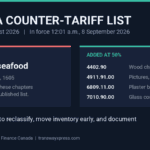
The Department of Finance published the list of US products subject to counter-tariffs on 25 August 2026, effective 12:01 a.m. on 8 September 2026. The measures apply 15, 25 and 50 per cent rates, with individual product rates set to match the corresponding US rate, across roughly $27.6 billion of US imports covering steel, dairy, appliances, agricultural equipment, pulp and paper, and electronics. Finance also states that the countermeasures do not apply to US goods in transit to Canada on the day they come into force. That in-transit carve-out is the only lever available at this stage, and it closes on 8 September. The full product list is on canada.ca.
Line those dates up against the calendar. Canada’s counter-tariffs take effect on 8 September, one day before the 9 September FBA cutoff for minimal splits. Any Canadian-bound restock that has not physically departed by 8 September faces the new surtax, and any US-bound restock has been paying Section 338 rates since 22 August. Both of the nearest Amazon FBA Q4 deadlines sit on the wrong side of a duty change.
How to Work Backwards From the Amazon FBA Q4 Deadlines
The mistake most brands make is treating the Amazon cutoff as a ship date. It is a receive date, and everything upstream has to be scheduled backwards from it.
Build the backward calendar
Start at the Amazon FBA Q4 deadlines that apply to your shipping method, then subtract each upstream stage. Carrier transit to the fulfillment centre, appointment scheduling, prep and labelling, customs clearance, and inbound freight from your supplier each consume time, and none of them compress well in October. The table below is a planning frame, not a quote; your actual durations depend on lane, mode and broker.
| Stage | Work backwards from the cutoff | Who owns it |
|---|---|---|
| Carrier transit to fulfillment centre | Subtract your carrier’s committed transit time | Carrier or 3PL |
| Appointment and dock scheduling | Subtract scheduling lead time, which lengthens near the cutoff | 3PL or prep partner |
| Prep, labelling and polybagging | Subtract prep throughput for your unit count | Prep centre |
| Customs clearance and duty payment | Subtract clearance time plus any exam risk | Broker and importer of record |
| Inbound freight from supplier | Subtract origin-to-warehouse transit | Freight forwarder |
Where prep time actually goes
Since Amazon Canada stopped offering its own FBA prep service, Canadian sellers have had to move prep to a third party, and that shift adds a handoff that did not exist a year ago. We covered the change and the options in our post on where sellers should send inventory now, and compared providers in our guide to Amazon FBA prep centres in Ontario. Prep throughput is the stage most likely to blow a deadline, because it is the only one where a labelling error means the units come back to you.
Your Amazon FBA Q4 Deadlines Checklist
Work this list against the Amazon FBA Q4 deadlines that apply to your account.
- Now, before 8 September: confirm whether any Canada-bound restock qualifies for the in-transit exception to the counter-tariffs, and get it moving if it does.
- Before 9 September: have Prime Big Deal Days inventory physically received if you use minimal shipment splits. If you cannot, decide now whether accepting Amazon-optimized splits to reach 16 September is worth the added placement complexity.
- This week: reclassify your top SKUs against the Section 338 headings and confirm with your broker which of your goods fall under the 50 per cent headings and which fall under the 0 per cent headings.
- Before 30 September: rebuild landed cost and pricing with peak fulfillment fees, the 3.5 per cent surcharge and current duty rates included.
- Before 15 October: pull slow-moving SKUs out of FBA so you are not paying peak rates to store units that will not sell through.
- Before 21 October: have Black Friday and Cyber Monday inventory received for minimal splits, with a buffer for exam risk at the border.
- Before 28 October: final receive date if you accept Amazon-optimized shipment splits. Treat this as the true last call.
- Throughout Q4: keep a returns plan in place, because peak-season return volume arrives in January while peak fees are still running.
How Transway Xpress Global Solves This
Transway Xpress Global runs warehouses in Oakville and Etobicoke, Ontario and in Buffalo, New York, with an office in Pendleton, Indiana, and is backed by trucking parent Transway Transport, which has operated out of Oakville since 2014. That footprint is built for exactly the problem the Amazon FBA Q4 deadlines create for cross-border brands: inventory can be received, prepped and staged on the side of the border where it needs to sell, rather than being pushed across a border twice under two different duty regimes.
Our services cover D2C and B2B fulfillment, Amazon FBA prep, warehousing, order and inventory management, cross-border shipping, returns and custom packaging. For a seller facing a 9 September receive date, that means prep and labelling happen in one place, inbound appointments are booked by a team that does it every week, and the customs decision about where a unit should clear is made before the freight moves rather than after. If you are choosing between Canadian and US placement for Q4, our guides to ecommerce fulfillment in Canada and choosing a US fulfillment warehouse set out the trade-offs, and our cross-border returns guide covers the January half of the problem.
Summary
The Amazon FBA Q4 deadlines for 2026 are 2, 9 and 16 September for Prime Big Deal Days and 14, 21 and 28 October for Black Friday Week and Cyber Monday, with holiday peak fulfillment fees running from 15 October 2026 to 14 January 2027 at an average USD 0.32 per unit increase plus a 3.5 per cent surcharge. Layered on top, Section 338 duties on certain Canadian goods have applied since 22 August 2026 and Canada’s counter-tariffs take effect on 8 September 2026. The brands that come through this quarter cleanly will be the ones that treated the Amazon cutoffs as receive dates, worked the calendar backwards through prep and clearance, and priced peak fees and current duty rates into their margins before committing inventory.
Frequently Asked Questions
What are the Amazon FBA Q4 deadlines for 2026?
Amazon lists two sets. For Prime Big Deal Days, the inbound cutoffs are 2 September 2026 for AWD shipments, 9 September 2026 for FBA with minimal shipment splits and 16 September 2026 for FBA with Amazon-optimized shipment splits. For Black Friday Week and Cyber Monday, the cutoffs are 14 October 2026 for AWD, 21 October 2026 for FBA with minimal splits and 28 October 2026 for FBA with optimized splits. These are dates by which inventory should be received, not shipped, and Amazon does not guarantee processing for units that arrive later.
When do Amazon’s holiday peak fulfillment fees apply?
Amazon has confirmed that holiday peak fulfillment fees apply from 15 October 2026 through 14 January 2027. The per-unit increase over non-peak rates is the same as last year, averaging USD 0.32 per unit, and Amazon’s 3.5 per cent fuel and logistics-related surcharge applies on top of the peak fees. Amazon has also stated there are no new eligibility requirements for the holiday promotional events. Marketplace-specific rates, including amazon.ca rates in Canadian dollars, are published separately inside Seller Central.
What happens if my inventory arrives after the FBA cutoff?
Amazon does not reject late inventory, but it stops guaranteeing that units will be received and available in time for the event. During September and October, fulfillment centre capacity is weighted toward receiving; from November onward it shifts toward processing customer orders, so receive times lengthen exactly when you need them shortest. Practically, inventory that misses the cutoff may sit unreceived through the highest-traffic days of the year while still accruing storage costs, which is the worst possible outcome for a seasonal SKU.
How do the new Section 338 duties affect Q4 inventory placement?
Section 338 additional duties on certain goods of Canada took effect at 12:01 a.m. eastern standard time on 22 August 2026, with most covered goods at a 50 per cent additional ad valorem rate under headings 9903.03.12 to 9903.03.14, and a 0 per cent additional rate under headings 9903.03.15 and 9903.03.16 for categories including aluminum, steel, vehicles, semiconductor articles, aircraft components and patented pharmaceuticals. A CUSMA claim does not exempt goods from a Section 338 action. Confirm your classification with your broker before deciding whether to stage Q4 inventory in Canada or in the US.
Do Canadian sellers on amazon.ca follow the same Amazon FBA Q4 deadlines?
Amazon publishes its Q4 inbound calendar and holiday peak fee window through Seller Central, and marketplace-specific details, including fee schedules in Canadian dollars, are published separately for amazon.ca behind a seller login. Use the dates above as your planning baseline and confirm the figures that apply to your marketplace in your own Seller Central account. If you sell on both amazon.com and amazon.ca, plan to the earlier of the two calendars, because splitting your inbound plan across two sets of Amazon FBA Q4 deadlines is how brands miss both.
Q4 will not wait for your freight. If you need prep, warehousing or cross-border placement sorted before the 9 September receive date, book a consultation with Transway Xpress Global and we will map your inventory against the Amazon FBA Q4 deadlines that actually apply to your account.