Your first retail purchase order looks like good news until you read the vendor agreement. B2B fulfillment Canada retailers accept is a different operation from the direct-to-consumer pick-and-pack that got your brand this far: different pick units, different labelling, different carriers, and a different definition of “on time”. A buyer wants 480 units on two pallets, delivered inside a four-hour appointment window, with a serialized carton label on every case and an advance ship notice transmitted before the truck leaves the dock. Miss any one of those and the penalty arrives as a deduction on your remittance rather than a phone call. This guide covers how B2B orders differ from D2C orders, what retail compliance demands of a fulfillment centre in Canada, where customs and landed cost enter the picture, and the checklist to work through before your first purchase order ships.
B2B Fulfillment Canada: What the Service Actually Includes
B2B fulfillment Canada providers quote covers the path from inbound receiving to a compliant delivery at a retailer’s distribution centre, and the scope is wider than most direct-to-consumer programs. The work splits into four blocks: receiving and putaway against a purchase order, case or pallet picking to the buyer’s specification, compliance labelling and documentation, and freight booking against a routing guide. A fulfillment centre in Canada that handles only parcels will do the first two well and quietly leave the last two with you, which is where new wholesale programs usually come apart.
The order profile is the real difference
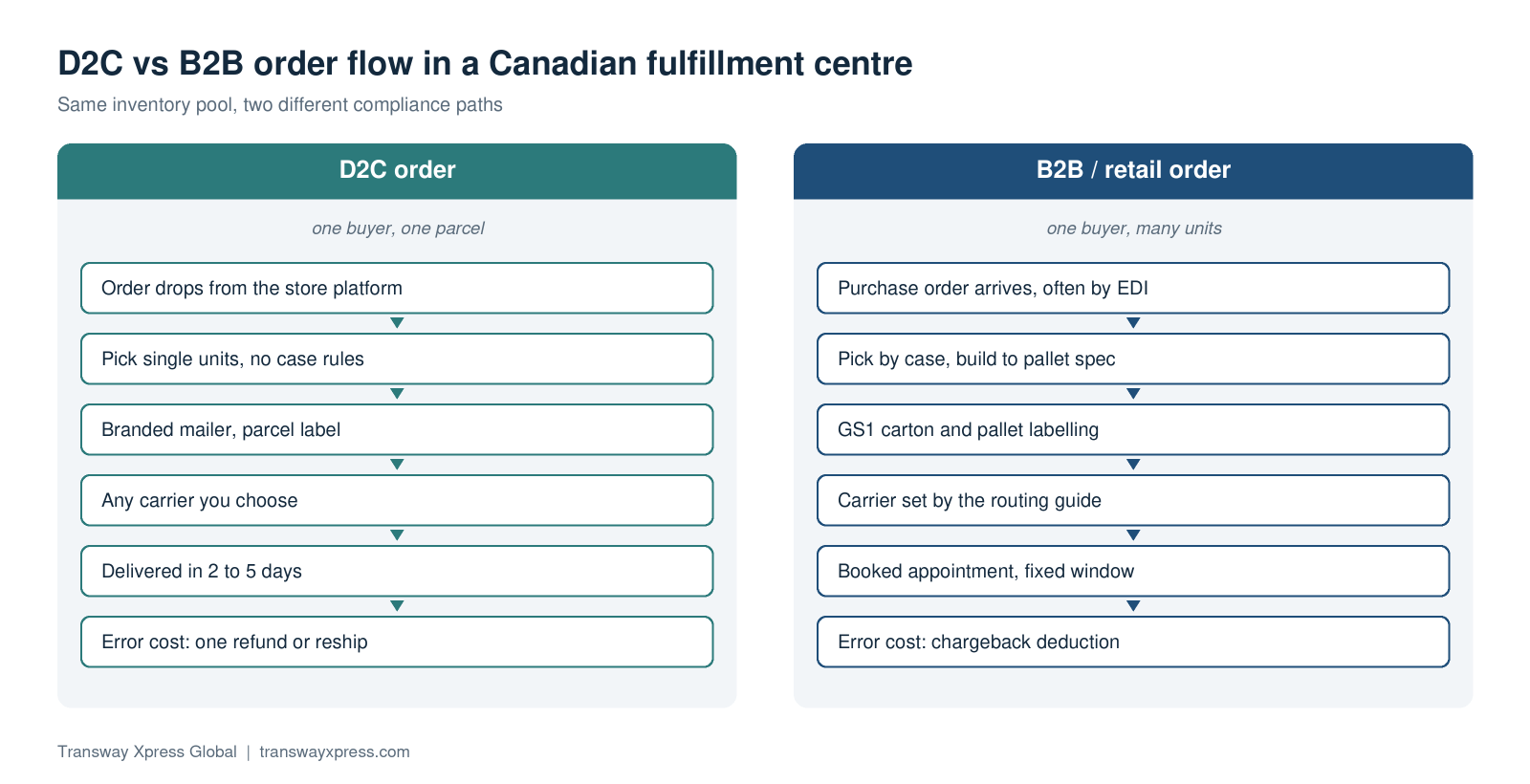
D2C demand arrives as a long tail: hundreds of small orders, each one or two units, spread across every day of the week. A single mispick costs you one refund. B2B demand arrives as a handful of very large orders with hard dates attached, and the units per order can exceed a full week of D2C volume. That changes how you plan labour, how you stage inventory, and how much buffer stock you need before a purchase order lands. If your ecommerce fulfillment in Canada setup was sized for parcel flow, the first retail order will expose every constraint in receiving and in dock scheduling at once.
What stays the same across both channels
Inventory accuracy, lot and expiry control, and cycle counting matter equally in both models. So does keeping one inventory pool rather than two. Splitting stock into a “retail” pile and a “web” pile feels tidy and almost always ends with one channel stocked out while the other sits on cover. The operational goal for B2B fulfillment in Canada is a single pool of sellable units with two different outbound paths layered on top, which is the same principle behind a 4PL model.
How B2B Orders Differ From D2C Orders
The table below maps the dimensions that change when a purchase order replaces a shopping cart. Each row is a place where a parcel-only process needs a second procedure written for it.
| Dimension | D2C order | B2B / retail order |
|---|---|---|
| How the order arrives | API or app feed from the store platform | Purchase order, often by EDI 850 or a vendor portal |
| Pick unit | Each (single unit) | Case, inner pack or full pallet |
| Packaging | Branded mailer or box, marketing inserts | Shipper carton to case-pack spec, stretch-wrapped pallet |
| Labelling | Carrier parcel label | GS1-128 carton labels, pallet licence plate, retailer-specific placement |
| Carrier choice | Yours, optimised on rate and transit | Set by the buyer’s routing guide, often a nominated LTL carrier |
| Documentation | Commercial invoice or packing slip | ASN (EDI 856), bill of lading, packing list, invoice (EDI 810) |
| Delivery timing | Transit window of a few days | Booked appointment inside a fixed window at a named door |
| Cost of an error | One refund or reship | Chargeback deducted from the invoice, scored against your vendor record |
| Returns | Individual consumer returns | Bulk returns, recalls or markdown reclamation |
Why small differences compound at volume
A mislabelled parcel affects one customer. A mislabelled pallet can put an entire purchase order into exception handling at the receiving door, and some retailers will refuse the delivery outright and bill the redelivery back to you. The asymmetry is the point: the per-unit margin on wholesale is thinner than D2C, so a deduction that looks small against the order value can erase the profit on the whole shipment. Good B2B fulfillment in Canada is mostly about removing the chance of those errors before the truck is loaded, not about picking faster.
What Retail Compliance Actually Requires
Every retailer publishes a vendor or routing guide, and that document, not your standard operating procedure, is the specification you are being measured against. Read it before you accept the order, not after.
Routing guides decide the carrier, not you
Most routing guides set a weight or pallet threshold above which the retailer’s nominated carrier must be used and the freight is billed collect. Below that threshold you may be free to choose. Booking the wrong carrier, or prepaying freight the buyer expected to control, is one of the most common first-order mistakes, and it is almost always chargeable. The guide will also name who books the delivery appointment and how far ahead, which is why a fulfillment centre in Canada running retail freight needs someone owning the carrier relationship rather than a rate shopping tool.
Carton labels, pallet labels and the ASN
Retail cartons carry a GS1-128 label built from the buyer’s required data elements, typically including the GTIN, purchase order number, quantity and a serial shipping container code that uniquely identifies the carton. The pallet gets its own licence plate label. The advance ship notice then transmits, in advance of the physical delivery, exactly what is on each pallet and in each carton so the receiving dock can scan rather than count. Label placement is prescribed down to the panel and the distance from the carton edge, and “close enough” is not a standard the scanner recognises.
Chargebacks are the scoreboard
Chargebacks are how retailers price non-compliance, and they are deducted rather than invoiced, so they show up in your bank reconciliation instead of your inbox. The recurring causes are consistent across most vendor programs: a late or early delivery against the appointment, a missing or unreadable carton label, an ASN that does not match what arrived, the wrong carrier, an incorrect case pack, and missing or incorrect documentation. Track them by root cause from the first purchase order. A pattern of the same deduction three months running is an operational defect, not bad luck.
Customs and Landed Cost on Wholesale Inbound
Wholesale changes your customs profile as much as your warehouse profile, because shipment values rise sharply and the goods usually move as freight rather than as courier parcels.
Valuation and documentation move from parcel to freight
Higher-value freight consignments attract more scrutiny on declared value, origin and classification than a stream of small parcels ever did. Your commercial invoice needs to carry complete descriptions, correct HS classification and the right incoterm, and the value you declare has to follow the statutory rules rather than whatever figure sits on the sales order. If you have not revisited this since you were shipping parcels, start with customs valuation rules in Canada and then rebuild your landed cost model on wholesale case quantities rather than single units.
Tariff and surtax exposure on cross-border inventory
If you are moving inventory between the United States and Canada to serve both markets, duty is no longer a rounding error on a parcel. Canada’s countermeasure surtaxes apply to specified US-origin goods by tariff item, and the Department of Finance publishes the complete list of US products subject to counter-tariffs as the authoritative reference. Check your own tariff items against that list before you quote a wholesale price, because a surtax discovered after the purchase order is signed comes out of your margin. Brands running inventory on both sides of the border should also read how US fulfillment for Canadian brands changes which entity is the importer of record.
Your B2B Fulfillment Readiness Checklist
Work through this list before you accept a purchase order, not after the buyer sends one.
What to confirm before the first purchase order ships
| Item | What “ready” looks like | Who owns it |
|---|---|---|
| Vendor / routing guide | Read in full, requirements extracted into a written work instruction | You and your 3PL together |
| EDI or portal connection | 850, 856 and 810 tested end to end in the retailer’s test environment | 3PL or EDI provider |
| GS1 company prefix | Licensed, with GTINs assigned at each and case level | Brand |
| Case pack specification | Units per case fixed, confirmed in writing with the buyer | Brand |
| Carton and pallet labelling | Label format and placement validated against a test scan | Fulfillment centre |
| Pallet build standard | Height, overhang, wrap and tier pattern agreed to the guide | Fulfillment centre |
| Freight and appointments | Named carrier, booking process and lead time documented | 3PL |
| Customs file | HS codes, origin and valuation method reviewed for freight volumes | Brand and customs broker |
| Chargeback tracking | Deductions logged by root cause from day one | Brand |
| Returns path | Bulk return and reclamation process agreed in advance | 3PL |
How Transway Xpress Global Solves This
Transway Xpress Global runs D2C and B2B fulfillment out of warehouses in Oakville and Etobicoke, Ontario, and Buffalo, New York, with an office in Pendleton, Indiana. The group grew out of Transway Transport, a trucking company operating from Oakville since 2014, so freight scheduling and carrier management sit inside the business rather than being brokered out to a third party when a retail routing guide names a carrier.
One inventory pool, two order types
The practical benefit of running both channels under one roof is that your retail cases and your web units draw from the same stock. A pallet can be broken down for D2C picking when a promotion runs hot, or units can be re-cased for a wholesale order when a buyer increases quantities. Alongside that, the same sites handle Amazon FBA prep, warehousing, order and inventory management, cross-border shipping between Canada and the United States, returns, and custom packaging. If you are also sending inventory into Amazon, the comparison of FBA prep options in Ontario covers how that work is scoped, and the cross-border returns guide covers the reverse flow. Current rates for storage, pick and pack and value-added work are on the pricing page.
Summary: Where to Start
Wholesale is not D2C with bigger boxes. It is a separate operating model with its own documentation, labelling and timing requirements, and the penalties for getting it wrong are financial and automatic.
The three decisions that matter most
First, decide who owns the routing guide, because an unowned vendor guide becomes an unowned chargeback. Second, decide whether your fulfillment partner can transmit an ASN and print compliant GS1 labels today, or whether that capability has to be built before you accept the order. Third, rebuild your landed cost and pricing on case quantities with duty and surtax included, so wholesale margin survives contact with a real purchase order. Brands that settle those three before the first shipment generally find B2B fulfillment in Canada becomes the stable, forecastable half of their business rather than the stressful one.
Frequently Asked Questions
What is B2B fulfillment in Canada?
B2B fulfillment Canada brands buy covers storing inventory and shipping bulk orders to businesses, retailers or distributors rather than to individual consumers. The service typically includes receiving against purchase orders, case and pallet picking, compliance labelling such as GS1-128 carton labels, pallet building, advance ship notice transmission, and booking freight against the buyer’s routing guide. It sits alongside D2C fulfillment in the same warehouse but follows a separate set of procedures.
How is B2B fulfillment different from D2C fulfillment?
D2C ships many small orders of one or two units directly to consumers using parcel carriers you choose. B2B ships a small number of very large orders to a business, picked by case or pallet, labelled to the buyer’s specification, carried by a nominated freight carrier, and delivered inside a booked appointment window. The cost of an error also differs: a D2C mistake usually means one refund, while a B2B mistake typically means a chargeback deducted from your invoice.
Do I need EDI to ship to Canadian retailers?
Most national retailers require EDI or an equivalent vendor portal, commonly the 850 purchase order, 856 advance ship notice and 810 invoice. Smaller independents and regional chains may accept email purchase orders and a packing list. Check the vendor guide before you commit to a delivery date, because EDI onboarding and testing can take several weeks and the retailer will not usually waive the requirement for a first order.
What is a retail chargeback and how do I avoid one?
A chargeback is a deduction a retailer applies when a shipment breaches the vendor guide, taken off your remittance rather than billed separately. The most common triggers are late or early delivery against the appointment, missing or unscannable carton labels, an ASN that does not match the physical shipment, the wrong carrier, and incorrect case packs. Avoiding them is a process problem: extract the guide into written work instructions, validate labels with a test scan, and log every deduction by root cause.
Can one 3PL handle both B2B and D2C fulfillment in Canada?
Yes, and keeping both in one building is usually the better choice because it avoids splitting inventory across sites. What matters is whether the provider can actually run both outbound paths: parcel picking and branded packing on one side, and case picking, GS1 labelling, pallet building, ASN transmission and routed freight on the other. Ask to see a sample carton label and an ASN before you sign, rather than taking the capability on description.
Planning a wholesale launch, or already absorbing chargebacks you cannot explain? Book a consultation and we will review your routing guide requirements, labelling and freight setup against what your fulfillment centre can do today.