Customs valuation rules Canada applies to every commercial import decide how much duty you actually pay, and in 2026 that figure carries far more weight than it did three years ago. With surtaxes on certain US-origin goods and new US measures stacked on ordinary rates, a value that is 8% too high is no longer a rounding error. Most brands still treat the commercial invoice total as the declared value. The Customs Act does not. Value for duty is a calculated figure: a price, plus specific additions, minus specific deductions, expressed in Canadian dollars at a rate fixed on a particular date. This guide covers the customs valuation rules Canada applies in sequence, what subsection 48(5)(a) forces you to add, what you may deduct, how related-party prices are tested, and where American rules diverge on the same shipment.
What value for duty actually means under Canadian law
Value for duty is the base figure customs duty is calculated on. CBSA requires it on every commercial shipment entering Canada, in Canadian dollars, whether or not duty is payable, because it also feeds trade statistics and GST. The obligation sits with you, not your broker: subsection 152(3) places the burden of proof on the importer.
Value for duty is not the same as the invoice total
An invoice records what you agreed to pay a supplier. Value for duty records what the goods are worth at a defined point in the journey, under a defined method. The two coincide only when the sale is simple, arm’s length, and the invoice already includes every addition the legislation demands, which is rarer than most finance teams assume. A tooling charge paid separately, a royalty paid to a third party, a sourcing agent’s commission, or inland freight inside the exporting country all sit outside the invoice total and inside the value for duty.
Why the number carries more weight in 2026
Duty is a percentage, so when rates were low a valuation error produced small dollar differences. Now that importers file against surtax declaration codes and manage layered trade measures, the customs valuation rules Canada enforces carry a materially larger exposure across every entry in a review period. Valuation errors compound quietly: nothing is rejected at the border, and the correction arrives later as an assessment.
Customs Valuation Rules Canada: The Six Methods CBSA Applies in Order
Sections 48 to 53 of the Customs Act set out six methods. They are not alternatives. Section 47 requires that they be considered in order, and that the first method capable of applying to your transaction be the one you use.
| Order | Method | Customs Act section | When it applies |
|---|---|---|---|
| 1 | Transaction value | Section 48 | A sale for export to a purchaser in Canada, with a price not distorted by the listed conditions |
| 2 | Transaction value of identical goods | Section 49 | No usable sale, but identical goods were imported at or about the same time |
| 3 | Transaction value of similar goods | Section 50 | No identical goods, but goods of comparable characteristics and function were imported |
| 4 | Deductive value | Section 51 | Work back from the Canadian selling price, deducting profit, general expenses and post-importation costs |
| 5 | Computed value | Section 52 | Build up from production cost plus profit and general expenses |
| 6 | Residual | Section 53 | Apply the earlier methods flexibly when none can be used as written |
Why you cannot choose the method that suits you
The sequence is the control. If transaction value is available you must use it, even where deductive value would produce a lower figure. CBSA’s Memorandum D13-3-1 is explicit that the first applicable method governs under these customs valuation rules. Importers get into trouble by skipping ahead because the transaction value paperwork is inconvenient, then being unable to show why section 48 could not apply.
The single exception to the sequence
One reversal is permitted: sections 51 and 52 may be switched at the importer’s request, so computed value is considered before deductive value. That is the whole of the flexibility; everything else runs top to bottom.
What must be added to the price paid or payable
Transaction value starts with the price paid or payable, then adds amounts not already included in it. These are mandatory, not optional, and they are the most common source of underdeclared value.
The additions listed in subsection 48(5)(a)
- Commissions and brokerage incurred by the purchaser, excluding buying commissions
- Packing costs and charges, including labour and materials
- Assists — goods or services you supplied to the producer free or at reduced cost, such as tooling, moulds, dies, components or offshore engineering work
- Royalties and licence fees the purchaser must pay as a condition of the sale
- Subsequent proceeds of any resale, disposal or use that accrue back to the vendor
- Transportation and insurance costs to the place of direct shipment
Freight and the place of direct shipment
This last addition separates the Canadian system from the American one, and it catches brands importing into both markets on one set of documents. Canada requires transport and insurance up to the place of direct shipment inside the value for duty. If your supplier’s ex-works price excludes trucking from the factory to the port of loading, that trucking still belongs in the declared value. Getting it right starts with a commercial invoice that itemises each charge rather than burying freight in one line, and it flows into how you calculate landed cost.
What you may deduct, and the proof CBSA expects
Subsection 48(5)(b) allows specific amounts to come out of the price paid or payable, provided they are identified separately.
Deductions only when the actual amount is known
You may deduct transportation from the place of direct shipment onward, post-importation construction, assembly, maintenance or technical assistance, and Canadian import duties and taxes. The condition is strict: the deduction is available only where the actual amount is known. Estimates are not accepted. A freight allocation set as a flat percentage of invoice value will not survive a review; an actual carrier invoice tied to the shipment will. It is one reason the Incoterm you agree with your supplier carries customs consequences.
Converting to Canadian dollars
Foreign currency amounts are converted at the rate CBSA recognises, the Bank of Canada rate, in effect on the date the goods began their direct and uninterrupted journey to Canada. Not the invoice date, not the payment date, not the arrival date. Brands booking at month-end average rates need a separate customs valuation conversion, or every entry starts life slightly wrong.
Related-party pricing: the rule that catches growing brands
The moment a brand sets up a Canadian subsidiary, appoints an affiliated distributor, or imports from a manufacturer it partly owns, the sale stops being arm’s length. Subsection 45(3) defines when persons are related, and paragraph 48(1)(d) limits when transaction value may still be used.
The circumstances-of-sale test
Transaction value survives if you can show the relationship did not influence the price. CBSA’s Memorandum D13-4-5 accepts evidence such as the vendor selling to unrelated Canadian customers on similar terms, pricing settled consistently with normal industry practice, or a price adequate to recover all costs plus a representative profit. Transfer pricing documentation prepared for income tax is useful support, but customs valuation rules ask a different question, so it is not automatically sufficient.
Test values and timing
The alternative is to show the price closely approximates a test value: the transaction, deductive or computed value of identical or similar goods exported to Canada at the same or substantially the same time, generally within 30 days before or after your export date. If neither route works, you fall down the sequence to section 49. Non-resident importers carry this analysis alongside their CARM registration obligations.
How Canada and the United States value the same shipment
Brands selling into both markets frequently reuse one declared value. Both systems share a common international framework, so the method sequence looks familiar, but the treatment of international freight differs.
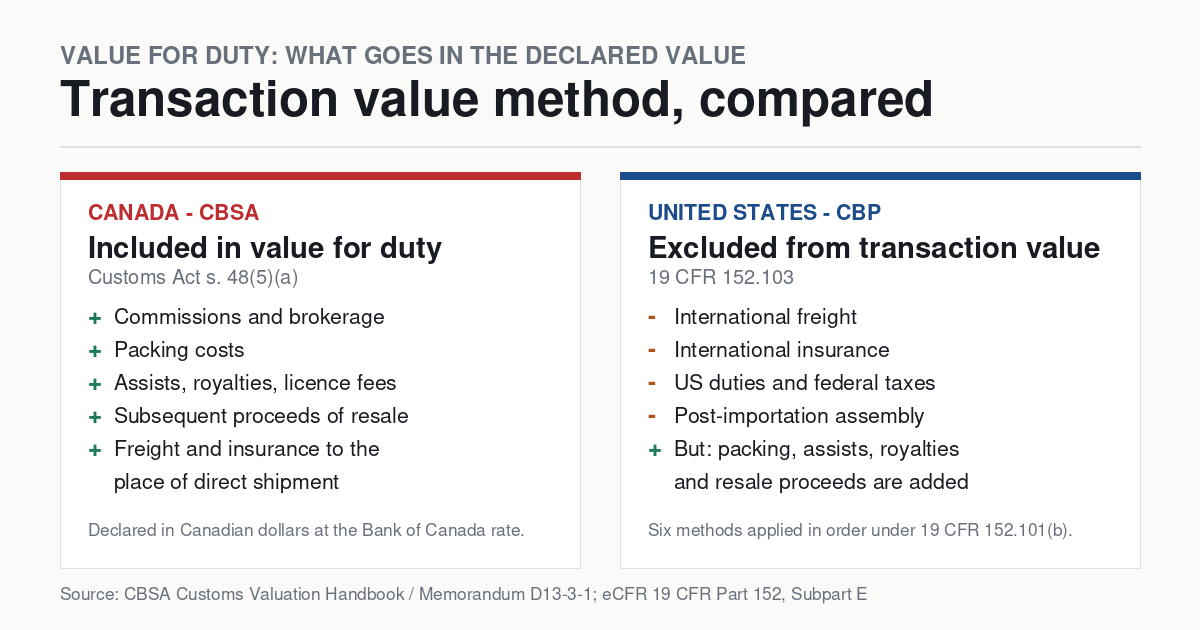
| Dimension | Canada (CBSA) | United States (CBP) |
|---|---|---|
| Governing rules | Customs Act, sections 48-53 | 19 CFR Part 152, Subpart E |
| Number of methods | Six, applied in order | Six, applied in order |
| Primary method | Transaction value, section 48 | Transaction value, 19 CFR 152.103 |
| International freight | Added, to the place of direct shipment | Excluded when separately identified |
| International insurance | Added, to the place of direct shipment | Excluded when separately identified |
| Assists and royalties | Added under 48(5)(a) | Added under 152.103 |
| Proceeds of resale to the seller | Added | Added |
| Import duties and taxes | Deductible if separately identified | Excluded when separately identified |
| Currency conversion | Bank of Canada rate on the date the direct journey began | CBP published conversion rules |
One invoice, two declared values
Read the freight rows together and the consequence is clear: one shipment, one invoice and one Incoterm can legitimately produce a higher declared value in Canada than in the United States. Copying the American figure onto a Canadian entry underdeclares; copying the Canadian figure south overdeclares and quietly overpays. Brands running a cross-border fulfillment model need two valuation workings from one commercial file. The same discipline applies to origin marking, where the regimes also differ.
A valuation self-audit checklist before your next entry
Run this against recent entries. If any answer is uncertain, that is where a review will land.
Ten checks to run this week
- Can you name the valuation method used on your last ten entries, and the section it sits under?
- If transaction value was used, is there a documented sale for export to a purchaser in Canada?
- Are commissions, other than genuine buying commissions, added to the declared value?
- Have you identified every assist — tooling, moulds, dies, free components, offshore design work?
- Are royalties and licence fees payable as a condition of sale included?
- Is inland freight to the place of direct shipment inside the Canadian value for duty?
- Are deductions supported by actual invoiced amounts rather than percentage allocations?
- Is currency converted at the Bank of Canada rate for the date the direct journey began?
- If any supplier is related, do you hold current circumstances-of-sale or test-value evidence?
- Can you retrieve the supporting records for any entry in the last six years?
That final point is not housekeeping. Under the customs valuation rules Canada enforces, importers keep records for six years, and self-adjustment is required once you have reason to believe a declared value was wrong. Finding the error yourself beats having it found for you.
How Transway Xpress Global solves this
Valuation errors are rarely bad faith. They happen because the data is scattered — the supplier invoice sits with procurement, the freight invoice with logistics, the tooling payment with finance, the royalty agreement with legal. By the time a broker files, nobody has the full picture.
Where fulfillment data meets the customs declaration
Transway Xpress Global operates warehouses in Oakville and Etobicoke, Ontario and in Buffalo, New York, with an office in Pendleton, Indiana, backed by our trucking parent Transway Transport, which has run cross-border freight out of Oakville since 2014. That footprint means we hold both sides of the border in one operation: inbound receiving, eCommerce fulfillment in Canada, Amazon FBA prep, B2B distribution, and the return leg.
Practically, we keep the shipment file intact. Commercial invoices, packing lists, freight documentation and inbound receipts stay on one consignment record, so the figures your broker needs are assembled rather than reconstructed. If you are weighing a broker, a forwarder or both, our guide on freight forwarder versus customs broker sets out who does what, and it is worth checking whether duty deferral programs fit your flow. Brands shipping out of India should start with our India to Canada customs clearance guide. One caution: CUSMA preference applies only to goods originating in Canada, the United States or Mexico, so goods manufactured in India do not qualify whatever route they travel.
Summary
The short version
Value for duty is built, not copied. The customs valuation rules Canada applies run in sequence through sections 48 to 53, and you use the first method that fits. Start from the price paid or payable; add commissions, packing, assists, royalties, proceeds, and transport and insurance to the place of direct shipment. Deduct only what you can evidence with actual amounts. Convert at the Bank of Canada rate for the day the direct journey began. Prove that no related-party relationship moved the price. Then keep the file for six years.
Frequently Asked Questions
What are the customs valuation rules Canada uses to set value for duty?
Canada applies six valuation methods set out in sections 48 to 53 of the Customs Act: transaction value, transaction value of identical goods, transaction value of similar goods, deductive value, computed value, and the residual method. Section 47 requires them to be considered in that order, and the first method that can apply to your transaction is the one you must use. Transaction value, based on the price paid or payable, covers most commercial imports.
Is value for duty the same as the price on my commercial invoice?
Usually not. The invoice is the starting point, but subsection 48(5)(a) requires you to add commissions and brokerage, packing costs, assists such as tooling or free components, royalties and licence fees payable as a condition of sale, any proceeds of resale flowing back to the vendor, and transport and insurance to the place of direct shipment. Subsection 48(5)(b) then allows specific deductions where the actual amounts are known. The declared value is the result of that calculation.
Does Canada include international freight in the declared value?
Canada includes transport and insurance up to the place of direct shipment inside the value for duty. Costs incurred from that point onward may be deducted if they are separately identified and the actual amount is known. This differs from the United States, where international freight and insurance are excluded from transaction value when separately identified. Brands importing into both markets should expect two different declared values from one commercial invoice.
How do customs valuation rules in Canada treat purchases from a related supplier?
Where the vendor and purchaser are related under subsection 45(3), transaction value may still be used if you can show the relationship did not influence the price, or that the price closely approximates a test value for identical or similar goods exported at about the same time. CBSA looks for evidence such as comparable sales to unrelated Canadian customers, pricing consistent with normal industry practice, or pricing that recovers all costs plus a profit. Without it, you move down the sequence.
How long do I need to keep customs valuation records in Canada?
Importers are expected to retain the records supporting a declared value for six years, and the burden of proof sits with the importer under subsection 152(3) of the Customs Act. That means supplier invoices, freight and insurance documentation, assist and royalty agreements, currency conversion working, and any related-party analysis. If you later discover a declared value was wrong, self-adjustment is required rather than optional.
Getting valuation right is cheaper than correcting it. If you import into Canada, the United States, or both, and you want your fulfillment operation to produce clean customs data rather than a reconstruction exercise, book a consultation with Transway Xpress Global and we will review how your shipment file is put together.
Authoritative sources: CBSA Customs Valuation Handbook; CBSA Memorandum D13-3-1; CBSA Memorandum D13-4-5; 19 CFR 152.101.