If you sell across the Canada–US border, sooner or later you hit a wall of job titles that all sound interchangeable: forwarder, broker, carrier, 3PL. Getting freight forwarder vs customs broker wrong is not a vocabulary problem — it is how shipments end up stuck at the border, how duty bills arrive weeks later, and how a “cheap” quote turns into a landed cost you never budgeted for. A freight forwarder moves your goods; a customs broker clears them; a 3PL stores and ships them to your customers. Different licences, different liabilities, different moments in the journey.
This guide breaks down the freight forwarder vs customs broker question for Canadian and cross-border sellers, shows where a 3PL fits, and explains who is actually on the hook when the Canada Border Services Agency (CBSA) or US Customs and Border Protection (CBP) has a question about your shipment.
What does a freight forwarder actually do?
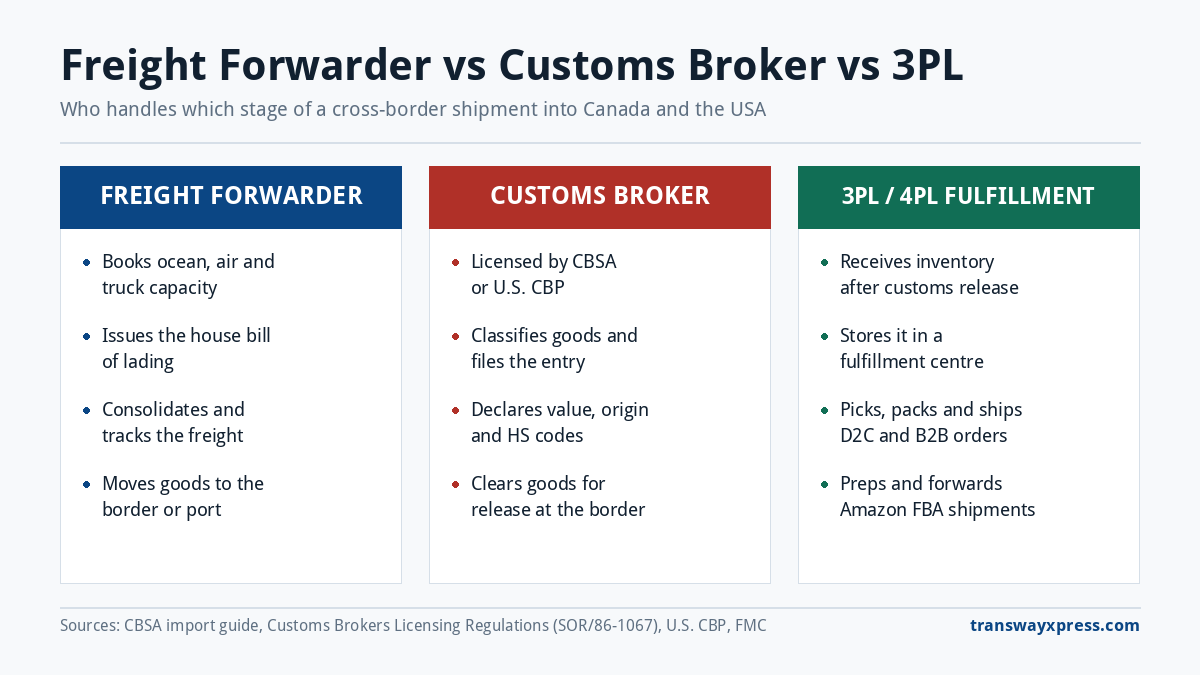
A freight forwarder is the logistics organizer of an international shipment. Forwarders do not usually own the ships, planes or trucks — they buy capacity from carriers, consolidate cargo, book the moves and manage the paperwork that gets your goods from origin to the border or port. Think of the forwarder as the travel agent for your freight.
The forwarder’s core responsibilities
A forwarder typically arranges ocean, air or ground transport, negotiates rates, issues a house bill of lading, coordinates consolidation and deconsolidation, and tracks the shipment end to end. Many forwarders also arrange cargo insurance and offer warehousing at origin. What they generally do not do is make the customs declaration to the government on your behalf — that is a separate, licensed function in both Canada and the United States.
Forwarder licensing in the United States
In the US, ocean freight forwarders and non-vessel-operating common carriers (NVOCCs) are Ocean Transportation Intermediaries regulated by the Federal Maritime Commission (FMC) under 46 CFR Part 515. According to the FMC, an ocean freight forwarder must post a $50,000 surety bond, a US-based or licensed non-US-based NVOCC must post $75,000, and an unlicensed non-US-based registered NVOCC must post $150,000. The key distinction: an ocean freight forwarder acts as the shipper’s agent and does not issue a bill of lading, while an NVOCC issues its own house bill of lading and takes on carrier liability.
What does a customs broker do?
A customs broker is a licensed specialist whose entire job is clearing goods through the border agency. Where the forwarder moves the box, the broker talks to the government: classifying the goods, declaring their value and origin, calculating duties and taxes, and filing the entry that releases the shipment. In the freight forwarder vs customs broker split, this is the compliance half of the equation.
The broker’s core responsibilities
A customs broker determines the correct Harmonized System (HS) classification, applies the right tariff treatment and rules of origin, prepares and submits the release and accounting documents, and remits duties and taxes to the government. A good broker also flags participating-government-agency requirements — think CFIA for food, Health Canada for cosmetics, or CPSC in the US for consumer products — before they turn into a hold at the border.
Customs broker licensing in Canada and the US
In Canada, customs brokers are licensed under the Customs Brokers Licensing Regulations (SOR/86-1067). Section 10 of those regulations requires an applicant to post security of $50,000 before a licence is issued or renewed, and section 13 lets a single national licence authorize business at any customs office as long as the holder keeps at least one business office in Canada. CBSA’s updated Memorandum D1-8-1 (revised February 11, 2026) folds in the national licensing model, mandatory criminal-record checks and the removal of pre-issuance site inspections under the CARM system. In the US, customs brokers are licensed by CBP under 19 U.S.C. 1641 and must hold a national permit after passing the Customs Broker License Examination.
Freight forwarder vs customs broker: the side-by-side comparison
The fastest way to see the difference is to line the two roles up against a 3PL fulfillment provider, since a cross-border ecommerce shipment usually touches all three.
Roles, licences and liability at a glance
| Dimension | Freight Forwarder | Customs Broker | 3PL / 4PL Fulfillment |
|---|---|---|---|
| Primary job | Books and moves freight to the border or port | Clears goods through CBSA / CBP | Stores inventory and ships orders to customers |
| Regulator / licence | FMC (OTI licence, 46 CFR 515) in the US | CBSA (SOR/86-1067) in Canada; CBP (19 U.S.C. 1641) in the US | No transport or customs licence required for the fulfillment function itself |
| Financial security | $50,000 (ocean forwarder) to $150,000 (unlicensed foreign NVOCC) bond | $50,000 security in Canada | Commercial contract; no statutory bond |
| Issues bill of lading? | NVOCC yes; ocean forwarder no | No | No |
| Talks to the border agency? | Not the customs declaration | Yes — files the entry | No |
| Where in the journey | Origin to border / port | At the border | After customs release, to the end customer |
| Who stays liable | Carrier liability up to BOL limits (NVOCC) | Importer of record remains ultimately liable | Contractual liability for storage and fulfillment |
Notice the pattern: the forwarder and broker touch the goods before they reach your warehouse, while the 3PL takes over once the shipment is released. That handoff is exactly where cross-border sellers lose money if the roles are not coordinated. Our cross-border ecommerce fulfillment guide walks through the full journey in more detail.
Do you legally need a customs broker or a freight forwarder?
Neither role is strictly mandatory in Canada — but understanding why changes how you should think about the freight forwarder vs customs broker decision.
What CBSA actually requires
CBSA is explicit that using a broker is optional. Its guide to importing commercial goods states that you “may feel comfortable preparing your own release and accounting documentation and transacting business directly with the Canada Border Services Agency (CBSA)” or you “may authorize a Licensed Customs Broker to act as your agent.” Before importing, though, you must obtain a Business Number with an import/export (RM) account from the Canada Revenue Agency. And this is the sentence that matters most: CBSA notes you are “ultimately responsible for the accounting documentation, payment of duties and taxes, and subsequent corrections… even if you use the services of a broker.”
Why most brands still use both
You can self-clear and self-forward, but few growing ecommerce brands do. Misclassifying an HS code, misdeclaring origin, or missing a participating-government-agency requirement can mean penalties, reassessments and border holds — and the importer of record, not the broker, carries that liability. A forwarder saves you from negotiating carrier contracts and managing consolidations. A broker saves you from a compliance minefield that changes constantly, as anyone who tracked the end of the US de minimis rule can attest. If you are a non-resident importer, the stakes are higher still — see our guide to CARM requirements for non-resident importers.
How duties and the de minimis threshold fit in
Whoever files your entry, the numbers are set by government thresholds — and getting them wrong is the fastest route to a surprise bill.
Canada’s courier de minimis thresholds under CUSMA
For goods shipped by courier from the US or Mexico, CUSMA set the low-value thresholds that took effect on July 1, 2020: shipments valued up to CA$40 are duty and tax free; shipments above CA$40 up to CA$150 are duty free but still subject to taxes; and shipments above CA$150 are subject to both duties and taxes. The commercial low-value shipment accounting threshold sits at CA$3,300. A critical caveat: CUSMA duty-free treatment applies to goods that qualify as North American in origin under the agreement’s rules of origin. Goods manufactured in, say, India and simply shipped through the US do not become duty-free under CUSMA — origin, not the shipping route, decides the tariff.
Landing the true cost
Because duties, taxes, brokerage and freight all stack on top of your product cost, the only number that matters for pricing is landed cost. Sellers who quote off the freight rate alone routinely underprice. Our walkthrough on how to calculate landed cost and the difference between DDP and DAP shipping terms shows how the broker’s declared value flows straight into your margins.
Where a 3PL fits — and how Transway Xpress Global solves this
A freight forwarder and a customs broker get your inventory to and across the border. A third-party logistics provider (3PL) — or a 4PL that coordinates the whole chain — takes over the moment your goods are released, storing them and shipping orders to your customers on both sides of the border.
One coordinated cross-border operation
Transway Xpress Global runs fulfillment centres in Oakville and Etobicoke, Ontario and in Buffalo, New York, with a US office in Pendleton, Indiana, backed by our trucking parent Transway Transport (Oakville, operating since 2014). That footprint lets us receive your inventory after customs release, store it in the right country, and handle D2C and B2B fulfillment, Amazon FBA prep, order and inventory management, returns and custom packaging from a single partner. We coordinate closely with the forwarders and licensed brokers who move and clear your freight, so the handoff from border to warehouse does not drop.
Built for brands entering North America
If you are an international brand — including brands shipping from India into the USA and Canada — the freight forwarder vs customs broker vs 3PL puzzle is exactly what stalls a launch. As a 4PL partner, we help you assemble the right forwarder, broker and warehouse mix instead of stitching three disconnected vendors together yourself.
Summary: matching the role to the moment
The freight forwarder vs customs broker question is really a question about timing and liability. The forwarder owns the movement of goods to the border. The broker owns the declaration that clears them. The 3PL owns everything after release. And no matter who files your paperwork, the importer of record stays ultimately responsible to CBSA for the accuracy of the accounting and the duties owed. Get the three roles coordinated and cross-border trade becomes predictable; leave a gap between them and that gap is where cost and delay live.
Frequently Asked Questions
What is the difference between a freight forwarder vs customs broker?
A freight forwarder arranges and moves your shipment — booking ocean, air or truck capacity, consolidating cargo and issuing transport documents — up to the border or port. A customs broker is a licensed specialist who clears the goods through CBSA or CBP by classifying them, declaring value and origin, and filing the entry that releases the shipment. The forwarder handles logistics; the broker handles the customs declaration. Many shipments use both because they cover different, sequential stages of the journey.
Do I legally need a customs broker to import into Canada?
No. CBSA allows you to prepare your own release and accounting documentation and deal with the agency directly, or to authorize a licensed customs broker to act as your agent. You do need a Business Number with an import/export account from the CRA before importing commercial goods. Most growing brands still hire a broker because the importer of record remains ultimately responsible for classification, valuation, duties and any later corrections, and the compliance rules are complex and change often.
Can a freight forwarder also act as my customs broker?
Sometimes, but only if that company also holds the separate customs broker licence — in Canada under the Customs Brokers Licensing Regulations, in the US under CBP’s broker rules. Forwarding and brokerage are distinct licensed functions with distinct bonds. Some larger providers hold both and offer a bundled service, which can simplify coordination. Always confirm the licences directly rather than assuming one title covers the other, because the liabilities attached to each role are different.
Does CUSMA make my imports duty-free?
Only if the goods qualify as North American in origin under CUSMA’s rules of origin. CUSMA reduces or eliminates duties on qualifying goods made in Canada, the US or Mexico — it does not make everything shipped between the three countries duty-free. Goods manufactured elsewhere, such as in India or China, and merely routed through the US do not become duty-free under CUSMA. Origin determines the tariff treatment, not the shipping path, so your broker must confirm origin before claiming preferential treatment.
How much does a customs broker cost compared with a freight forwarder?
Costs are structured differently. A freight forwarder charges for transportation and handling — freight rates, consolidation, documentation and optional insurance. A customs broker charges an entry or clearance fee per shipment, plus disbursement fees when they advance duties and taxes on your behalf. Both feed into your landed cost alongside the actual duties and taxes. Because the numbers stack, the smartest move is to model total landed cost per unit rather than comparing forwarder and broker quotes in isolation.
Not sure whether you need a forwarder, a broker, a 3PL — or all three? Book a free cross-border consultation with Transway Xpress Global and we will map the right setup for your Canada and US fulfillment.
Authoritative sources: CBSA Guide to importing commercial goods and the Federal Maritime Commission OTI bond program.