The CBP Canada import ban guidance landed on 28 September 2026, less than twelve hours before the exclusion it explains took effect. If you move Canadian-origin goods into the United States — or route Indian or other international inventory through a Canadian fulfillment centre before it crosses south — the CBP Canada import ban guidance is now the operative document at the border, not the proclamations alone. Three presidential proclamations bar certain Canadian alcoholic beverages, dairy products and motor vehicles from importation into the United States as of 12:01 a.m. eastern time on 29 September 2026. What CBP added the day before is the operational detail importers actually file against: the HTS headings its systems screen, confirmation that the ban reaches foreign trade zones and bonded warehouses and not just consumption entries, and the error codes ACE now throws when a filing crosses the line.
What the CBP Canada import ban guidance actually says
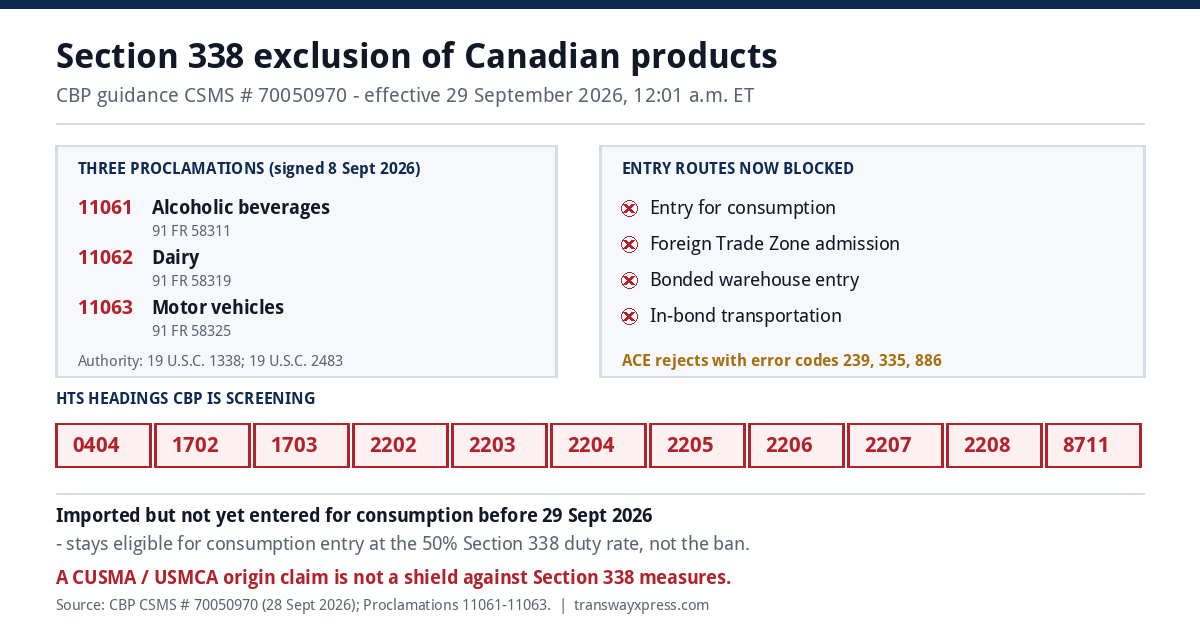
CBP issued CSMS # 70050970 on 28 September 2026 at 1:34 p.m. EDT. It is short, and every line of it matters, because it converts three proclamations written in legal language into instructions your broker can execute. The message covers three categories of Canadian product — alcoholic beverages, motor vehicles and dairy — and confirms one effective moment for all of them. For importers shipping out of Canada, this guidance is the practical reference now, not the proclamation text.
Three proclamations, one effective moment
The President signed all three instruments on 8 September 2026 and the Federal Register published them on 14 September 2026. Each rests on Section 338 of the Tariff Act of 1930 (19 U.S.C. 1338) together with Section 604 of the Trade Act of 1974 (19 U.S.C. 2483). Section 338 is the rarely used provision that lets the President go beyond duties and bar goods from entry altogether, which is exactly what these three did.
| Proclamation | Product category | Federal Register citation | Exclusion effective |
|---|---|---|---|
| 11061 | Alcoholic beverages of Canada | 91 FR 58311 | 29 Sept 2026, 12:01 a.m. ET |
| 11062 | Dairy products of Canada | 91 FR 58319 | 29 Sept 2026, 12:01 a.m. ET |
| 11063 | Motor vehicles of Canada | 91 FR 58325 | 29 Sept 2026, 12:01 a.m. ET |
| 11064 | Scope change to the 50% alcohol duties | 91 FR 58331 | 15 Sept 2026, 12:01 a.m. ET |
Proclamation 11064 is the one importers keep missing. It did not ban anything. It moved products between Annex I Part A, which stays subject to the 50 percent additional duty, and Annex I Part B, which came out of scope, and it took effect two weeks before the ban. If your classification review predates 15 September 2026, it is already out of date. We walked through that scope shift when it was announced in our note on the Section 338 import ban and the 29 September deadline.
The eleven HTS headings CBP is screening
CSMS # 70050970 names the headings CBP systems check: 0404, 1702, 1703, 2202, 2203, 2204, 2205, 2206, 2207, 2208 and 8711. A heading is four digits, so each one covers a family of subheadings, and the annexes to the proclamations, not the CSMS, decide which specific subheadings fall inside the exclusion. Treat the list below as your screening filter, then verify at the ten-digit level against the annex.
| HTS heading | What the heading covers | Category |
|---|---|---|
| 0404 | Whey and products consisting of natural milk constituents | Dairy |
| 1702 / 1703 | Other sugars and sugar syrups; molasses | Dairy annex inputs |
| 2202 | Waters and other non-alcoholic beverages, including sweetened | Beverages |
| 2203 | Beer made from malt | Alcoholic beverages |
| 2204 / 2205 | Wine of fresh grapes; vermouth and flavoured wine | Alcoholic beverages |
| 2206 | Other fermented beverages, including cider and mead | Alcoholic beverages |
| 2207 / 2208 | Undenatured ethyl alcohol; spirits, liqueurs and other spirituous beverages | Alcoholic beverages |
| 8711 | Motorcycles, including mopeds and cycles with an auxiliary motor | Motor vehicles |
The presence of 2202 catches consumer-goods brands by surprise. Non-alcoholic beverages sit in that heading, so a product you think of as a soft drink can land inside a screening filter built for an alcohol measure. Run the screen before anything else leaves Canada, because the guidance hands CBP systems a heading-level filter that flags more goods than the annexes will ultimately bar from import. Our guide to country of origin marking in the US and Canada covers how CBP establishes origin in the first place, which is the question that decides whether these proclamations touch your goods at all.
Which entry routes the exclusion now blocks
This is where the CBP Canada import ban guidance goes further than most importers assumed. An exclusion from importation is not the same thing as a prohibition on consumption entry, and CBP said so plainly.
Consumption entry is only part of it
Under the guidance, the exclusion prevents entry into foreign trade zones, entry into bonded warehouses, in-bond transportation, and entry for consumption. Every route that would normally let an importer park goods on US soil while a duty question is resolved is closed for excluded Canadian product.
| Entry route | Before 29 Sept 2026 | From 29 Sept 2026, 12:01 a.m. ET |
|---|---|---|
| Entry for consumption | Permitted at 50% Section 338 duty | Blocked for excluded goods |
| Foreign trade zone admission | Available | Blocked for excluded goods |
| Bonded warehouse entry | Available | Blocked for excluded goods |
| In-bond transportation | Available | Blocked for excluded goods |
| Goods imported before the effective date | n/a | Still eligible for consumption entry at 50% |
What this does to a bonded or FTZ strategy
Plenty of cross-border programmes were built on the assumption that a zone or a bonded warehouse gives you somewhere to wait. That assumption held through the duty phase of Section 338 and it does not hold now. Nothing in the guidance leaves an import route open for excluded goods leaving Canada, so the inventory needs a different destination before it reaches the border rather than after. Duty deferral still works for everything outside these annexes, and our overview of duty deferral programs in Canada and the US sets out which tools remain available for the rest of your catalogue.
How the packaged alcohol carve-out narrows the ban
The alcohol side of the CBP Canada import ban guidance is narrower than the headline suggests, and the narrowing is worth real money. The guidance draws the line at the container, so the same liquid leaving Canada can face two different import outcomes.
What packaged means under the Alcohol Annex
CBP states that the exclusion applies only to products that meet the scope limitations in the Alcohol Annex, and that the packaged restriction refers to bottles, cans, boxes, kegs or other similar direct-to-consumption containers. The measure targets finished retail-ready alcohol, not every litre of Canadian liquid in Chapter 22.
Non-packaged product still pays 50 percent
Per the guidance, non-packaged alcoholic beverages remain subject to the 50 percent ad valorem duty rather than the exclusion. That is a meaningful distinction for anyone shipping bulk. Bulk wine or spirits moving for bottling in the United States sits in a different position from the same product in a case of bottles. Get the packaging description right on the commercial invoice, because it is now doing compliance work. Our field-by-field commercial invoice guide covers how to describe goods so that a border officer reaches the same conclusion you did.
What happens to goods that were already imported
The grandfathering clause, read literally
Each proclamation contains the same saving provision: products that would be subject to the import ban, but that were imported and not yet entered for consumption or withdrawn from warehouse for consumption prior to 29 September 2026, remain subject to the 50 percent duty rate rather than the exclusion. Read the verbs carefully. The trigger is importation before the effective moment, not departure from Canada and not the date on the purchase order. The guidance does not extend that treatment to anything imported from Canada after 12:01 a.m. eastern time on 29 September 2026.
ACE error codes 239, 335 and 886
CBP has updated ACE to reject non-compliant submissions with error codes 239, 335 and 886. Expect those to appear on filings that name an excluded heading without a qualifying basis. Two practical consequences follow. First, your broker will see the rejection before you see the shipment, so agree now on who calls whom and how fast. Second, a rejected filing is not a customs decision you can appeal — it is a system refusal, and the fix is upstream in classification or in routing. CBP directs questions to its Trade Remedy mailbox at [email protected].
Does a CUSMA claim protect Canadian goods? No
Section 338 sits outside the agreement
A CUSMA claim is not a shield here. Section 338 duties apply even to goods that originate under the agreement, and the exclusions built on the same authority apply the same way. A valid certification of origin still governs the preferential tariff treatment of goods that are not caught by these measures, and it still matters for the rest of your entries — but it does not carve you out of an import prohibition. If a supplier or a broker tells you otherwise, ask them to point at the text. Canada own measures run on a parallel track: the counter-tariff list took effect on 8 September 2026 and the relief route is separate again, which we covered in our note on Canada counter-tariff relief and remission.
A note for India-origin inventory
Goods manufactured in India are not products of Canada, and CUSMA does not apply to them in any case — the agreement covers North-American-origin goods only. What matters for an India-origin product routed through a Canadian warehouse is whether the work performed in Canada changes the country of origin for US purposes. Storage, picking, packing and FBA prep normally do not. That usually keeps India-origin inventory outside these three annexes, but the US tariff treatment attaching to Indian origin still follows the goods south. Our overview of customs valuation rules and value for duty explains the other half of that calculation.
Your compliance checklist under the CBP Canada import ban guidance
This week
| Action | Why it matters | Owner |
|---|---|---|
| Screen every active SKU against headings 0404, 1702, 1703, 2202–2208 and 8711 | Identifies exposure in one pass | Compliance |
| Verify flagged SKUs at ten digits against the proclamation annexes | Headings over-capture; annexes decide | Broker |
| Re-check alcohol SKUs against the 15 Sept 2026 Annex I Part A and Part B split | Proclamation 11064 moved products both ways | Compliance |
| Confirm packaged versus non-packaged status on every Chapter 22 line | Decides exclusion versus 50% duty | Operations |
| Identify any excluded goods sitting in an FTZ or bonded plan | Those routes are now closed | Logistics |
| Establish the import date for goods already on US soil | Determines the grandfathering position | Broker |
| Brief your broker on escalation for ACE codes 239, 335 and 886 | Rejections surface at the filing, not the dock | Logistics |
Before 8 November 2026
Section 338 is also live as a policy question. The US International Trade Commission announced on 4 September 2026 that it is seeking public comment on how it should meet its statutory obligations under Section 338(g), with written comments due by 5:15 p.m. on 8 November 2026 — 39 days from today. If an exclusion has removed a product line from your US business, that is exactly the kind of commercial fact the Commission asked for. We set out what a useful submission looks like in our guide to the Section 338 comment period.
How Transway Xpress Global solves this
The practical problem this creates is not legal, it is physical. Inventory has to be somewhere, and the border is no longer a place you can park it. Transway Xpress Global runs warehouses in Oakville and Etobicoke, Ontario, and in Buffalo, New York, with an office in Pendleton, Indiana, and the trucking parent Transway Transport has operated out of Oakville since 2014. That footprint means a brand can hold Canadian-market inventory in Ontario and US-market inventory in Buffalo, on separate entries, instead of running everything through one crossing and discovering the problem at the filing.
Where inventory placement changes the outcome
The services that matter under a measure like this are the ordinary ones done deliberately: warehousing on the correct side of the border, order and inventory management that keeps the two pools distinct, Amazon FBA prep close to the marketplace being served, custom packaging, returns handling, and cross-border shipping. For Indian and other international brands, a single 4PL partner covering both countries stops an exclusion in one market stranding the inventory for both. Our page on US fulfillment for Canadian brands sets out how that split is normally structured, and our India to USA and Canada service covers the international leg.
Summary
What to take away
The CBP Canada import ban guidance turned three proclamations into border practice on 29 September 2026. Eleven HTS headings are screened. Four entry routes are closed, not one. Goods imported before the effective moment keep a consumption-entry path at 50 percent; goods that were not do not. Packaged alcohol is excluded while non-packaged alcohol keeps paying 50 percent ad valorem, and a CUSMA claim changes none of it. The work ahead is a classification pass at ten digits, a packaging review on Chapter 22, and a decision about where inventory sits before it reaches the crossing.
Frequently Asked Questions
What is the CBP Canada import ban guidance?
It is CSMS # 70050970, a message CBP issued to the trade community on 28 September 2026 explaining how it will enforce Presidential Proclamations 11061, 11062 and 11063. Those proclamations exclude certain Canadian alcoholic beverages, dairy products and motor vehicles from importation into the United States from 12:01 a.m. eastern time on 29 September 2026. The guidance identifies the HTS headings CBP screens, confirms that foreign trade zones, bonded warehouses and in-bond movements are covered as well as consumption entries, and lists the ACE error codes that reject non-compliant filings.
Which Canadian products are banned from import into the United States?
Certain alcoholic beverages, dairy products and motor vehicles, as set out in the annexes to Proclamations 11061, 11062 and 11063. CBP screens HTS headings 0404, 1702, 1703, 2202, 2203, 2204, 2205, 2206, 2207, 2208 and 8711. A heading is broader than the exclusion itself, so a product can sit inside a screened heading and still be importable. The annexes, read at the ten-digit level, are what decide the answer for a specific SKU.
Can excluded Canadian goods still enter a foreign trade zone or bonded warehouse?
No. The CBP guidance states that the exclusion prevents entry into foreign trade zones, entry into bonded warehouses, in-bond transportation and entry for consumption. This is the point that most often surprises importers, because duty-based measures usually leave those routes open. The guidance closes every import route into the United States for excluded goods arriving from Canada, so the routing decision has to be made before the goods move.
Does CUSMA origin exempt goods from the Section 338 import ban?
No. Section 338 duties apply even to goods that originate under CUSMA, and the exclusions built on the same authority apply the same way. A CUSMA certification of origin still governs preferential tariff treatment for goods outside these measures, and it remains worth maintaining, but it is not a defence against an import prohibition. Separately, CUSMA applies only to goods originating in Canada, the United States or Mexico, so India-origin inventory cannot claim it at all.
What happens to Canadian goods that were already in the United States on 29 September?
Each proclamation preserves them. Products that were imported but not yet entered for consumption, or not yet withdrawn from warehouse for consumption, prior to 29 September 2026 remain subject to the 50 percent duty rate rather than the exclusion. The test is the date of importation, not the date of shipment or of the order. Establish and document that date now, because it is the difference between a dutiable entry and no entry at all.
Sources: CBP CSMS # 70050970 (28 September 2026); Proclamation 11063, 91 FR 58325; USITC news release, 4 September 2026.
If you need to know where your inventory should sit before the next crossing, book a consultation with Transway Xpress Global and we will map your SKUs against the screened headings and your current warehouse footprint.