Entry Type 13 mail entries went live in CBP’s Automated Commercial Environment on 22 September 2026, and the filing that comes with them is now the route most low-value parcels take into the United States through the international postal network. If your brand ships to American customers by post, whether from Canada, from India or from anywhere else, the package that once cleared on a manifest line now needs a classified, bonded, duty-paid filing with your name on it. CBP has set 22 October 2026 as the compliance date for the final two pieces of the rule, which leaves 30 days from today. This guide sets out what the process requires, who is allowed to file, what data CBP expects, and what changes on 22 October if you are not ready.
What is an Entry Type 13 mail entry?
An Entry Type 13 mail entry is the electronic informal entry CBP created for international mail. This entry type is the digital counterpart to the postal informal entry process CBP wrote into 19 CFR Part 145 when it suspended duty-free de minimis treatment for mail. Instead of a declaration form riding on the outside of a parcel and a duty bill handed to the recipient, the owner of the mailed goods files a classified entry and pays the duty. The entry type you use for mail is therefore no longer a carrier decision; it is yours.
Where the new process came from
CBP published two interim final rules on 24 June 2026. The first, covering mail shipments and the new postal informal entry process, indefinitely suspended the de minimis exemption for merchandise arriving through the international postal network and built a new entry process in its place. The second suspended de minimis for everything arriving by any other mode, where a different entry type applies. A separate Federal Register notice published the same day established the test of the new electronic informal entry process for mail, which is Entry Type 13.
The postal rule took effect on 24 July 2026, except for one amendment to 19 CFR 145.31 that took effect on publication day. If your team has been treating the collapse of the $800 threshold as a courier story, it is worth revisiting what the end of de minimis means for your brand, because the postal side moved on a separate track with its own deadlines.
What CBP replaced
Under the old arrangement, a mailed parcel worth $800 or less could enter the United States free of duty with almost no data attached. The postal operator handed CBP a manifest, CBP released most of it, and nobody filed anything resembling a customs entry. That arrangement is gone. Mail now needs a 10-digit classification, a declared country of origin, a stated value, a calculated duty and a bond, submitted on the entry type CBP specifies.
What changed on 22 September 2026?
The Federal Register notice governing the test is explicit about the start: “The test will commence on September 22, 2026 and will continue until concluded by an announcement published in the Federal Register.” Until today the process ran on spreadsheets. From today there is an electronic filing path in ACE production.
The ACE production deployment
CBP’s message to the trade, CSMS #69289734, set out the deployment schedule: Entry Type 13 went to the ACE certification environment on 24 July 2026 and to the ACE production environment on 22 September 2026. Certification is where brokers and software vendors test their message formats for the new entry type. Production is where live mail filings land. Today’s move to production is the point at which your broker can actually transmit a mail entry on your behalf.
What still runs on a spreadsheet
The postal informal entry process CBP wrote into the regulations does not require ACE. It requires an International Mail Duty Worksheet submitted to CBP by email, with duty paid through Pay.gov. Both routes are live for mail. The electronic entry type is the option for filers who can support it; the worksheet remains the fallback for filers who cannot. Deciding which route your mail takes is a conversation to have with your broker this week, not next month.
Who can file an Entry Type 13 mail entry?
This is the question that catches the most brands out, because the answer narrowed sharply between CBP’s early guidance and the rule as written.
Eligible filers
Under the interim final rule, the filer of a mail entry must be the owner or purchaser of the merchandise being mailed to the United States, or a licensed customs broker appropriately designated by the owner, purchaser or consignee. The test notice adds carriers transporting international mail, for the purpose of filing manifest data. That is the complete list of parties permitted to touch this entry type.
Who lost eligibility
Foreign postal operators and the broader category of qualified third parties that some earlier guidance contemplated are not eligible filers under the rule. If your plan for US-bound mail assumed a foreign post or an overseas consolidator would handle the entry for you, that plan needs replacing. Most brands will designate a licensed US customs broker, which means a broker relationship, a power of attorney and a bond must exist before the first mail entry is transmitted.
What does the 22 October compliance date actually change?
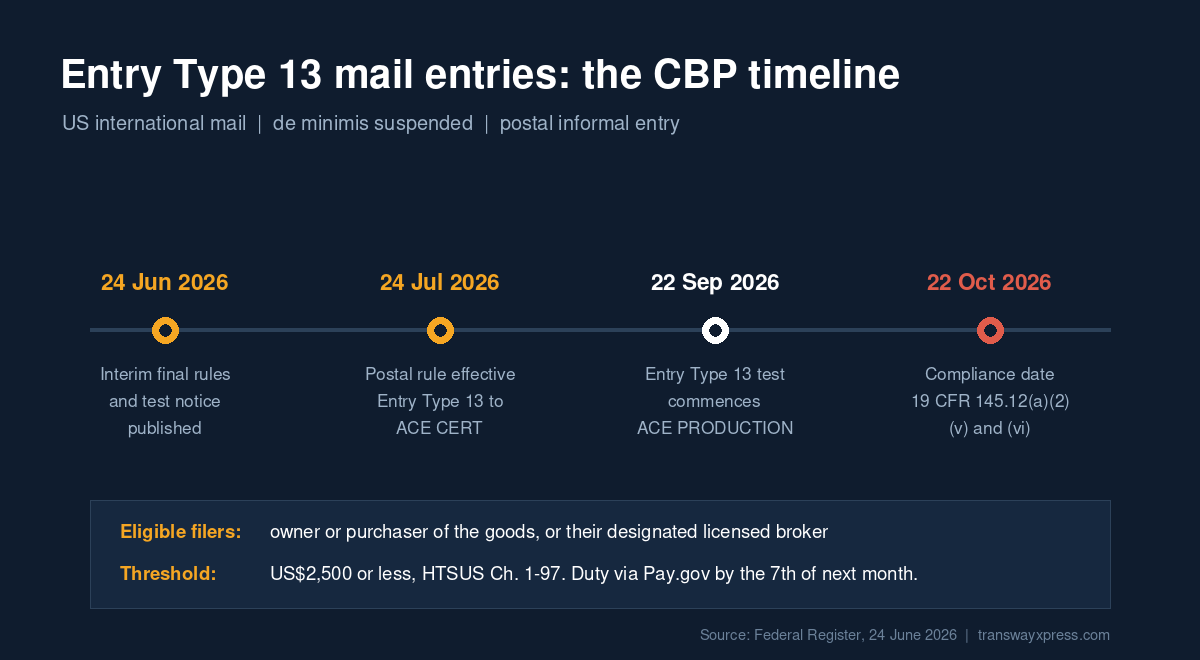
The DATES section of the interim final rule is precise: the rule is effective 24 July 2026, except for one amendatory instruction effective 24 June 2026, and “the compliance date for 19 CFR 145.12(a)(2)(v) and (vi) is on October 22, 2026.”
The two provisions on delay
Those two subsections are the ones that push certain merchandise out of the informal process and into formal entry. Per CBP’s preamble, they cover merchandise subject to Partner Government Agency data requirements, and merchandise subject to duties under Chapters 98 and 99 of the HTSUS or for which duty-free treatment is claimed under Chapter 98 or under a free trade agreement. CBP described the delay as a narrow and short-term compliance window. It closes on 22 October 2026, after which those goods leave the informal mail entry route entirely.
How many days are left
From 22 September 2026, you have 30 days. If you sell anything regulated by a Partner Government Agency, cosmetics, supplements, food, electronics with radio emissions, children’s products, or if any part of your programme relies on a Chapter 98 or free trade agreement duty-free claim, that is the window in which to move those flows off the postal informal process and onto a formal entry footing.
| Date | What happens | Source |
|---|---|---|
| 24 June 2026 | Interim final rules and test notice published; 19 CFR 145.31 amendment effective | Federal Register |
| 24 July 2026 | Postal interim final rule effective; comments due; Entry Type 13 deploys to ACE CERT | Federal Register / CSMS #69289734 |
| 22 September 2026 | Entry Type 13 test commences; deployment to ACE PROD | Federal Register / CSMS #69289734 |
| 22 October 2026 | Compliance date for 19 CFR 145.12(a)(2)(v) and (vi) | Federal Register |
Mail and courier are now two separate rulebooks
Both interim final rules landed on the same day, and brands routinely conflate them. They are not the same. The mode your parcel travels in decides which rule applies, which filing you make, and who is permitted to make it.
Comparing the two regimes
| Dimension | International mail (postal network) | Courier, air and ocean (non-postal) |
|---|---|---|
| Governing interim final rule | Suspension of de minimis for mail shipments, published 24 June 2026 | Suspension of de minimis for all other modes, published 24 June 2026 |
| De minimis status | Indefinitely suspended | Indefinitely suspended |
| Value ceiling for the process | US$2,500 or less | Informal entry procedures apply per CBP |
| Filing mechanism | Postal informal entry, or Entry Type 13 in ACE | Informal entry, commonly Entry Type 11 |
| Who may file | Owner, purchaser, or their designated licensed customs broker | Importer of record or their licensed customs broker |
| Bond | Basic importation and entry bond under 19 CFR 113.62 | Standard entry bond requirements apply |
| Duty payment | Pay.gov, by the 7th day of the month following arrival | Per standard informal entry procedures |
| Classification detail | 10-digit HTSUS | 10-digit HTSUS |
One consequence deserves emphasis: if you quote delivered prices to US customers assuming small parcels arrive duty-free, those quotes are wrong in both columns. Rebuild them from true landed cost, then choose deliberately between DDP and DAP terms rather than inheriting your carrier’s default.
The data CBP expects on every filing
The rule specifies the fields. There is no partial version of this list, and a filing that guesses at classification is a filing that invites a penalty rather than a release.
Field by field
| Field | What it means in practice | Where it comes from |
|---|---|---|
| Filer code | Identifies the party transmitting | Your broker, or you if self-filing |
| Bond number | The importation and entry bond standing behind the duty | Surety, recorded in ACE |
| Merchandise description | Plain-language description of the goods | Your product master |
| Country of origin | Where the goods were produced, not where they shipped from | Supplier declaration and your own records |
| 10-digit HTSUS classification | Full statistical-level classification, not a 6-digit guess | Classification review |
| Quantity or weight | Conditional on the classification | Packing data |
| Duty rate and total duty owed | Rate applied and the arithmetic result | Calculated from classification and value |
| Value | Declared transaction value | Commercial invoice |
| Carrier and conveyance number | Who moved it and on what | Transport documents |
| Tracking number | The parcel identifier | Postal or carrier system |
| Arrival port and date | Where and when it landed | Transport documents |
Country of origin is where most brands are exposed. A parcel shipped out of a Canadian warehouse is not Canadian-origin merchandise simply because it departed Canada, and a CUSMA claim applies only to goods that genuinely originate in North America under the agreement’s rules of origin. Goods manufactured in India and forwarded from an Ontario facility remain Indian-origin and are dutiable as such. Section 338 duties, where they apply, reach USMCA-originating goods too, so an origin claim is not a shield against them. Our field-by-field commercial invoice guide covers the source documents CBP expects you to stand behind.
Your 30-day compliance checklist
Thirty days is enough time if you start this week. It is not enough time if you start in the third week of October.
What to do before 22 October 2026
- Confirm how your US-bound parcels travel. Postal network or commercial courier decides which rulebook applies. Ask your carrier in writing.
- Appoint a licensed US customs broker and execute a power of attorney. Foreign postal operators cannot file for you.
- Put a bond in place. A basic importation and entry bond under 19 CFR 113.62 is required; a continuous bond suits regular volume.
- Register for Pay.gov and set up ACH payment. Duty is due by the 7th day of the month following arrival.
- Classify your catalogue to 10 digits. Six-digit international classifications are not sufficient.
- Flag every Partner Government Agency item. These leave the informal mail entry route on 22 October.
- Flag every Chapter 98 or free trade agreement duty-free claim. Same date, same consequence.
- Reprice. Duty that used to be zero is now a line in your unit economics.
- Decide whether mail is still the right mode. Consolidated freight into a US facility often now beats per-parcel entries.
That last point is worth sitting with. When every mailed parcel carries its own entry, classification and duty calculation, the economics of shipping single orders across the border shift materially. Holding inventory inside the United States removes the per-parcel customs event entirely, a comparison our cross-border fulfillment guide works through in detail.
How Transway Xpress Global solves this
Transway Xpress Global operates warehouses in Oakville and Etobicoke, Ontario, and in Buffalo, New York, with an office in Pendleton, Indiana, backed by our trucking parent Transway Transport, which has run cross-border lanes out of Oakville since 2014. That footprint exists precisely so brands do not have to run a customs event on every individual order.
For most brands selling into the United States, the practical answer to the mail entry rules is to stop crossing the border one parcel at a time. We receive your inventory in bulk, clear it once as a commercial shipment with proper classification and origin documentation, hold it in Buffalo, and ship domestically to your American customers. Duty is calculated against a single entry rather than parcel by parcel, and delivery times drop because the goods are already inside the country when the order lands.
We run D2C and B2B fulfillment, Amazon FBA prep, warehousing, order and inventory management, custom packaging and returns from the same operation, so Canadian and US demand draw on inventory managed in one system. Brands shipping out of India can read our India to Canada customs clearance guide, and Canadian brands eyeing the American market can start with our US fulfillment service for Canadian brands.
Summary
The short version
Electronic mail filing entered ACE production on 22 September 2026. The postal informal entry process it supports has been mandatory since 24 July 2026, and the narrow window CBP left open for Partner Government Agency merchandise, Chapter 98 and 99 duties and free trade agreement duty-free claims closes on 22 October 2026. Only the owner or purchaser of the goods, or a designated licensed customs broker, may file. Every mailed parcel needs a 10-digit classification, a country of origin, a value, a calculated duty and a bond. The next 30 days are the time to fix whatever is missing. Returns flows deserve the same review, which our cross-border returns guide covers.
Frequently asked questions
What is an Entry Type 13 mail entry?
It is the electronic informal entry CBP created for international mail shipments, filed in the Automated Commercial Environment. It carries the data CBP now requires for postal parcels: filer code, bond number, merchandise description, country of origin, 10-digit HTSUS classification, quantity or weight, duty rate, value, total duty owed, carrier, tracking number and arrival details. The test commenced on 22 September 2026 and runs until CBP concludes it by notice in the Federal Register.
Who is allowed to file an Entry Type 13 mail entry?
The owner or purchaser of the merchandise being mailed to the United States, or a licensed customs broker appropriately designated by the owner, purchaser or consignee. Carriers transporting international mail may file manifest data. Foreign postal operators and other third parties contemplated in earlier guidance are not eligible filers under the interim final rule, so brands relying on a foreign post to handle US customs need a licensed broker instead.
What is the value limit for the postal informal entry process?
US$2,500 or less, for merchandise classifiable in Chapters 1 through 97 of the HTSUS. Shipments subject to antidumping or countervailing duties or to quota are excluded and must be entered under formal entry procedures. From 22 October 2026, merchandise subject to Partner Government Agency data requirements, merchandise subject to Chapter 98 or 99 duties, and goods claiming duty-free treatment under Chapter 98 or a free trade agreement also move out of the informal process.
When is duty due and how is it paid?
Under the postal informal entry process, the filing and the duty payment are both due no later than the 7th day of the month following the month in which the package arrived, with payment made through Pay.gov. That monthly rhythm is a cash-flow change worth modelling before volume builds through the fourth quarter, because duty accrues on arrival but leaves your account in a single monthly settlement.
Does CUSMA exempt my parcels from duty?
Only if the goods actually originate in North America under the agreement’s rules of origin. Shipping from a Canadian warehouse does not make goods Canadian-origin. Products manufactured in India, China or anywhere else outside the CUSMA region remain non-originating and are dutiable, regardless of which country they were posted from. Separately, Section 338 duties apply even to USMCA-originating goods, so an origin claim does not protect against them.
Get your US-bound flow reviewed before 22 October
If you are unsure whether your parcels travel by postal network or commercial courier, whether your broker is appointed, or whether your bond is active, that uncertainty is the risk. Book a consultation with Transway Xpress Global. We will map your US-bound flow against the filing that now applies to it and tell you plainly whether consolidating into a US facility beats filing parcel by parcel.