The courier low value shipment stream is how most parcels worth under CAD $3,300 actually enter Canada, and on 14 September 2026 the CBSA quietly loosened one of the rules that governs it. Customs Notice 26-24 removes the requirement that third-party air carriers moving goods under the program hold Partners in Protection certification. It took effect immediately — two days before this post — and the Agency gave a blunt reason: air transportation capacity challenges and limited availability of PIP carriers in the air mode. If you sell into Canada from the United States, India or anywhere else and your parcels fly, your courier just gained a wider pool of aircraft heading into peak season. The notice also left several obligations exactly where they were, and those are the ones that will bite if you assume it did more than it did.
What is the courier low value shipment (CLVS) program?
CLVS is a CBSA release stream, not a duty exemption. It lets authorized couriers report and release qualifying parcels as a consolidated list rather than as individual transactions, so a truckload or aircraft container of e-commerce parcels clears on one cargo/release list instead of hundreds of separate entries. That single design decision is why next-day and two-day delivery into Canada is commercially possible at all.
Participation is not open to shippers. The authorization sits with the courier, and Memorandum D17-4-0 sets eleven eligibility criteria for it, including that the applicant be a bonded carrier in the relevant mode, maintain a physical presence and place of business in Canada, hold Partners in Protection membership as a carrier, register in the CARM Client Portal, post Release Prior to Payment security, hold or have access to a sufferance warehouse licence, and run a qualifying courier proprietary system. Since Customs Notice 19-12, dated 3 June 2019, the CBSA has held a moratorium on new applications to the program while it looks to modernize it for an e-commerce environment. In practice, you do not join CLVS; you choose a courier that is already in it.
The CAD $3,300 ceiling
The program covers goods with a value for duty not exceeding CAD $3,300. Cross that line and the parcel leaves the stream entirely: it needs a standard commercial release, a full accounting entry and, in most cases, a broker. Brands that split a single order across two parcels to stay under the ceiling should be careful here, because value for duty is assessed on the shipment as presented, and deliberate splitting to evade a threshold is an enforcement issue rather than a planning tactic. If you are unsure how your invoice values map to value for duty, our guide to calculating landed cost walks through the build-up.
What cannot move through the stream
Several categories are excluded from a courier low value shipment release regardless of value. D17-4-0 lists goods prohibited, controlled or regulated by an Act of Parliament; prescription drugs and food, plant and animal products subject to Health Canada requirements; diplomatic bags and mail; personal effects classified under tariff item 9805.00.00; and commercial shipments of alcohol. If your catalogue includes supplements, cosmetics with regulated actives, or anything with a plant or animal input, assume the parcel needs a different release path and plan the documentation accordingly. The field-level detail belongs on your paperwork, which our commercial invoice guide covers line by line.
What Customs Notice 26-24 actually changed on 14 September 2026
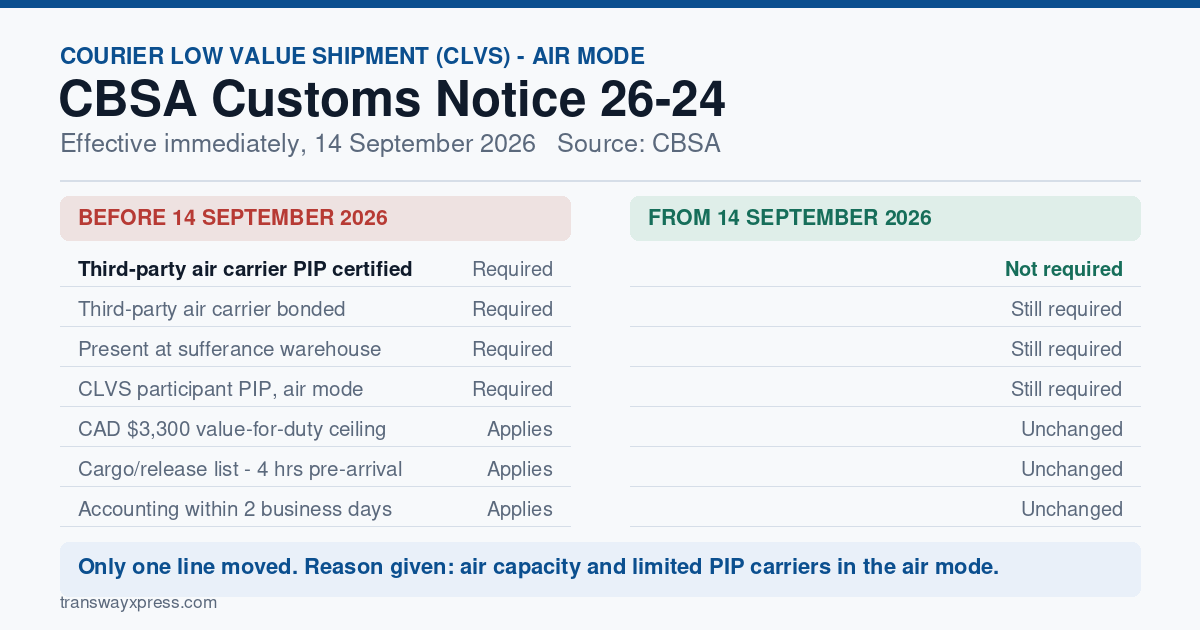
Customs Notice 26-24 is short, and its scope is narrower than the headline suggests. It permits authorized CLVS participants to use third-party air carriers that do not hold PIP certification. That is the whole of the change. Everything else in the program stands.
The requirement before the notice
Before 14 September, a courier authorized under the program could only tender CLVS freight to a third-party air carrier that was itself PIP certified. Partners in Protection is a voluntary trusted-trader program with a security profile, a two-stage review consisting of a preliminary eligibility review and a site validation, and no application fee — but it still takes time, and comparatively few air carriers hold it. The result was a small pool of compliant aircraft, and in a tight air freight market that pool became the constraint.
The three conditions that survived
The exemption is conditional, and the conditions do real work:
- The non-certified third-party air carrier must remain bonded.
- That carrier must continue to present CLVS shipments at the designated sufferance warehouse.
- The authorized CLVS participant — your courier — must maintain an active PIP certification in the air mode.
Read the third one twice. The CBSA did not remove PIP from the air lane; it moved the obligation so that it sits entirely with the program participant rather than with every aircraft operator in the chain. Your courier still has to be a trusted trader. The aircraft no longer does.
| Element | Before 14 September 2026 | From 14 September 2026 |
|---|---|---|
| Third-party air carrier PIP certification | Required | Not required |
| Third-party air carrier bonded status | Required | Still required |
| Presentation at designated sufferance warehouse | Required | Still required |
| CLVS participant PIP certification, air mode | Required | Still required, and must stay active |
| CAD $3,300 value for duty ceiling | Applies | Unchanged |
| Cargo/release list timing, air | 4 hours before arrival | Unchanged |
| Post-release accounting window | 2 business days | Unchanged |
| Excluded goods list | Applies | Unchanged |
Why the CBSA made the change
The notice states the reason directly: the exception exists in the air mode because of air transportation capacity challenges and the limited availability of PIP carriers in that mode. This is a supply-side fix. Demand for air lift into Canada rises through the autumn, PIP-certified air capacity did not grow to match it, and the certification requirement was preventing authorized couriers from buying lift that was otherwise perfectly acceptable from a customs-control standpoint. Rather than let parcels sit, the Agency shifted the trust anchor to the participant and the physical control point to the warehouse.
What bonded and sufferance warehouse actually require
Both surviving conditions are about custody. A bonded carrier has posted security with the CBSA and is legally accountable for goods moving in-bond between the point of arrival and the point of release. A sufferance warehouse is a privately operated, CBSA-licensed facility where imported goods are held until the Agency releases them; presenting at the designated facility means the parcels enter a controlled environment under an accountable licensee. Together they preserve the chain of custody that PIP certification would otherwise have evidenced. The notice does not weaken customs control — it relocates where that control is demonstrated.
What this means for brands shipping into Canada
Air capacity ahead of Q4
The practical effect lands on your courier’s procurement desk, not on your customs file. A wider carrier pool means more routing options and, in a tight market, better odds that your parcels move on the day they were tendered rather than rolling to the next flight. Every courier low value shipment competes for the same lift. You will not see a line item for this. You may see fewer exception scans in November. If you are already mapping your fourth-quarter timeline, this is one constraint that just got slightly looser — but only one, and it does not change any of the marketplace cut-offs you are working to.
The duty and tax thresholds did not move
This is where brands most often misread a CLVS notice. The CAD $3,300 figure is a release ceiling, not a de minimis. The amounts that decide whether duty and tax are actually payable are separate, lower, and set by trade agreement rather than by this notice.
| Origin and mode | Value for duty | Duty | Tax |
|---|---|---|---|
| Courier, United States or Mexico | Up to CAD $40 | None | None |
| Courier, United States or Mexico | Above CAD $40 to CAD $150 | None | Applies |
| Courier, United States or Mexico | Above CAD $150 | Applies | Applies |
| Courier, all other countries | Up to CAD $20 | None | None |
| Courier, all other countries | Above CAD $20 | Applies | Applies |
| Mail, any country | CAD $20 and under | None | None |
| Mail, any country | Above CAD $20 | Applies | Applies |
Source: CBSA, low-value shipment thresholds under CUSMA. Two consequences follow for anyone selling into Canada. First, a brand shipping from India, China or the United Kingdom gets the CAD $20 threshold, not the CAD $40 and CAD $150 tiers — those are a CUSMA benefit tied to goods shipped from the United States or Mexico, and they turn on where the shipment comes from rather than on a preference claim. Second, none of this resembles the United States position, where the $800 de minimis exemption has been suspended; we covered what that means for brands in our analysis of the end of de minimis. Canada and the United States are moving in different directions on low-value parcels, and a single cross-border playbook written for one will misprice the other.
Your importer obligations are untouched
A CLVS release still produces an accounting obligation. The courier reports the shipment; you remain the importer of record. Commercial goods must be accounted for within two business days after the date of the report, and the importer of record remains responsible for classification, valuation, origin and any surtax payable. Canada’s counter-tariff surtaxes on certain United States goods apply through the same declarations — see our walkthrough of the surtax declaration codes if you import from the United States. Non-resident importers should also confirm their CARM position; Customs Notice 26-13, issued 12 June 2026, extends for twelve months an operational measure allowing a broker’s BN15 to be used to account for commercial goods while the broker works with the importer on securing CARM and Release Prior to Payment enrolment, which places the practical deadline in June 2027. Our CARM guide for non-resident importers covers the enrolment steps.
A compliance checklist for your next courier low value shipment
Before the aircraft departs
- Confirm each parcel’s value for duty is at or below CAD $3,300, and route anything above it to a standard commercial entry.
- Screen the SKUs against the excluded categories — regulated products, food, plant and animal inputs, alcohol — before they reach the courier.
- Ask your courier to confirm in writing that it holds active PIP certification in the air mode, since the exemption is conditional on exactly that.
- Make sure the cargo/release list will be transmitted at least four hours before arrival, or at time of departure where the flight is shorter than four hours.
- Check that commercial invoice values, HS codes and country of origin are complete at the line level, not summarized at the parcel level.
After release
- Account for commercial goods within two business days after the date of the report.
- Apply any surtax owing and record the accounting code used.
- Confirm your CARM and Release Prior to Payment position rather than relying indefinitely on a broker’s BN15.
- Retain the release and accounting records against a future CBSA verification.
How Transway Xpress Global fits into this
Most of what changed on 14 September is your courier’s problem to solve. What sits on your side of the line is whether the goods are in the right country, in the right condition, with the right paperwork, before anything is tendered to an aircraft at all. That is the part we handle. Transway Xpress Global operates warehouses in Oakville and Etobicoke, Ontario and in Buffalo, New York, with an office in Pendleton, Indiana, and we are part of Transway Transport, an Oakville trucking company operating since 2014.
For brands shipping from India or elsewhere overseas, the CAD $20 threshold makes parcel-by-parcel air delivery into Canada expensive at scale. Consolidating inbound freight into our Ontario warehouse and fulfilling domestically converts a stream of dutiable low-value parcels into one import event, and it takes the courier low value shipment question off the table for the majority of your orders. Our Canadian e-commerce fulfillment service and our cross-border fulfillment guide set out how that model works in practice, alongside FBA prep, warehousing, order and inventory management, and returns.
The bottom line
Customs Notice 26-24 is a capacity measure, not a liberalization. From 14 September 2026 your courier can put CLVS freight on a third-party aircraft whose operator does not hold PIP, provided the carrier is bonded, the goods are presented at the designated sufferance warehouse, and your courier’s own air-mode PIP certification stays active. The CAD $3,300 ceiling, the excluded goods list, the four-hour cargo/release list window, the two-business-day accounting rule and every duty and tax threshold are exactly where they were on 13 September. How you classify, value and document each courier shipment is unchanged. Treat the notice as one fewer reason for a parcel to miss a flight, and nothing else.
Frequently asked questions
What is the courier low value shipment program?
It is a CBSA release stream that lets authorized couriers report and release qualifying parcels valued at or below CAD $3,300 on a consolidated cargo/release list instead of as individual entries. It speeds up release; it does not exempt anything from duty or tax. Authorization belongs to the courier, not to the shipper, and the CBSA has kept a moratorium on new applications to the program since 3 June 2019 while it works on modernizing it for e-commerce.
Does Customs Notice 26-24 mean PIP no longer applies to air shipments?
No. It means a third-party air carrier no longer needs its own PIP certification to move CLVS freight. The authorized CLVS participant must still maintain an active PIP certification in the air mode, and the non-certified carrier must still be bonded and still present shipments at the designated sufferance warehouse. The obligation moved; it did not disappear.
What is the value limit for a courier low value shipment?
CAD $3,300 value for duty. Goods above that ceiling fall outside the stream and require a standard commercial release and full accounting entry. Note that this is a release threshold and not a de minimis: duty and tax can be payable well below CAD $3,300, starting above CAD $40 for courier shipments from the United States or Mexico and above CAD $20 for courier shipments from everywhere else.
Do parcels from India get the CAD $150 duty-free threshold?
No. The CAD $40 and CAD $150 courier thresholds are a CUSMA measure that applies to shipments imported by courier from the United States or Mexico. Goods shipped from India fall under the general CAD $20 threshold, above which duties and taxes apply. This is one of the main reasons overseas brands consolidate inbound freight into a Canadian warehouse and fulfill domestically rather than shipping direct to consumer by air.
When did the air carrier exemption take effect, and is there a deadline?
It took effect immediately on 14 September 2026, the date of the notice, and no end date is stated. There is no filing deadline attached to it and no action is required from importers to benefit. The one thing worth doing is confirming with your courier that its air-mode PIP certification is current, because the exemption for its third-party carriers is conditional on that certification staying active.
If air capacity, surtax exposure and the CAD $20 threshold are all landing on the same Q4 plan, it is worth modelling whether direct-to-consumer air parcels or a consolidated Canadian inventory position costs you less per order. Book a consultation with Transway Xpress Global and bring your last quarter’s parcel volumes and origins — that comparison takes about twenty minutes once the numbers are on the table.