CPSC eFiling requirements became mandatory on July 8, 2026, and they now sit directly in the critical path of every US customs entry for regulated consumer products. If you import toys, children’s apparel, mattresses, bicycle helmets, furniture or dozens of other categories into the United States, your certificate of compliance data has to travel electronically with the entry rather than sit in a folder waiting for a request that may never come. Importers who treated certificates as a back-office document are learning that a missing data element now looks identical to a missing product: the freight does not move. This guide covers what the CPSC eFiling requirements actually demand, which goods are caught, the certificate data elements you must transmit, how the collapse of de minimis compounds the problem, and the readiness steps that keep your shipments clearing.
What are the CPSC eFiling requirements and when did they take effect?
The US Consumer Product Safety Commission has required certificates of compliance for regulated consumer products for well over a decade. What changed in 2026 is the delivery mechanism. Under the final rule amending 16 CFR Part 1110, certificate data must now be transmitted electronically to US Customs and Border Protection through the Automated Commercial Environment (ACE) at the moment of entry. The CPSC eFiling requirements convert a document you used to hold into a data set you must file.
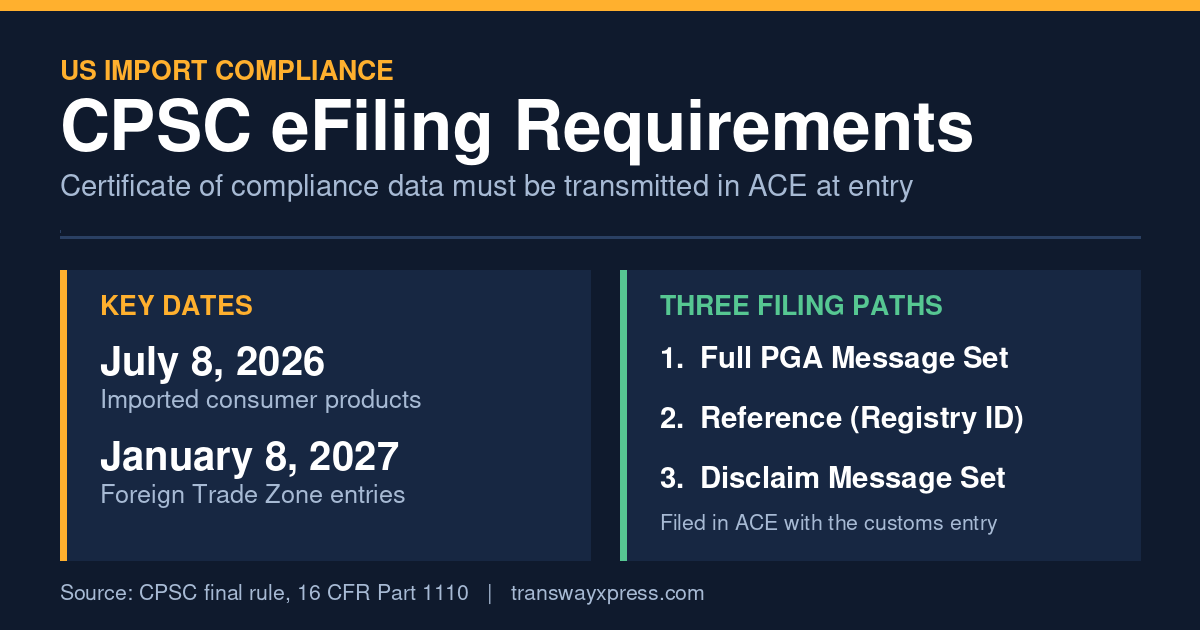
The July 8, 2026 mandate and the FTZ extension
CPSC published the final rule in the Federal Register on January 8, 2025, with an 18-month implementation runway. eFiling became mandatory for imported consumer products on July 8, 2026. Products entering from a foreign trade zone for consumption or warehousing received an additional six months and fall under the mandate on January 8, 2027. The agency describes the programme as the product of more than a decade of development, including voluntary pilots that ran from 2016 through 2024, so the timelines are firm rather than provisional.
What the CPSC eFiling requirements do not change
Be precise here, because the confusion is expensive. eFiling introduces no new testing obligation, no new certification obligation and no new safety standard. CPSC states plainly that the programme does not create new testing, certification, or compliance obligations. If your product already needed a Children’s Product Certificate or a General Certificate of Conformity, it still needs exactly the same one, backed by exactly the same testing. What is new is that the underlying data must be machine-readable and present at entry. CPSC also confirmed that eFiling itself does not apply to domestic manufacturers, including small businesses manufacturing inside the United States, although the updated certificate content rules do reach domestically manufactured goods.
Which products and importers do the CPSC eFiling requirements apply to?
The mandate covers finished consumer products that are subject to a CPSC mandatory standard, rule, ban or regulation. That is a broader universe than most brands assume, and it is not organised the way a merchandising team thinks about categories.
Roughly 600 flagged tariff lines
CPSC has flagged approximately 600 Harmonized Tariff Schedule numbers for potential eFiling. UPS, which publishes guidance for its brokerage customers, cautions that this list is not exhaustive of every CPSC-regulated product, so tariff classification alone is a starting filter rather than a final answer. Work from the applicable rule, not only from the HTS line. If you are still building your classification discipline, our field-by-field commercial invoice guide is a useful companion, because the same identifiers have to agree across both documents.
| Product family | Typical examples | Why it is captured |
|---|---|---|
| Children’s products | Toys, cribs, strollers, high chairs, children’s furniture | Require a Children’s Product Certificate based on third-party testing |
| Apparel and textiles | Children’s sleepwear, certain clothing, mattresses and mattress pads | Flammability standards under the Flammable Fabrics Act |
| Sporting and outdoor goods | Bicycle helmets, ATVs, certain recreational equipment | Product-specific mandatory standards |
| Household and hardware | Lighters, drywall, fireworks, portable generators | Bans, labelling rules or performance standards |
| Electronics and small appliances | Products with lithium cells, certain corded goods | Applicable CPSC rules and voluntary standards made mandatory |
Who is the certifier on the entry
For imported finished products, the importer of record carries primary responsibility for the certificate and for the filing. The rule identifies importers, domestic manufacturers and private labelers as finished product certifiers. A customs broker can transmit the data on your behalf, but the broker is filing your attestation. Brokers can only submit what you give them, which is why the CPSC eFiling requirements land hardest on brands with fragmented supplier documentation. Choosing a partner that can hold that documentation properly is part of the exercise; our guide to choosing a US fulfillment warehouse walks through the questions worth asking.
What certificate data must you transmit at entry?
Section 1110.11(a) of the rule sets out what a finished product certificate must contain. Brokers and carriers commonly describe this as a seven-element message set; the rule itself enumerates the elements below plus the compliance attestation.
The certificate data elements
| # | Data element | What you actually need |
|---|---|---|
| 1 | Product identification | A unique identifier such as GTIN, UPC, SKU or model number, plus a description sufficient to match the product to the certificate |
| 2 | Applicable rules | Every CPSC rule, ban, standard or regulation the product is certified against |
| 3 | Certifying entity | Name, street address, city, state or province, country, email and telephone |
| 4 | Records contact | Name and contact details of the individual who maintains the test records |
| 5 | Date and place of manufacture | Month and year at minimum, plus the manufacturing location |
| 6 | Date and place of testing | When and where the product was last tested for compliance |
| 7 | Third-party assessor | The CPSC-accepted laboratory, where third-party testing is required (children’s products) |
| 8 | Attestation | The statement that the product complies with the cited rules |
Three ways to satisfy the filing
CPSC deliberately built more than one path so that high-volume importers are not retyping the same certificate on every entry. Choosing the right one is a genuine operational decision, not a formality.
| Filing path | How it works | Best suited to |
|---|---|---|
| Full PGA Message Set | All certificate data elements are transmitted through ACE with each entry | Low SKU count, infrequent shipments, or one-off imports |
| Reference PGA Message Set | Certificate data is loaded into the CPSC Product Registry in advance; only a unique reference ID moves with the entry | Repeat importers and large catalogues; supports UI, CSV batch and API upload |
| Disclaim Message Set | Declares that no certificate is required, for example outside CPSC jurisdiction or a component part not sold separately | Mixed shipments containing non-regulated goods |
For any brand shipping the same catalogue repeatedly, the Product Registry route is almost always the right answer. Loading certificates once and referencing them keeps entry data small, reduces keying errors and gives you a single place to update a certificate when a test is refreshed.
How the end of de minimis changed low-value shipments
The CPSC eFiling requirements arrived in the same year that the low-value shipping lane most direct-to-consumer brands relied on disappeared. The two changes compound each other.
Entry Type 86 is gone
On June 24, 2026, CBP indefinitely suspended the duty-free de minimis exemption for merchandise valued at 800 USD or less arriving through all modes other than the international postal network. The agency simultaneously suspended the Entry Type 86 test, pushing those goods into informal Type 11 or formal entry procedures that demand substantially more data. CBP justified the move with its own volume figures: 1.36 billion de minimis shipments in fiscal year 2024 against 139 million in 2015. Bona fide gifts and travellers’ personal articles keep their separate exemptions.
What this means for parcel programmes
Direct-to-consumer parcels of regulated consumer products no longer slip through on a manifest release. They need a proper entry, and if they are CPSC-regulated they need certificate data with it. For most brands this makes the economics of bulk import plus domestic pick-and-pack decisively better than parcel-by-parcel cross-border shipping. We covered the wider commercial impact in our analysis of the end of de minimis, and the arithmetic behind the switch in how to calculate landed cost.
What happens when a CPSC eFiling is missing or wrong
The practical failure modes
A defective or absent filing does not usually produce an immediate penalty letter. It produces friction. UPS warns that failing to submit CPSC certificate data accurately and on time may result in entry delays, cargo holds, requests for additional information, refusal of admission, or enforcement action. In a peak-season context, a three-day hold on a container of seasonal goods is a more expensive outcome than most fines.
The compliance exposure behind the filing
Behind the mechanics sits the Consumer Product Safety Act itself. Importing a product that requires a certificate without holding one, or providing a false certificate, is a prohibited act that can expose a company to civil and criminal penalties, forfeiture and recall obligations. The CPSC eFiling requirements simply make the gap visible at the border rather than years later during an investigation. That visibility is precisely the point: CPSC has said the goal is to identify and target high-risk imported products more efficiently.
Your CPSC eFiling readiness checklist
Ten steps to close the gap
- Pull your full SKU list and map each item to its HTS classification.
- Screen those classifications against CPSC’s flagged tariff lines, then verify by applicable rule rather than by HTS alone.
- For every in-scope SKU, confirm a current certificate exists and identify the certifying entity.
- Collect the third-party test reports and confirm the laboratory is CPSC-accepted for children’s products.
- Standardise your product identifiers so the same GTIN or model number appears on the certificate, the commercial invoice and the entry.
- Name a single records contact and make sure that person is reachable at the address you file.
- Decide between full message set and Product Registry references, and load the registry before your next entry if you choose the reference route.
- Brief your customs broker in writing on which SKUs are in scope and which require a disclaim.
- Build a refresh trigger so certificates are updated when testing dates, suppliers or manufacturing sites change.
- Diarise January 8, 2027 if any of your volume moves through a foreign trade zone.
Brands importing from Asia or from India into North America should run this exercise alongside their duty and documentation review. Our guides to shipping from India to the USA and Canada and cross-border ecommerce fulfillment cover the surrounding paperwork.
How Transway Xpress Global solves this
A US entry point that keeps documentation intact
Most certificate failures are not compliance failures. They are handoff failures: the supplier holds the test report, the brand holds the invoice, the broker holds neither, and nobody owns the identifier that ties them together. Transway Xpress Global operates warehouses in Oakville and Etobicoke, Ontario and in Buffalo, New York, with an office in Pendleton, Indiana, and grew out of Transway Transport, an Oakville trucking business operating since 2014. That footprint lets a brand land bulk inventory once, on a properly documented entry, then distribute domestically inside the United States and Canada without re-running border risk on every order.
Where we fit in your compliance chain
Our services span direct-to-consumer and B2B fulfillment, Amazon FBA prep, warehousing, order and inventory management, cross-border shipping, returns and custom packaging. We are not your customs broker and we do not issue your certificates, but we do give your broker a clean, consistent SKU-level data set to file against, and we hold inventory on the correct side of the border so a hold on one entry does not stop your entire sales channel. If Amazon is a major channel for you, pair this with our guide to Amazon FBA prep centres in Ontario, and if you also import into Canada, review CARM requirements for non-resident importers.
Key takeaways
What to remember
- eFiling has been mandatory for imported consumer products since July 8, 2026; FTZ entries follow on January 8, 2027.
- Nothing about testing or certification changed. Only the transmission of certificate data changed.
- Approximately 600 HTS lines are flagged, but the flag list is not exhaustive of regulated products.
- You can file the full message set, reference a Product Registry entry, or disclaim where no certificate is required.
- De minimis is indefinitely suspended for non-postal modes, so low-value parcels now need real entries too.
Frequently asked questions
What are the CPSC eFiling requirements in simple terms?
The CPSC eFiling requirements mean that when a regulated consumer product enters the United States, the certificate of compliance data must be transmitted electronically to CBP through ACE as part of the customs entry. Previously, importers held certificates and produced them on request. Since July 8, 2026, the data must accompany the entry itself. The obligation covers finished consumer products subject to a CPSC standard, rule, ban or regulation, and it is the importer of record who carries responsibility for the filing being accurate and complete.
Do the CPSC eFiling requirements apply to low-value or de minimis shipments?
There is no carve-out for small parcels. The point is largely academic now in any case: on June 24, 2026, CBP indefinitely suspended the de minimis exemption for goods valued at 800 USD or less arriving by any mode other than the international postal network, and suspended the Entry Type 86 test alongside it. Those goods now move under informal or formal entry procedures, which require more data, not less. If the product is CPSC-regulated, the certificate data travels with that entry.
Does eFiling apply to domestic manufacturers?
No. CPSC has been explicit that eFiling does not apply to domestic manufacturers, including small businesses manufacturing in the United States, because there is no customs entry to file against. Domestic manufacturers still need valid certificates and are still subject to the updated certificate content requirements that took effect on the same date. The distinction is between holding a compliant certificate, which everyone must do, and transmitting certificate data at entry, which applies to importers.
What is the difference between the full and reference message sets?
With a full PGA message set, every certificate data element is transmitted through ACE on each individual entry. With a reference message set, you load the certificate into the CPSC Product Registry once, then transmit only a unique reference identifier with subsequent entries covered by that certificate. The registry accepts submissions through a user interface, a CSV batch template or an API. Importers shipping a stable catalogue repeatedly generally find the reference route faster, less error-prone and easier to keep current.
How long does it take to get eFiling-ready?
For a brand with clean supplier documentation and a modest catalogue, two to four weeks is realistic: classify the SKUs, gather certificates, standardise identifiers and brief your broker. For brands sourcing from multiple factories without centralised test records, plan for two to three months, because chasing laboratory reports and manufacturing dates from suppliers is the slow part. Start with your highest-volume regulated SKUs so the goods that matter most clear cleanly first.
Cross-border compliance is easier when your inventory, documentation and fulfillment sit with one partner who understands both sides of the border. Book a free consultation with Transway Xpress Global and we will map your US and Canadian fulfillment footprint around the compliance reality you are actually facing.
Sources: CPSC news release on mandatory eFiling; CPSC final rule, 16 CFR Part 1110; CBP interim final rule suspending de minimis.