Canada is the largest export market for U.S. Shopify merchants, and the one that generates the most abandoned carts. The reason is rarely the product or the price — it is the parcel that arrives with a courier invoice attached. Shopify cross-border shipping to Canada fails at the point where a shopper who paid $89 at checkout is asked for another $31 at the door. Getting it right in 2026 means understanding three separate systems that most merchants treat as one: the CUSMA courier thresholds that decide whether duty applies, the GST/HST rules that decide who collects sales tax, and the labelling law that decides whether your product can legally sit on a Canadian shelf. This guide covers each one, with the current thresholds, the Shopify settings that matter, and the point at which shipping parcels across the border stops making financial sense.
What does Shopify cross-border shipping to Canada actually involve?
Every Canadian order placed on a U.S.-based Shopify store crosses an international border, which makes it an import. That single fact triggers customs valuation, duty assessment, sales tax collection and product compliance obligations that do not exist on a domestic order. Shopify cross-border shipping to Canada is therefore less a shipping problem than a data problem: the accuracy of your product records determines what the border does with your parcel.
The three cost layers a Canadian buyer sees
Shopify cross-border shipping to Canada charges a buyer in three separate places. First, the product price and international shipping rate at checkout. Second, customs duty assessed by the Canada Border Services Agency (CBSA) from the item’s Harmonized System (HS) code and country of origin. Third, GST or HST on the duty-paid value. On top sits the courier’s brokerage fee for advancing those charges — frequently $10 to $20 on a small parcel, and often larger than the duty itself.
Why the checkout experience decides the conversion rate
When those charges appear after purchase, the order becomes a refund request. When they appear inside the checkout total, it converts at close to domestic rates. That is the practical difference between DDP (Delivered Duty Paid) and DAP (Delivered at Place), and it is the highest-leverage decision in Shopify cross-border shipping to Canada. Our breakdown of DDP vs DAP shipping terms covers the trade-offs in detail.
What are Canada’s duty and tax thresholds for parcels in 2026?
Canada does not have one de minimis threshold. It has three, and which one applies to Shopify cross-border shipping to Canada depends on where the goods shipped from and who carried them.
The CUSMA courier thresholds: CAD $40 and CAD $150
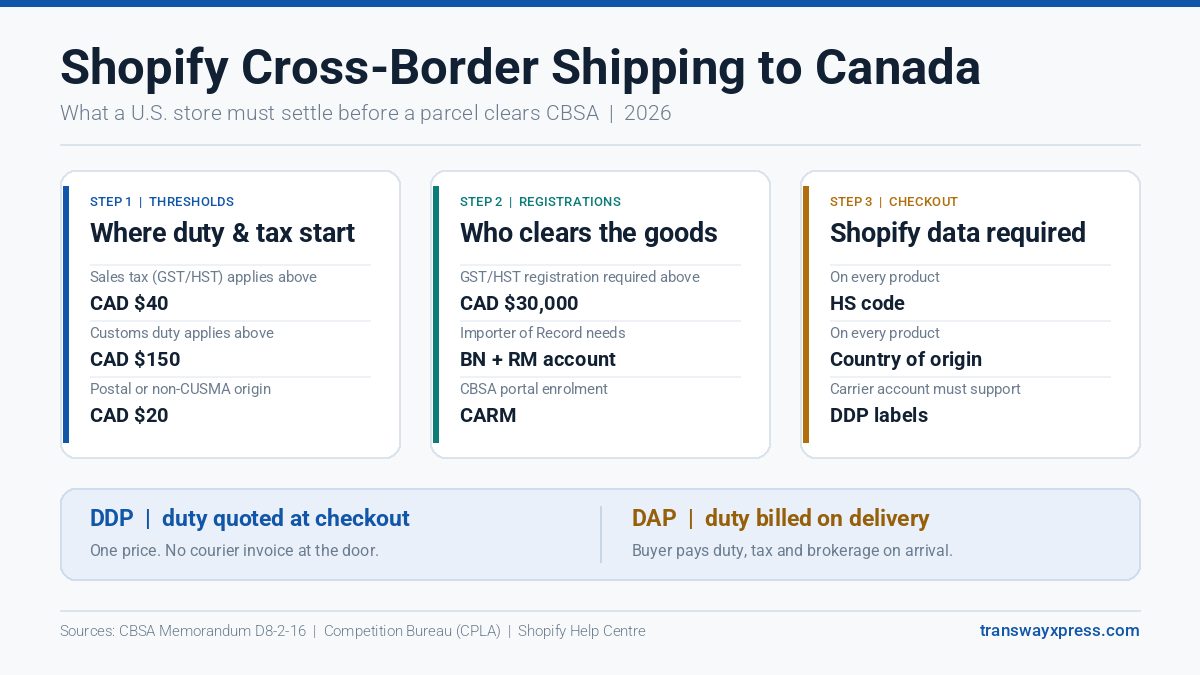
Under the Canada-United States-Mexico Agreement, goods shipped by commercial courier from the United States or Mexico are relieved of sales and excise taxes at a value for duty of CAD $40 or less, and relieved of customs duties at CAD $150 or less. Above $40, taxes apply on the full value; above $150, duty applies as well. Critically, CBSA’s Memorandum D8-2-16 confirms the goods need not originate in North America — they only need to have entered the commerce of the U.S. or Mexico before shipping to Canada. A Vietnamese-made jacket sitting in your Ohio warehouse qualifies for the courier thresholds; it does not qualify for CUSMA duty-free tariff treatment, which is a separate test based on CUSMA rules of origin.
Shipments arriving by post rather than courier, and shipments from countries other than the U.S. and Mexico, fall back to the long-standing CAD $20 remission threshold.
| Shipment scenario | Duty-free up to | Tax-free up to | Applies when |
|---|---|---|---|
| Courier from U.S. or Mexico (CUSMA) | CAD $150 | CAD $40 | Commercial courier on a scheduled international route |
| Postal shipment from U.S. or Mexico | CAD $20 | CAD $20 | Carried by postal service, not courier |
| Any shipment from other countries | CAD $20 | CAD $20 | Origin outside the U.S. and Mexico |
| Low Value Shipment (LVS) stream | — | — | Value for duty at or below CAD $3,300; simplified release and accounting |
| CUSMA certification of origin | — | — | Waived by CBSA at or below CAD $3,300 value for duty |
What CBSA collects at the border — GST, HST and PST
GST is 5% nationally. In the participating provinces the federal and provincial components are combined into HST, and for casual (non-commercial) goods CBSA collects that full harmonized rate based on the importer’s province of residence. Nova Scotia reduced its HST from 15% to 14% effective 1 April 2025, so any landed-cost model built before that date is now wrong for Atlantic Canada.
| Province or territory | Rate collected on imports | Structure |
|---|---|---|
| Ontario | 13% | HST |
| New Brunswick, Newfoundland and Labrador, Prince Edward Island | 15% | HST |
| Nova Scotia | 14% | HST (reduced 1 April 2025) |
| British Columbia, Manitoba, Saskatchewan, Quebec | 5% GST at the border | GST; provincial tax handled separately |
| Alberta, Yukon, Northwest Territories, Nunavut | 5% | GST only, no provincial sales tax |
To model this properly before you quote a price, work through our guide on how to calculate landed cost rather than guessing at a flat percentage.
Do you need to register for GST/HST and become a Non-Resident Importer?
These are two different registrations, issued by two different agencies, and merchants routinely confuse them. Both can apply to Shopify cross-border shipping to Canada, and neither substitutes for the other.
The CAD $30,000 small-supplier threshold
A non-resident business making taxable supplies in Canada generally must register for GST/HST once its taxable supplies in Canada exceed CAD $30,000 over four consecutive calendar quarters. Below that you are a small supplier and registration is voluntary. Registering voluntarily is often the better commercial call: it lets you charge tax transparently at checkout and recover input tax credits on the GST you pay at the border, instead of absorbing it as a cost.
Becoming the Importer of Record with a business number and CARM
If you ship DDP, you are acting as the Importer of Record on a commercial import. That requires a Canada Revenue Agency business number with an RM import-export program account, registration in the CBSA Assessment and Revenue Management (CARM) Client Portal, and your own financial security. This is the Non-Resident Importer model, and it is what lets a U.S. brand clear its own goods, pay its own duty and present a fully landed price to the buyer. Our walkthrough of CARM requirements for non-resident importers covers portal setup and security options step by step.
DDP or DAP on Shopify — which should you choose?
Shopify supports both. The configuration effort differs substantially, and this is where most of the operational work in Shopify cross-border shipping to Canada actually sits.
How Shopify calculates duties at checkout
Shopify’s duties and import taxes feature estimates duty and import tax inside the checkout, but it depends entirely on product data you supply. Per Shopify’s documentation, every product needs an HS code and a country or region of origin, and your carrier account must support DDP labels. Shopify charges a per-transaction fee for the calculation — 0.85% with Shopify Payments and 1.5% without, per its published international pricing — and it is included at no extra cost inside Shopify Managed Markets. Missing HS codes are the most common failure point: without them, Shopify cannot estimate duty, the parcel ships DAP by default, and your customer meets the courier invoice you were trying to avoid.
When Shopify Managed Markets makes sense
Managed Markets bundles duty calculation, tax remittance and merchant-of-record functions into a single transaction fee, which suits brands testing Canada without wanting to register anything. The trade-off is margin and control — you are renting compliance rather than owning it. Once Canadian revenue becomes material, most brands move to their own GST/HST registration and Non-Resident Importer number.
| Dimension | DDP (duties paid at checkout) | DAP (duties billed on delivery) |
|---|---|---|
| Customer experience | One price, no surprises | Courier invoice at the door |
| Setup burden | HS codes, origin data, DDP-capable carrier | Minimal |
| Registrations needed | BN with RM account, CARM, usually GST/HST | None for the seller |
| Typical refusal rate | Low | Elevated — refused parcels return at your cost |
| Returns handling | Cleaner — duty relief claimable | Messy — buyer already paid charges |
| Brokerage fees | Consolidated, negotiable | Per-parcel, charged to the buyer |
| Best suited to | Repeat Canadian volume | Occasional or test orders |
What compliance rules apply to products sold into Canada?
Duty and tax are the visible costs of Shopify cross-border shipping to Canada. Product compliance is the one that stops a shipment outright.
Bilingual labelling under the Consumer Packaging and Labelling Act
Prepackaged consumer products sold in Canada must carry three mandatory statements under the Consumer Packaging and Labelling Act: the product identity, the net quantity declaration, and the dealer’s name and principal place of business. Per the Competition Bureau’s guide, the identity and net quantity declarations must appear in both English and French; the dealer declaration may appear in either language. For imported goods you may state the foreign dealer’s name and address, or use "Imported by / Importé par" ahead of a Canadian dealer’s details. Relabelling at a Canadian fulfillment centre is usually cheaper than reprinting an entire packaging run, which is why bilingual relabelling and custom packaging sit inside our eCommerce fulfillment services.
Quebec’s French-language requirements
Quebec applies additional French-language obligations to packaging, product inscriptions and commercial documentation that go beyond the federal bilingual rules. Brands selling nationally on a single SKU should design to the Quebec standard rather than maintain a separate provincial pack.
Ship from the U.S. or stock in Canada? Comparing the two models
At some point, parcel-by-parcel border crossings stop being the cheapest route to a Canadian customer, and Shopify cross-border shipping to Canada gives way to domestic Canadian fulfillment.
Cross-border parcel from a U.S. warehouse
Every order clears customs individually. You pay international parcel rates, per-shipment brokerage, and duty on each unit at retail value. Delivery typically runs five to ten business days. It is the right model while Canadian volume is low and unpredictable, because it carries no inventory risk.
Domestic fulfillment from an Ontario fulfillment centre
You import once, in bulk, clearing a single commercial entry at wholesale value rather than retail. Duty is assessed on a lower base, brokerage is spread across the whole shipment, and every subsequent order ships as a domestic Canadian parcel. Returns come back to a Canadian address instead of re-crossing the border. Our overview of eCommerce fulfillment in Canada covers how that model works in practice.
| Factor | Cross-border parcel | Canadian inventory |
|---|---|---|
| Customs entries | One per order | One per bulk shipment |
| Duty valuation base | Retail price | Wholesale or transfer price |
| Brokerage cost | Per parcel | Spread across the shipment |
| Delivery speed | 5–10 business days | 1–3 business days |
| Returns | Re-cross the border | Domestic Canadian address |
| Inventory risk | None | Capital tied up in stock |
| Break-even signal | — | Roughly 150–300 Canadian orders per month, sustained |
Your Shopify cross-border shipping to Canada launch checklist
Before you switch Canada on
- Assign an HS code and a country of origin to every product and variant in Shopify.
- Create a Canadian market in Shopify Markets with CAD pricing and local payment methods.
- Decide DDP or DAP, and confirm your carrier account supports DDP labels if you choose DDP.
- Register for GST/HST if you are over — or expect to exceed — the CAD $30,000 threshold.
- Obtain a business number with an RM import-export account and register in the CARM Client Portal if acting as Importer of Record.
- Audit packaging against the bilingual identity and net quantity requirements.
- Publish a Canada-specific shipping and returns policy with a Canadian return address.
- Model landed cost per SKU before you set CAD retail prices.
- Track Canadian checkout abandonment, refused deliveries and brokerage cost per parcel after launch.
How Transway Xpress Global solves this
Warehouses on both sides of the border
Transway Xpress Global operates fulfillment centres in Oakville and Etobicoke, Ontario, and in Buffalo, New York, with an office in Pendleton, Indiana. That footprint means a Shopify brand does not have to choose between the two models above — you can hold Canadian inventory in Ontario for domestic delivery speed while keeping U.S. stock in Buffalo for replenishment. The company is backed by Transway Transport, a trucking operation running out of Oakville since 2014, so the linehaul between the two sides is handled in-house.
The services that matter most for Shopify cross-border shipping to Canada are D2C and B2B fulfillment, order and inventory management, cross-border shipping, returns processing, custom packaging and relabelling for bilingual compliance, and Amazon FBA prep if you run a marketplace channel alongside your store. Our guide on how to choose a fulfillment warehouse is a useful starting frame, our pricing packages set out what the service costs, and our guide to cross-border returns that actually work covers the reverse flow most brands underestimate.
Summary
Key takeaways for Shopify cross-border shipping to Canada
The courier thresholds — CAD $40 for taxes and CAD $150 for duty from the U.S. and Mexico — mean most apparel and consumer-goods orders attract both. Shopify can quote those charges at checkout, but only if every product carries an HS code and country of origin. Charging DDP requires Non-Resident Importer status: a business number, an RM account and CARM registration. Bilingual labelling is a separate obligation no shipping setting resolves. And once Canadian volume becomes steady, holding inventory inside Canada removes the per-parcel customs entry entirely. For the wider picture, start with our cross-border eCommerce fulfillment guide, and read our field-by-field commercial invoice guide if paperwork errors are holding your parcels at the border.
Frequently Asked Questions
Do I have to charge duty on Shopify orders going to Canada?
You are not obliged to collect duty at checkout, but somebody pays it. Under DAP the courier collects duty, GST or HST and a brokerage fee from your customer on delivery. Under DDP you collect an estimate at checkout and settle with CBSA as the Importer of Record. Because Shopify cross-border shipping to Canada is tax-relieved under CAD $40 and duty-relieved under CAD $150 by courier from the U.S., low-value parcels often clear with nothing owing either way.
What is the minimum value before Canada charges duty on a parcel?
For goods shipped by commercial courier from the United States or Mexico, customs duty applies above a value for duty of CAD $150, and sales taxes apply above CAD $40. Postal shipments and goods from other countries revert to the CAD $20 threshold. These are the courier import remission thresholds in CBSA Memorandum D8-2-16, assessed on the value for duty rather than on the total the customer paid including shipping.
Do U.S. Shopify sellers need a GST/HST number?
Registration is generally required once your taxable supplies in Canada exceed CAD $30,000 over four consecutive calendar quarters. Below that you qualify as a small supplier and may register voluntarily. Most brands shipping DDP register anyway, because a GST/HST number lets you recover the GST paid at the border as an input tax credit rather than treating it as a sunk cost on every shipment.
What is a Non-Resident Importer and do I need to be one?
A Non-Resident Importer is a foreign business acting as Importer of Record on Canadian imports, holding a CRA business number with an RM import-export program account, registered in the CARM Client Portal and posting its own financial security. You need it to ship DDP and control the customer’s landed price. You do not need it if you ship DAP and let the buyer act as the importer, though that comes at a conversion cost.
Is it cheaper to stock inventory in Canada than to ship every order across the border?
Beyond roughly 150 to 300 Canadian orders per month, usually yes. Bulk importing clears one customs entry at wholesale value instead of one per order at retail value, spreads brokerage across the whole shipment, and turns every outbound order into a domestic parcel with faster transit and a domestic return address. Below that volume, cross-border parcel shipping avoids tying up capital in stock you may not sell.
Selling into Canada from Shopify and unsure whether to ship across the border or hold inventory locally? Book a consultation with Transway Xpress Global and we will map your SKUs, order volume and destination mix against both models so you can see the landed cost of each before you commit.