Anyone importing drones, drone parts or docking stations into the United States paid a different rate this week than they did last week. Section 232 drone tariffs took effect at 12:01 a.m. eastern time on 3 September 2026, adding 100% or 25% ad valorem duty to unmanned aircraft systems and a defined list of components. The Section 232 drone tariffs were set out in a presidential proclamation signed on 13 August 2026, and U.S. Customs and Border Protection issued entry guidance the day before they went live. If you sell drones, gimbals, thermal payloads or FPV kits into the U.S. market, or you warehouse them for a brand that does, your landed cost changed overnight and your existing purchase orders are already exposed.
What changed on 3 September 2026?
The proclamation adjusts imports of unmanned aircraft systems (UAS) and UAS components under Section 232 of the Trade Expansion Act of 1962 — the national security statute already used for steel, aluminum and copper. It does not replace any duty you pay today. It adds one.
The two rate tiers
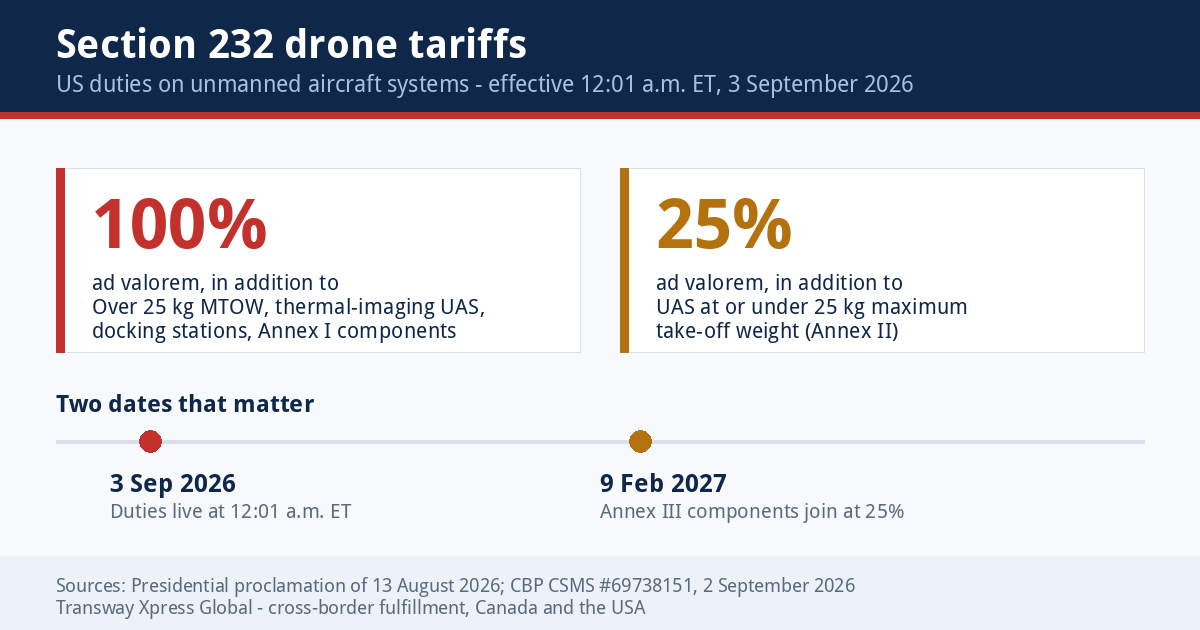
The proclamation splits covered goods into a heavy tier and a light tier. The heavy tier carries 100% ad valorem duty and covers UAS with a maximum take-off weight above 25 kg, UAS fitted with thermal imagers, UAS docking stations, and the critical components listed in Annex I of the proclamation. The light tier carries 25% ad valorem duty and covers UAS at or under 25 kg maximum take-off weight, listed in Annex II.
That 25 kg line and the thermal-imager test do most of the work. A consumer camera drone under 25 kg without a thermal payload sits in the 25% tier. Add a thermal imager to the same airframe and the classification moves to the 100% tier. If you are building kit variants for different price points, that single specification decision now carries a 75-point duty spread.
Where the Section 232 drone tariffs sit in the tariff schedule
CBP published entry guidance in CSMS #69738151 on 2 September 2026. It assigns the new duties to Chapter 99 subheadings in the 9903.08.20 to 9903.08.26 range, with separate subheadings for the reduced allied-country rates and for goods covered by an approved onshoring plan. Pull the message and match your specific product to a subheading before your broker files the next entry — do not let a classification default carry over from an August entry summary.
Which countries get a lower rate, and which do not
The proclamation sets rate ceilings for a named group of allied jurisdictions, but the relief is conditional on where the critical components come from, not simply on where the drone was assembled.
The allied-country ceilings
Products of Japan, South Korea, Taiwan, Switzerland, Liechtenstein or a European Union member state qualify for a rate no higher than 15% ad valorem, provided substantially all critical components originate in those countries or in the United States. United Kingdom products qualify for a rate no higher than 10% on the same condition. The proclamation also provides a 180-day delay from the date of signature for products of companies on the Blue UAS Cleared List and the FCC Conditional Approval List — read the operative paragraph before assuming your supplier qualifies.
Canada, Mexico and India are not on the list
This is the part that matters most to the brands we work with. The reduced-rate list does not include Canada, Mexico or India. Nothing in the proclamation carves out USMCA-originating goods from these duties, and CUSMA preference does not exempt a drone from a Section 232 action — CUSMA governs origin and preferential tariff treatment for North-American-origin goods, not national security duties layered on top. Goods of Indian origin have no reduced ceiling here either. If you have been routing UAS inventory through a Canadian warehouse on the assumption that North American origin softens the blow, that assumption does not survive this proclamation.
| Dimension | Heavy tier | Light tier |
|---|---|---|
| Rate | 100% ad valorem | 25% ad valorem |
| Covers | UAS over 25 kg MTOW, thermal-imager UAS, docking stations, Annex I critical components | UAS at or under 25 kg MTOW (Annex II) |
| Effective | 12:01 a.m. ET, 3 September 2026 | 12:01 a.m. ET, 3 September 2026 |
| Allied ceiling (EU, Japan, Korea, Switzerland, Taiwan, Liechtenstein) | No higher than 15%, conditional on component origin | No higher than 15%, conditional on component origin |
| UK ceiling | No higher than 10%, conditional on component origin | No higher than 10%, conditional on component origin |
| Canada, Mexico, India | No reduced ceiling | No reduced ceiling |
| Second tranche | Annex III components at 25% from 9 February 2027 | Annex III components at 25% from 9 February 2027 |
How the duties stack with tariffs you already pay
Stacking is where importers lose money quietly, because the number in the quote and the number on the entry summary stop matching.
Section 232 is additive, not a replacement
CBP’s guidance states that the duties under these headings “shall be collected in addition to any special rate of duty otherwise applicable.” Your most-favoured-nation rate stays. Any Section 301 exposure on Chinese-origin goods stays. Any other trade remedy that already applied still applies. Rebuild your landed cost model with the Section 232 line as a separate row rather than folding it into a blended duty percentage, or your margin math will drift within one purchase cycle.
Foreign trade zones and privileged foreign status
Goods subject to these duties must be admitted to a U.S. foreign trade zone under privileged foreign status. That fixes the classification and rate at the time of admission, so an FTZ does not let you wait out the duty — it only defers the payment until entry for consumption. Canadian and Indian brands weighing deferral options should read our guide to duty deferral programs in Canada and the US before restructuring anything. The proclamation also restricts drawback on these duties, so do not build a refund assumption into your pricing without reading that paragraph first.
What happens on 9 February 2027
The proclamation runs in two tranches, and the second one is already scheduled.
The Annex III component tranche
A further group of UAS components listed in Annex III picks up 25% ad valorem duty on 9 February 2027 — 157 days from today. That delay exists so importers can requalify suppliers, and 157 days is roughly two ocean sailings plus a requalification cycle from most Asian origins. It is not spare time. Pull your Annex III bill-of-materials exposure now, because the sourcing decisions that would change your February landed cost have to be made in September and October, not in January.
Your compliance checklist before the next shipment
Run these seven checks before your next U.S.-bound entry clears.
Seven checks to run this week
- Pull CSMS #69738151 and map every UAS SKU you import to a specific Chapter 99 subheading.
- Confirm the maximum take-off weight on record for each airframe, in kilograms, from the manufacturer’s specification sheet — not from a marketing page.
- Flag every SKU with a thermal imager, including kits where the imager ships as an accessory in the same carton.
- Check whether your supplier’s critical components qualify for an allied-country ceiling, and get that in writing with component origin stated.
- Reissue your commercial invoice templates so component origin and take-off weight appear as declared fields.
- Recalculate landed cost and retail price for every affected SKU, treating the Section 232 line separately.
- List your Annex III component exposure and set a supplier decision date before 1 December 2026.
How Transway Xpress Global solves this
Prep, warehousing and landed-cost visibility on both sides of the border
Transway Xpress Global runs warehouses in Oakville and Etobicoke, Ontario, and in Buffalo, New York, with an office in Pendleton, Indiana, backed by our trucking parent Transway Transport, operating out of Oakville since 2014. That footprint matters when a duty action changes which side of the border your inventory should sit on. We handle D2C and B2B fulfillment, Amazon FBA prep, warehousing, order and inventory management, cross-border shipping, returns and custom packaging.
For brands caught by this action, the practical work is unglamorous: getting component origin onto the paperwork, keeping U.S.-bound and Canada-bound inventory physically separated so a classification decision on one does not contaminate the other, and giving your finance team a duty line they can actually reconcile. Our Amazon FBA prep centre in Ontario and our U.S. facility let you stage inventory on the side of the border that makes sense after the duty, not before it. If you are new to this, start with our cross-border e-commerce fulfillment guide.
Dated action list
What to do, and by when
- Now (duties already live): the Section 232 drone tariffs have applied since 12:01 a.m. ET on 3 September 2026. Any entry filed after that moment is already subject to them. Audit entries filed on and after 3 September for correct Chapter 99 classification.
- By 8 September 2026 (3 days): if you also ship U.S.-origin goods into Canada, Canada’s counter-tariffs take effect at 12:01 a.m. on 8 September 2026. See our breakdown of what changed on the counter-tariff list and our wider view of US-Canada tariffs in 2026.
- By 1 December 2026: finalise supplier decisions for Annex III components.
- 9 February 2027 (157 days): Annex III components pick up 25% ad valorem duty.
Three practical notes on scope. The Section 232 drone tariffs reach listed components and docking stations, not only complete aircraft, so a parts-only shipment is not automatically outside them. The drone tariffs are ad valorem, so they are assessed on declared customs value — worth a conversation with your broker if you have been excluding freight or assists from that value. And because these drone tariffs were set by proclamation under Section 232, the relief routes are the ones named in the text: the allied-country ceilings and a Commerce-approved onshoring plan. Read the Section 232 drone tariffs proclamation alongside your own bill of materials before you decide which route fits.
The honest summary: this is a rate change, not a paperwork change, and there is no origin route through Canada or India that avoids it. What you can control is classification accuracy, component-origin documentation and where inventory sits.
Frequently asked questions
What are the Section 232 drone tariffs?
They are additional U.S. import duties on unmanned aircraft systems and UAS components, imposed by presidential proclamation on 13 August 2026 under Section 232 of the Trade Expansion Act of 1962. They took effect at 12:01 a.m. eastern time on 3 September 2026. The rate is 100% ad valorem for UAS over 25 kg maximum take-off weight, UAS with thermal imagers, docking stations and Annex I critical components, and 25% ad valorem for UAS at or under 25 kg. A further tranche of components in Annex III joins at 25% on 9 February 2027.
Do the Section 232 drone tariffs apply to goods from Canada?
Yes. The proclamation’s reduced-rate list covers the European Union, Japan, South Korea, Taiwan, Switzerland, Liechtenstein and the United Kingdom. Canada is not on it. CUSMA preference does not exempt goods from a Section 232 action — CUSMA governs preferential tariff treatment for North-American-origin goods, and these duties sit on top of whatever rate otherwise applies. Goods of Indian origin have no reduced ceiling either, so routing Indian-made UAS through a Canadian warehouse does not change the U.S. duty outcome.
Do these duties stack with Section 301 duties on Chinese goods?
Yes. CBP’s guidance states the new duties are collected in addition to any special rate of duty otherwise applicable. A Chinese-origin drone can therefore carry its normal rate, any applicable Section 301 duty, and the new Section 232 duty together. Model each as a separate line in your landed cost so you can see which one moves when policy changes, rather than reconciling a single blended percentage after the fact.
Does a foreign trade zone let me avoid the duty?
No. Covered goods must be admitted to a U.S. foreign trade zone under privileged foreign status, which locks in the classification and rate at admission. The FTZ defers when you pay, not whether you pay, and the duty applies when the goods are entered for consumption. Deferral can still help cash flow if you are holding inventory for a seasonal sell-through, but it does not reduce the amount owed.
How much time is left before the next drone tariff change?
The second tranche lands on 9 February 2027, which is 157 days from 5 September 2026. That window covers the components listed in Annex III of the proclamation, which pick up 25% ad valorem duty on that date. Use the time to confirm component origin with suppliers, decide whether an allied-country supply route is viable for your bill of materials, and reprice affected SKUs before the change rather than after it.
Primary sources: the presidential proclamation Adjusting Imports of Unmanned Aircraft Systems and Unmanned Aircraft Systems Components into the United States (13 August 2026) and CBP CSMS #69738151 (2 September 2026).
If the Section 232 drone tariffs have changed your landed cost and you need to rethink where inventory sits, book a consultation with Transway Xpress Global and we will map your U.S. and Canadian inventory positions against the new duty tiers.