If your brand puts plastic packaging into Canadian hands — poly mailers, bubble wrap, shrink film, a PET bottle, a polybag around a garment — Federal Plastics Registry reporting is a legal obligation with a hard federal deadline, and it lands on 29 September 2026. That is 27 days from today. Federal Plastics Registry reporting is not a voluntary sustainability survey; it is a mandatory information demand issued under subsection 46(1) of the Canadian Environmental Protection Act, 1999, and the government has already run one full reporting cycle. Most e-commerce brands selling into Canada have never heard of it, because it arrived through environmental law rather than customs law. It still applies to them.
What Is Federal Plastics Registry Reporting, and Who Does It Cover?
The Federal Plastics Registry (FPR) is Environment and Climate Change Canada’s system for tracking plastic from manufacture to end of life. Every year, in-scope organisations must report how much plastic they placed on the Canadian market, what resin it was, and where in the country it went. The registry is not a tax and it does not create a fee at the border. It creates a filing obligation, and filings that do not happen are visible to the regulator.
The producer definition is wider than most brands assume
The word “producer” does a lot of work here, and it does not mean “factory.” Environment and Climate Change Canada describes producers as those who import, manufacture, and place plastic packaging or plastic products on the market in Canada — explicitly including brand owners, importers, retailers, and marketplace facilitators. If you are a Shopify brand with a Canadian entity shipping from an Ontario fulfillment centre, you are a producer. If you are a Canadian retailer importing finished goods that arrive in plastic clamshells, you are a producer. Selling through a marketplace does not automatically move the obligation off your books.
Three Phase 1 categories are in scope right now: plastic packaging, electronic and electrical equipment, and single-use or disposable products. For a typical direct-to-consumer operation, packaging is the category that bites. It is also the one nobody measures, because packaging is bought by the pallet and consumed by the order.
The 1,000 kg exemption, and why packaging blows past it
There is a genuine small-volume carve-out. The notice exempts any person who manufactures, imports or places on the market less than 1 000 kg of plastic products or packaging per calendar year. One thousand kilograms sounds generous until you weigh what a fulfillment operation actually consumes.
Work it backwards. A mid-size poly mailer weighs roughly 10–20 grams. At 15 grams, 1,000 kg is about 67,000 mailers. Add void fill, tape, polybags on individual units, and shrink wrap, and a brand shipping a few hundred orders a day in Canada crosses the threshold well inside a year. If you have never weighed your packaging, you do not currently know which side of the line you are on — and “I assumed we were exempt” is not a filing.
When Is the Federal Plastics Registry Reporting Deadline?
The dates are fixed in the Canada Gazette notice published 20 April 2024, and they have not moved. The notice states plainly: information for the 2024 calendar year was due no later than 29 September 2025; information for the 2025 calendar year is due no later than 29 September 2026; information for the 2026 calendar year is due no later than 29 September 2027.
Twenty-seven days from today
| Reporting year | Data covered | Deadline | Status as of 2 September 2026 |
|---|---|---|---|
| Year 1 | 2024 calendar year | 29 September 2025 | Closed |
| Year 2 | 2025 calendar year | 29 September 2026 | Open — 27 days remaining |
| Year 3 | 2026 calendar year | 29 September 2027 | Not yet open |
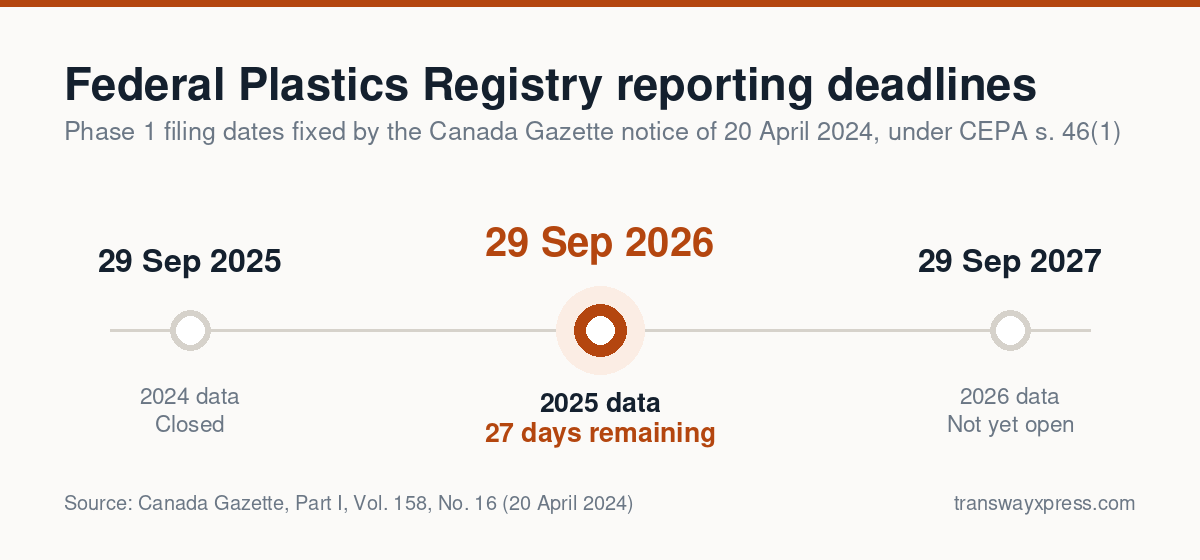
Note what you are reporting: 2025 data, in 2026. If you were selling into Canada last year and only discovered this obligation today, the numbers you need are historical. You cannot fix 2025 by changing your packaging in September 2026 — you can only reconstruct what already shipped.
What changed for 2026, and what did not
In December 2025 the federal government announced it was deferring Phases 2 and 3 of the registry, which would have pulled in resin producers, service providers, and a much longer list of product categories such as tires, textiles and construction materials. That deferral generated headlines, and it generated a dangerous misreading: that the registry itself was paused.
It was not. Phase 1 obligations remain in force, unchanged, on the original schedule. Organisations already in scope must keep filing. The 29 September 2026 deadline for 2025 data survived the deferral intact. If your compliance calendar recorded “FPR delayed” in December and stopped there, that entry is wrong and it is now three and a half weeks from costing you.
What Data Does Federal Plastics Registry Reporting Actually Ask For?
Two blocks: who you are, and what you placed on the market. Neither is conceptually hard. Both are operationally annoying if your packaging records live in a supplier’s invoices and your volume records live in a fulfillment platform.
Administrative information
Identification details, your federal business number from the Canada Revenue Agency, an authorised representative, your NAICS codes, the provinces and territories where you place products on the market, and the extended producer responsibility or stewardship programmes you participate in, including any producer responsibility organisation you have engaged.
Plastics information
| Data field | What you report | Where it usually lives |
|---|---|---|
| Quantity | Kilograms of plastic manufactured, imported, or placed on the market | Purchase orders plus unit weights |
| Resin type | Resin identity per the notice’s classification (PET, HDPE, LDPE, PP, PVC and others) | Packaging supplier spec sheets |
| Category | Product category and subcategory — packaging, EEE, single-use | Your own SKU and packaging map |
| Geography | Breakdown by province and territory | Order data from your 3PL or store |
| Source | Whether the plastic was manufactured in Canada or imported | Supplier country of origin |
The provincial breakdown is the field that surprises people. You are not reporting one national number — you are allocating kilograms across the jurisdictions where the goods landed. That means your Federal Plastics Registry reporting depends on ship-to data you may only be able to get from your fulfillment partner. Filing happens through the government’s online reporting platform at rfp-fpr.ec.gc.ca.
Do Non-Resident Brands Have to Report?
This is the question that decides whether an Indian, American, or European brand needs to act at all, and the answer is more nuanced than a simple yes.
The residency rule
Environment and Climate Change Canada’s guidance is direct: only residents in Canada with a Canadian address must report on plastics in imported products. Foreign exporters are not themselves obligated to file. That does not make the data problem disappear — it moves it. Whoever the Canadian-resident importer is inherits the reporting duty, and they cannot report resin types and weights they have never been told.
If you sell into Canada as a non-resident importer, this sits next to your other cross-border obligations rather than replacing them. Our guide to CARM requirements for non-resident importers covers the customs side of the same structural question: who, legally, is the Canadian party on the hook.
Who files, in practice
| Your structure | Who carries the FPR obligation | What you must supply |
|---|---|---|
| Canadian entity, Canadian address, importing your own goods | You | Everything — you are the filer |
| Non-resident brand, Canadian importer of record takes title | The Canadian importer | Resin types, unit packaging weights, volumes by province |
| Non-resident brand, no Canadian resident entity | Not you directly | Data on request from downstream Canadian parties |
| Under 1,000 kg per calendar year, any structure | Exempt | Keep the weight calculation that proves it |
That last row matters. An exemption you cannot evidence is a position, not a defence. Keep the arithmetic.
Your Federal Plastics Registry Reporting Checklist Before 29 September
Four weeks, step by step
- Days 1–3 — Decide if you are in scope. Confirm whether a Canadian-resident entity in your structure places plastic on the market. If yes, continue.
- Days 3–7 — Weigh your packaging. Get gram weights for every mailer, box liner, polybag, void fill and piece of tape you used in 2025. Your packaging supplier has these on spec sheets; ask rather than estimate.
- Days 7–12 — Pull 2025 volumes. Order counts by month and by province, plus units per order. Your 3PL or store platform is the source. Request it now — historical exports are rarely instant.
- Days 12–18 — Map resin types. Match each packaging component to its resin identity. LDPE mailers, PP strapping, PET bottles: your supplier’s technical data sheet gives you this.
- Days 18–22 — Calculate kilograms by province. Multiply weights by volumes, allocate across jurisdictions, and check whether the total clears 1,000 kg.
- Days 22–26 — Register and file. Create your account on the reporting platform, enter administrative details and the plastics data, and submit.
- Days 26–27 — Archive the workings. Save the spreadsheet, the supplier specs, and the submission confirmation. Next year’s filing is the same exercise, and the 2026 data is already accumulating.
How Transway Xpress Global Solves This
Most of the pain in Federal Plastics Registry reporting is not legal interpretation. It is that the two numbers you need — packaging weight per order and order volume per province — sit in two different systems, and neither is yours. That is a fulfillment data problem, and it is solvable at the fulfillment layer.
Packaging data lives in the fulfillment centre
Transway Xpress Global runs warehouses in Oakville and Etobicoke, Ontario, and in Buffalo, New York, with an office in Pendleton, Indiana. We are the operator picking, packing and shipping your Canadian orders, which means we hold the ship-to detail behind the provincial breakdown and we specify the packaging that goes around every unit. When we handle your e-commerce fulfillment in Canada, the packaging bill of materials and the order-by-province history are already in one place.
For brands running custom packaging through us, resin identity is a question we can put to the supplier on your behalf rather than a mystery you chase in September. For Indian and international brands entering North America through our India to USA and Canada lane, the residency question is worth settling early: who your Canadian-resident party is determines who files, and that is a structural decision best made before volume builds, not after.
This is the same reason we push clients to treat regulatory calendars as operational data rather than legal reading. The counter-tariff list change taking effect on 8 September works the same way: the compliance answer depends on facts your fulfillment operation already holds.
Summary
Federal Plastics Registry reporting for the 2025 calendar year closes on 29 September 2026 — 27 days out. Phase 1 was never delayed; only Phases 2 and 3 were deferred. Any Canadian-resident brand owner, importer, retailer or marketplace facilitator placing more than 1,000 kg of plastic packaging or products on the Canadian market must file quantity, resin type, category and provincial breakdown through the ECCC portal. Non-resident brands do not file directly, but their Canadian importer does, and that importer will need packaging data only the brand and its fulfillment partner can produce. The work is arithmetic, not advocacy — but it takes longer than a week to assemble, and you are reconstructing a year that has already happened. For the wider context on running compliant cross-border operations, see our complete cross-border e-commerce fulfillment guide and our fulfillment pricing.
Frequently Asked Questions
What is the Federal Plastics Registry reporting deadline in 2026?
Information for the 2025 calendar year must be submitted no later than 29 September 2026, as set out in the Canada Gazette notice issued under subsection 46(1) of the Canadian Environmental Protection Act, 1999. That is 27 days from 2 September 2026. The same notice sets 29 September 2027 for 2026 calendar-year data. Filing is done through Environment and Climate Change Canada’s online reporting platform, and the deadline was not affected by the deferral of later phases.
Who has to do Federal Plastics Registry reporting?
Producers who import, manufacture, or place plastic packaging or plastic products on the market in Canada — a definition that expressly includes brand owners, importers, retailers and marketplace facilitators. Phase 1 covers plastic packaging, electronic and electrical equipment, and single-use or disposable products. Only residents in Canada with a Canadian address are required to report on plastics in imported products, so a non-resident brand’s obligation typically lands on its Canadian importer instead.
Is there a minimum threshold before I have to report?
Yes. Anyone who manufactures, imports or places on the market less than 1,000 kg of plastic products or packaging per calendar year is exempt. For a direct-to-consumer brand, that threshold arrives faster than expected: at roughly 15 grams per poly mailer, 1,000 kg is around 67,000 shipments before you count void fill, polybags or tape. Weigh your packaging and keep the calculation on file, because an exemption you cannot evidence is difficult to defend later.
Was the Federal Plastics Registry delayed?
Only partly, and not the part that applies to most e-commerce brands. In December 2025 Canada announced it was deferring Phases 2 and 3, which would have expanded reporting to resin producers, service providers and categories such as tires, textiles and construction materials. Phase 1 remains in force with no change to its deadlines, so organisations already in scope must continue filing on 29 September each year for the prior calendar year.
What data does my 3PL need to give me for Federal Plastics Registry reporting?
Two things above all: the packaging specification for every order type you shipped in 2025, with gram weights and resin identity, and your 2025 order volumes broken down by province and territory. Those two inputs produce the kilograms-by-jurisdiction figure the registry asks for. Ask your fulfillment provider for both in writing now — reconstructing a full prior year from invoices is materially slower than pulling a report.
Not sure whether your Canadian entity is in scope, or struggling to get 2025 packaging and volume data out of your current provider? Book a consultation with Transway Xpress Global and we will walk through your structure, your packaging bill of materials and what your fulfillment partner should be handing you before 29 September. You can also read Environment and Climate Change Canada’s own overview of the Federal Plastics Registry and the underlying Canada Gazette notice setting the deadlines.