An IEEPA tariff refund is not a claim you have to win in court. It is money U.S. Customs and Border Protection already accepts it owes you, sitting in a processing queue — and for tens of thousands of importers it is stuck there because one banking field in a government portal is empty. If your brand imported into the United States and paid duties under the International Emergency Economic Powers Act on entries filed between 3 February 2025 and 24 February 2026, you are in that pool. CBP has told the Office of Management and Budget it is working through roughly $166 billion in refundable IEEPA duties across more than 53 million entry summaries. Most of that money is moving. A meaningful slice is not. This guide covers who qualifies, how the CAPE filing works, the two clocks that quietly disqualify entries, and the single setting that stops payment.
What Is an IEEPA Tariff Refund and Who Is Owed One?
Between February 2025 and February 2026, U.S. importers paid additional duties imposed under the International Emergency Economic Powers Act. Those duties were collected at entry like any other. They are now refundable following the Supreme Court’s decision in Learning Resources, Inc. v. Trump, and CBP has been ordered to give the money back.
The window that defines eligibility
CBP’s own information collection notice, published in the Federal Register on 8 July 2026, defines the scope precisely: the agency must process refunds of tariffs collected under IEEPA from 3 February 2025 through 24 February 2026. If your entries fall outside that window, IEEPA duties are not the issue. If they fall inside it, and you paid the additional duty, you are owed money.
This is a separate question from the other trade measures still in force. Section 232 and Section 301 duties were never part of the IEEPA case and remain payable. So do Canada’s countermeasures — if you also ship northbound, our breakdown of the Canada counter-tariff list changes effective 8 September 2026 covers that side separately, and the wider picture sits in our guide to US–Canada tariffs in 2026.
Why the size of this matters to smaller sellers
CBP estimated roughly 330,000 respondents would need to submit IEEPA refund filings under this collection. That is not a handful of multinationals. It is the long tail of e-commerce brands, Amazon sellers and small importers who paid the duty quietly at entry and never tracked it as a recoverable asset. For a brand importing a few container loads a year, the sums are often five or six figures of working capital sitting with the U.S. Treasury.
How CBP Pays an IEEPA Tariff Refund Through CAPE
The volume made entry-by-entry processing impossible, so CBP built a bulk tool inside the Automated Commercial Environment called CAPE — Consolidated Administration and Processing of Entries.
What a CAPE declaration actually is
A CAPE declaration is a CSV file. You upload it through the CAPE tab in the ACE Portal, and it contains one thing: entry numbers. CBP’s deployment notice is explicit that no additional data is required beyond the entry numbers themselves, and that a single file may carry up to 9,999 entries. The system validates the file format and confirms that the submitter is authorised for those entries.
Once a declaration is accepted, CBP liquidates or reliquidates the entries without the IEEPA duties and issues the refund. The agency’s stated processing expectation is 60 to 90 days following acceptance of the declaration.
Who is allowed to file one
Only the importer of record or a licensed customs broker acting for that importer can submit a CAPE declaration. This is where many brands stall: their importer of record details turn out to be wrong, out of date, or pointing at a broker’s contact block. That problem compounds — CBP has separately announced it will void importer of record numbers with inaccurate Form 5106 data, covered in our guide to the importer of record number void taking effect 18 September 2026. A voided number cannot file a declaration.
Which entries CAPE accepts and which it rejects
CAPE is not a catch-all. CBP’s deployment guidance lists specific rejection conditions, and an entry that trips one of them needs a different route.
| Entry situation | Accepted by CAPE? | What it means for you |
|---|---|---|
| Standard consumption entry, IEEPA duty paid | Yes | The main path. File the declaration and expect payment in 60–90 days. |
| More than 80 days past the liquidation date | No | Outside the CAPE window. Needs a protest or a court route. |
| Entry with an open or pending protest | No | Resolve or withdraw the protest first, if still inside the window. |
| Associated with a drawback claim | No | Handle through the drawback process instead. |
| Flagged for Reconciliation, or entry types 09, 47, 08 | Restricted | Reconciliation-flagged entries were brought in later under separate guidance. |
| Warehouse entries, types 21 and 22 | No | Removed from CAPE eligibility as of 7 July 2026. |
| AD/CVD entries with pending liquidation | No | Excluded from the initial phase. |
Why Approved Refunds Are Still Sitting Unpaid
Here is the part that catches brands out. A declaration can be accepted, the entry reliquidated and the IEEPA refund approved — and the money still does not arrive.
The ACH rule that changed in February 2026
CBP issued an Electronic Refunds interim final rule, published in the Federal Register on 2 January 2026 and effective 6 February 2026. Its requirement is short: CBP issues all tariff refunds electronically via Automated Clearing House transfer, subject to limited exceptions. Paper cheques are no longer the default.
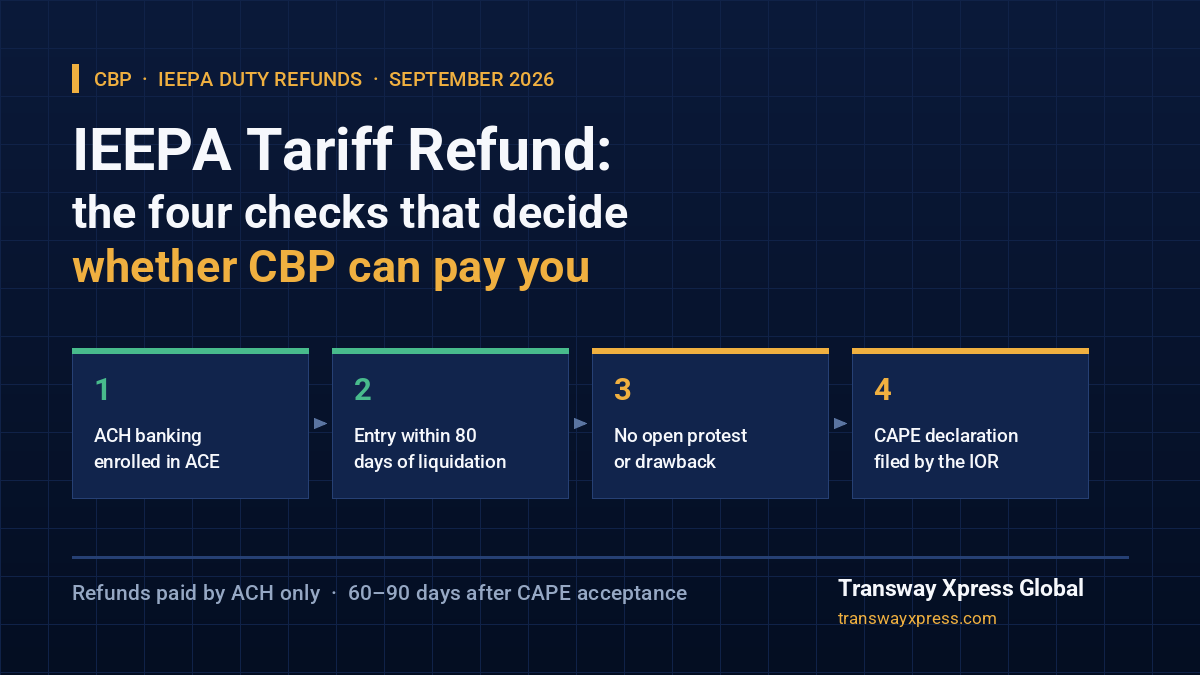
That means an approved IEEPA refund with no banking details on file has nowhere to go. CBP built an automated ACH authorisation tool inside the ACE Secure Data Portal and automated the importer account application needed to reach it, but the enrolment itself is still something the importer or an authorised CBP Form 4811 designee has to complete. Nobody does it for you.
The scale of the backlog
In its 25 August 2026 status report to the U.S. Court of International Trade, CBP set out where the programme stands. The figures below come from that filing.
| Measure | Reported position | Why it matters |
|---|---|---|
| Refundable IEEPA duties in scope | ~$166 billion | Across more than 53 million entry summaries. |
| Accepted for CAPE processing | ~$132.5 billion | Declarations filed and validated. |
| Certified and sent to Treasury | ~$106.6 billion | Money already on its way out. |
| Held for missing banking details | 22,170 IEEPA refunds, ~$1.7 billion | Approved, unpayable, waiting on ACH enrolment. |
| Entries passing entry-level validation | ~26.4 million | The bulk of the volume has cleared the first gate. |
Roughly $1.7 billion is approved and undeliverable. Averaged across 22,170 held IEEPA refunds, that is about $77,000 per importer — not a rounding error for a mid-sized brand. CBP has since confirmed that CAPE Phase 3, which covers finally liquidated entries, will launch on 6 October 2026 — and that it is limited to importers holding a Court of International Trade reliquidation order. See our breakdown of who CAPE Phase 3 actually pays. Phases 1 and 2 continue to operate normally.
The Two Clocks That Decide Whether You Get Paid
IEEPA refund eligibility is not open-ended. Two separate timers run against every entry, and both are measured from liquidation, not from the date you paid.
The 80-day post-liquidation cut-off
CBP’s guidance excludes entries more than 80 days past the liquidation date from CAPE. This is the operational deadline most importers have never checked, because liquidation dates live in ACE and in broker systems rather than in the accounting ledger where the duty was expensed.
The 180-day protest window
Behind the CAPE window sits the statutory protest period: 180 days from liquidation to file a protest under U.S. customs law. Where an entry has fallen outside the 80-day CAPE window but is still inside 180 days, a protective protest preserves the claim. Trade counsel has been advising importers to assess entries approaching that mark rather than assume the bulk process will sweep them up.
A third route exists for importers who filed their own actions at the Court of International Trade. On 15 July 2026 the court ordered CBP to refund IEEPA duties on finally liquidated entries in roughly 3,700 pending cases. Importers who never filed do not have that court-ordered mechanism and depend on the bulk process and ongoing appeals.
| Clock | Runs from | Length | What it governs |
|---|---|---|---|
| CAPE eligibility window | Liquidation date | 80 days | Whether the bulk tool will accept the entry |
| Protest period | Liquidation date | 180 days | Whether a protective protest can preserve the claim |
| CAPE processing time | Declaration acceptance | 60–90 days | When the money should actually land |
| Reliquidation period | Liquidation date | 90 days | Whether an entry counts as finally liquidated |
Your IEEPA Tariff Refund Checklist
This is a finite exercise. For most e-commerce importers it is an afternoon of work with the broker, not a project.
What to do this week
- Confirm your ACH refund enrolment in ACE. Log into the ACE Secure Data Portal and check that current banking details are recorded against your importer account. If they are not, nothing else on this list will result in payment.
- Pull every U.S. entry between 3 February 2025 and 24 February 2026. Your broker can export this. Isolate the lines where IEEPA duty was assessed.
- Record the liquidation date for each entry, not the entry date. Both clocks run from liquidation.
- Sort entries into three buckets: inside the 80-day CAPE window, outside 80 days but inside 180, and beyond 180 days.
- File or instruct CAPE declarations for the first bucket. Only the importer of record or a licensed broker can submit.
- Ask counsel about protective protests for the second bucket before the 180-day mark passes.
- Verify your Form 5106 data is current so your importer of record number is not voided mid-process.
- Diarise a follow-up at 90 days after each declaration is accepted, and chase anything unpaid.
Who should own this internally
In most brands this falls between finance, which treats the duty as a sunk cost, and operations, which treats customs as the broker’s job. Neither owns the IEEPA refund. Assign one person, give them ACE portal access, and make the ACH enrolment check their first task. A fulfillment partner that handles your import documentation should be able to produce the entry list the same day.
How Transway Xpress Global Solves This
Transway Xpress Global runs cross-border fulfillment for brands selling into both the United States and Canada, with warehouses in Oakville and Etobicoke, Ontario, and in Buffalo, New York, plus an office in Pendleton, Indiana. We are part of Transway Transport, an Oakville trucking company operating since 2014, so customs paperwork has never been an afterthought here.
Clean import records are a fulfillment problem
The importers struggling with IEEPA refunds right now are rarely the ones who filed badly. They are the ones whose entry data is scattered across three brokers, two warehouses and a former 3PL, so nobody can produce a clean list of entries and liquidation dates. That is a record-keeping failure before it is a customs one.
We run D2C and B2B fulfillment, Amazon FBA prep, warehousing, order and inventory management, cross-border shipping and returns from a single operating record. That means your entry documentation, commercial invoices and shipment history sit in one place when a deadline like this appears. If you are still working out what you actually pay per shipment, our guides to calculating landed cost and to the commercial invoice for customs are the right starting points, and duty deferral programs in Canada and the US covers how to avoid paying duty you will later have to reclaim. Brands shipping the other direction can start with US fulfillment for Canadian brands.
Key Takeaways
The short version
- Duties paid under IEEPA on entries from 3 February 2025 to 24 February 2026 are refundable.
- CBP processes them in bulk through CAPE in the ACE Portal, filed by the importer of record or a licensed broker.
- Entries more than 80 days past liquidation are rejected by CAPE; the statutory protest window runs to 180 days.
- All IEEPA tariff refunds are paid by ACH under a rule effective 6 February 2026. No banking details means no payment.
- CBP reported 22,170 approved IEEPA refunds worth about $1.7 billion held solely for missing banking information as of 25 August 2026.
- Expect 60 to 90 days from declaration acceptance to payment. CAPE Phase 3 opens 6 October 2026, for CIT plaintiffs only.
Frequently Asked Questions
What is an IEEPA tariff refund?
It is the return of additional duties that U.S. importers paid under the International Emergency Economic Powers Act on entries filed between 3 February 2025 and 24 February 2026. Following the Supreme Court’s decision in Learning Resources, Inc. v. Trump, those IEEPA duties are no longer owed, and CBP has been directed to refund them. The agency is processing roughly $166 billion across more than 53 million entry summaries. It is an IEEPA refund of money already collected, not a new claim you have to argue.
How do I know if I am owed an IEEPA tariff refund?
Ask your customs broker for every U.S. entry summary filed between 3 February 2025 and 24 February 2026, and look for lines where IEEPA duty was assessed. If you imported commercial goods into the United States in that period and paid the additional duty, you are almost certainly in scope. Record the liquidation date alongside each entry, because every deadline in this process runs from liquidation rather than from the entry date or the date you paid.
Why has my IEEPA tariff refund not arrived yet?
The most common reason is that CBP has no banking details for you. Since 6 February 2026 all IEEPA refunds are issued electronically by ACH, so an approved refund with no enrolled account simply sits. CBP reported 22,170 IEEPA refunds worth about $1.7 billion in that state in late August 2026. Other causes include an entry falling outside the 80-day CAPE window, an open protest or drawback claim blocking the entry, or the tariff refund waiting on CAPE Phase 3, which opens 6 October 2026 for finally liquidated entries covered by a CIT order.
Can my customs broker file the CAPE declaration for me?
Yes. CBP allows either the importer of record or a licensed customs broker acting on that importer’s behalf to submit a CAPE declaration through the ACE Portal. The file itself is a CSV of entry numbers, up to 9,999 per submission, with no additional data required. What a broker cannot do for you is enrol your bank account — that has to come from the importer of record or an authorised CBP Form 4811 designee, and it is the step most often missed.
How long does an IEEPA refund take to arrive?
CBP’s stated expectation is 60 to 90 days from acceptance of the CAPE declaration for standard unliquidated entries. Unliquidated entries are set to liquidate 45 days after acceptance, and the IEEPA refund follows. That timeline assumes your ACH enrolment is already in place. If it is not, the clock effectively stops at approval, and the payment waits indefinitely until banking details are supplied.
Sitting on an unclaimed IEEPA tariff refund is a working capital decision you did not make deliberately. If you want help pulling your entry history together, checking which entries are still inside the window, or restructuring your cross-border operation so records like these are never scattered again, book a consultation with Transway Xpress Global and we will walk through it with you.
Sources: CBP information collection notice on court-ordered IEEPA refunds, Federal Register, 8 July 2026; CBP CSMS message on the CAPE deployment; CBP CSMS message on the Electronic Refunds interim final rule; and CBP’s IEEPA Duty Refunds programme page. Figures on IEEPA refunds held for missing banking information are from CBP’s 25 August 2026 status report to the U.S. Court of International Trade. This article is general information, not legal or customs advice.