Foreign export documentation — the paperwork your supplier files with its own customs authority before a shipment ever leaves — is about to become US Customs and Border Protection business. On 2 September 2026, CBP published an advance notice of proposed rulemaking in the Federal Register titled Heightened Import Disclosures for Supply Chain Visibility. It asks whether importers of record should have to hand CBP the foreign export documentation their vendors already file abroad, name every party in the chain from factory to front door, and adopt tracing technology that proves where goods really came from. Comments close on 1 December 2026, which is 84 days from today. Nothing is binding yet. But the 64 questions CBP is asking map out precisely what the next rule will demand, and most ecommerce importers cannot answer them today.
What is the CBP foreign export documentation proposal?
CBP states the objective plainly. The agency is “considering amending its regulations to give CBP greater visibility into the supply chains of goods imported into the United States,” and is seeking comment on “collecting foreign export documentation that foreign exporters are required to submit to the foreign customs authority prior to the exportation of those goods to the United States.”
That sentence is the whole shift. Today CBP grades the paperwork you give it. Under this proposal it would also read the paperwork your supplier gave someone else, and compare the two versions line by line.
An advance notice is not a rule yet
An ANPRM sits one step earlier than a proposed rule. CBP says the comments it receives “will be used, potentially, to draft a Notice of Proposed Rulemaking (NPRM), which would propose regulations to implement these proposals.” There is no regulatory text to comply with, no penalty exposure, and no compliance date. What exists instead is a 64-question map of the agency thinking, published while the outcome can still be influenced. That is the opportunity, and it expires on 1 December.
Docket details worth writing down
- Document: Heightened Import Disclosures for Supply Chain Visibility (ANPRM)
- Agency: US Customs and Border Protection, Department of Homeland Security
- Published: 2 September 2026 in the Federal Register
- Docket number: USCBP-2026-1058
- RIN: 1685-AA47
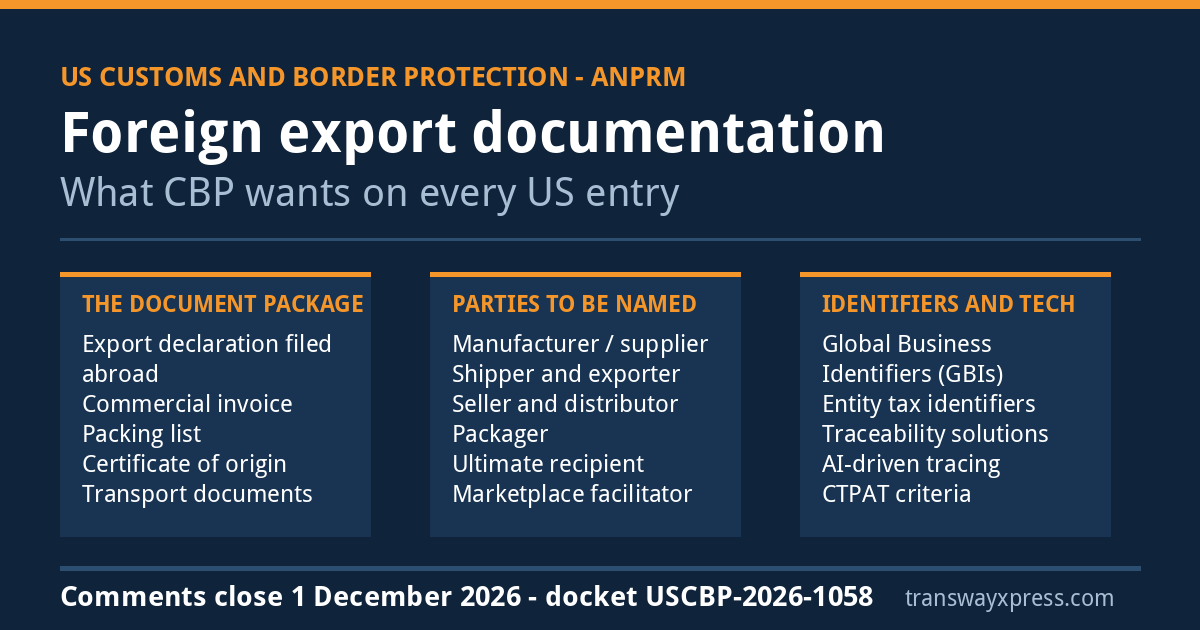
- Comments due: on or before 1 December 2026, through regulations.gov
Which foreign export documentation would CBP collect?
The document package
The ANPRM anchors on export declarations made by the foreign exporter to the foreign customs authority, and lists commercial invoices, packing lists, certificates of origin and transport documents such as bills of lading and air waybills alongside it. Question 1 asks bluntly whether CBP should require the importer of record to submit foreign export documentation for all goods imported. Question 3 asks a softer version of the same thing: whether CBP should randomise the requirement and collect foreign export documentation on a sample of entries instead of every one.
Neither option is comfortable if your supplier has never shown you an export declaration, and most have not. The document is filed in the exporting country language, inside that country own customs system, usually by a local forwarder your brand never speaks to. It is not part of the commercial packet that arrives with your goods. Getting it will be a procurement conversation, not a compliance one.
The second problem is reconciliation. Foreign export documentation is prepared for a different audience, under different rules, often by a different party than the one who invoices you. Value, quantity, classification and origin can all differ innocently between the export filing and your US entry. Once CBP holds both, every difference needs an explanation you can defend.
From the MID to Global Business Identifiers
CBP is also weighing whether to replace or supplement the Manufacturer Identification Code with Global Business Identifiers and entity-level tax identifiers. The MID is a string built from a company name and address, so two unrelated factories can produce confusingly similar codes and one factory can appear under several. A tax identifier does not bend that way. If GBIs arrive, the practical effect for importers is that a factory becomes a permanent, traceable entity across every entry you file, and across every other importer who uses it.
| Data point | What CBP generally receives today | What the ANPRM contemplates |
|---|---|---|
| Proof of origin | Importer declaration plus a certificate of origin on request | The foreign export declaration filed with the exporting country customs authority |
| Factory identity | Manufacturer Identification Code derived from name and address | Global Business Identifiers plus entity-level tax identifiers |
| Parties named | Importer of record, consignee, seller, manufacturer | Adds shipper, exporter, distributor, packager, ultimate recipient and marketplace facilitator |
| Commercial paperwork | Commercial invoice and packing list supplied to CBP | The same documents as filed abroad, so both versions can be compared |
| Transport records | Bill of lading or air waybill through the carrier | Transport documents tied to the foreign export filing |
| Traceability | Records retained and produced on request | Supply chain traceability and AI-driven tracing solutions |
| Trusted trader terms | CTPAT security criteria | CTPAT criteria potentially extended to tracing technology and cybersecurity |
Every party CBP wants named
The list runs well past your direct supplier
The ANPRM asks about identifying the manufacturer or supplier, the shipper, the seller, the exporter, the distributor, the packager, the ultimate recipient of the delivery, and online marketplace facilitators. Read that list against your own purchase orders. Several of those parties have no contract with you, no reason to answer your questions, and no visibility into why an American agency wants their tax number.
This is where a foreign export documentation requirement stops being a paperwork task and becomes a sourcing decision. Suppliers who will not share export documentation, or who cannot name the factory behind their own brand, become a compliance liability rather than a cost saving.
Why marketplace facilitators are in scope
Question 33 asks whether a marketplace that facilitated the sale of imported merchandise should itself be identified on the entry. For brands selling through Amazon, Walmart or Shopify-hosted channels, that is a signal worth reading early. The direction of travel is toward attributing every import to a named commercial chain rather than a single importer of record standing alone at the border.
Why CBP wants deeper visibility now
Transshipment and origin laundering
CBP names illegal transshipment, “the practice of routing goods through a third country to obscure or misrepresent their true country of origin,” as a core target of the proposal. The context is a tariff landscape where origin is worth more than it has been in decades. Canada counter-tariffs on roughly $27.6 billion of US goods took effect at 12:01 a.m. on 8 September 2026 at rates of 15, 25 and 50 per cent, and the US Section 338 duties that triggered them run at 50 per cent on covered Canadian goods regardless of whether those goods originate under CUSMA. When the spread between two origins is half the invoice value, the incentive to misstate origin rises with it, and paper filed in the exporting country becomes the most useful thing CBP does not currently see.
Dual invoicing and rules of origin
The ANPRM also cites dual-invoicing, forced labour obligations and rules of origin among the enforcement problems it is trying to solve. A foreign export declaration is valuable precisely because it was filed for a different reader, before the goods moved, by a party with no stake in the US duty outcome. Two documents describing one shipment are much harder to align than one.
Who is most exposed to a foreign export documentation requirement?
Ecommerce brands importing from Asia
If you buy through a trading company or a contract manufacturer, you may not know which factory actually made the goods, let alone hold its tax identifier. That gap is normal, and under this proposal it becomes reportable. Brands moving product from India, Vietnam or China into North America should start by asking a single question of every vendor: can you send me a copy of the export declaration you filed for our last shipment? Our India to Canada customs clearance guide walks through the document set that already travels with those consignments.
The same brands are still absorbing the end of low-value duty relief. If you have not revisited your duty model since that change, our breakdown of the end of de minimis and our guide to calculating landed cost are the right places to restart.
Canadian brands that act as US importer of record
If your brand holds the US importer of record number, every disclosure obligation in this proposal lands on you rather than your freight partner. That is worth confirming before it is tested, particularly after CBP recent enforcement activity around importer of record records, which we covered in our note on voided importer of record numbers. Brands weighing whether to hold that role themselves can compare the operating models in our guide to US fulfillment for Canadian brands.
Amazon sellers moving inventory into FBA
Sellers who import directly and then send goods to a fulfillment centre sit at the intersection of both risks: they are the importer of record, and their sale was facilitated by a marketplace CBP has explicitly asked about. Clean commercial paperwork is the cheapest insurance available, and our field-by-field commercial invoice guide is a practical starting point.
Your 84-day readiness checklist
Six steps to take before 1 December 2026
- Map what you already hold. For your top 20 SKUs, list the manufacturer, exporter, shipper and country of origin, and mark every field you cannot evidence.
- Request one export declaration. Ask each major supplier for a copy of the foreign export documentation filed on your most recent shipment. The response time alone tells you how ready that vendor is.
- Reconcile a sample. Compare value, quantity, classification and origin between the foreign export documentation and your US entry summary. Document why any differences exist.
- Collect entity identifiers. Gather tax identifiers for manufacturers and exporters now, while the request is voluntary and relationships are calm.
- Check your contracts. Confirm your supply agreements oblige vendors to produce customs documentation and to stand behind the accuracy of origin information.
- File a comment. CBP asked for cost data and small business impact in questions 62 to 64. Operational specifics from a real importer carry more weight than general objection.
| Window | Dates | Priority action |
|---|---|---|
| Weeks 1 to 2 | 8 to 21 September 2026 | Map suppliers, factories and identifiers for your highest-volume SKUs |
| Weeks 3 to 6 | 22 September to 19 October 2026 | Request sample foreign export documentation from every major vendor |
| Weeks 7 to 10 | 20 October to 16 November 2026 | Reconcile export filings against US entry data and log the gaps |
| Final stretch | 17 November to 1 December 2026 | Submit your comment to docket USCBP-2026-1058 on regulations.gov |
How to make a comment actually count
CBP is not asking whether importers like the idea. It is asking what the idea costs. Comments that quantify supplier lead times, translation burden, system changes and the share of vendors who simply will not release export documentation are the ones that shape a proposed rule. Note also that small businesses make up roughly 70 per cent of CTPAT membership, which gives smaller importers a legitimate claim to be heard on any change routed through that programme.
How Transway Xpress Global helps importers get ready
Documentation discipline across Oakville, Etobicoke and Buffalo
Transway Xpress Global runs D2C and B2B fulfillment from warehouses in Oakville and Etobicoke, Ontario and in Buffalo, New York, with an office in Pendleton, Indiana and a trucking parent, Transway Transport, operating out of Oakville since 2014. That footprint means the same shipment is often received, prepped and cross-docked under one operator on both sides of the border, so the commercial paperwork does not get rebuilt from scratch at each hand-off.
Practically, that helps in three places. Inbound receiving captures what actually arrived against what the invoice said, which is the reconciliation CBP is proposing to perform for you. Amazon FBA prep and labelling run against the same record, so carton content and origin marking stay consistent through to the fulfillment centre. And cross-border moves are planned with the duty treatment known in advance rather than discovered on arrival — the approach we set out in our cross-border ecommerce fulfillment guide.
Where you need a licensed broker to file, you still need one. The division of labour is worth understanding before a rule lands, and we explain it in freight forwarder versus customs broker.
What changes, and what does not
Three things to remember
First, nothing is enforceable today. This is an advance notice, not a rule, and no importer needs to change a filing because of it. Second, the direction is unambiguous: CBP wants foreign export documentation, named parties and machine-readable identifiers, and agencies rarely ask 64 questions about something they intend to drop. Third, the work that prepares you for the rule is work that pays off immediately, because supplier records, entity identifiers and reconciled invoices reduce duty risk under the tariffs already in force.
The importers who will find this easy in 2027 are the ones who started asking suppliers awkward questions in 2026.
Frequently asked questions
What is foreign export documentation?
Foreign export documentation is the set of records an exporter files with its own government before goods leave the country, most importantly the export declaration submitted to that country customs authority. It typically travels with commercial invoices, packing lists, certificates of origin and transport documents such as bills of lading or air waybills. US importers rarely see it today, because it is filed abroad by the seller or its forwarder rather than by the buyer.
Is CBP requiring foreign export documentation right now?
No. The 2 September 2026 publication is an advance notice of proposed rulemaking, which is a request for public input rather than a binding rule. CBP has said the responses may be used to draft a notice of proposed rulemaking later. There is no compliance date, no new filing requirement and no penalty exposure attached to the ANPRM itself. The only date that matters right now is the 1 December 2026 comment deadline.
When is the deadline to comment on the CBP proposal?
Comments must be received on or before 1 December 2026, submitted through the Federal eRulemaking Portal at regulations.gov under docket number USCBP-2026-1058. From 8 September 2026 that leaves 84 days. CBP posed 64 numbered questions, and questions 62 to 64 specifically invite cost-benefit data, small business impact and effects on medical product availability, so operational detail from working importers is what the agency has asked for.
Which parties would importers have to identify?
The ANPRM raises identifying the manufacturer or supplier, shipper, seller, exporter, distributor, packager, the ultimate recipient of the goods and any online marketplace that facilitated the sale. CBP is also considering replacing or supplementing the Manufacturer Identification Code with Global Business Identifiers and entity-level tax identifiers. In practice that means naming parties you may have no direct contract with, which is why supplier mapping is the first task rather than the last.
How should a small ecommerce brand prepare?
Start narrow. Take your top 20 SKUs, record the actual manufacturer, exporter and origin for each, and ask one supplier for a copy of its export declaration to see how hard the request is. Reconcile a single shipment between that filing and your US entry, and write down why any figures differ. Then add a documentation clause to your next supplier agreement. Four hours of that work now is worth more than a rushed programme after a proposed rule publishes.
Cross-border rules are moving faster than most brands can track, and the paperwork burden is landing on importers rather than carriers. If you want a fulfillment partner that treats customs documentation as part of the operation rather than an afterthought, book a consultation with Transway Xpress Global and we will walk through your current flow, your document gaps and what a foreign export documentation requirement would mean for your lanes.