Copper smelt and cast reporting stopped being optional on 31 August 2026. On that date US Customs and Border Protection issued CSMS #69711865, confirming that from Monday 14 September 2026 the Automated Commercial Environment (ACE) will reject any entry summary filed against four copper cable classifications without copper smelt and cast reporting data attached. That is seven days from today. If you import USB cables, charging cords, extension cords or telecommunications cable assemblies into the United States, the rejection lands on your entry summary, not your supplier’s paperwork, and the freight waits until the filing is corrected. This is a data problem rather than a duty problem, and the only place to fix it is upstream at the factory.
What changed with copper smelt and cast reporting on 31 August 2026?
Two CBP messages built this requirement, and the second one is the one with teeth.
The proclamation behind the requirement
Presidential Proclamation 11021, signed 2 April 2026, restructured the Section 232 tariff regime for aluminum, steel and copper, moving the duty base to the full customs value of covered metal articles. CBP operationalised the copper piece in CSMS #69252300 on 15 July 2026, which deployed copper smelt and cast reporting into ACE production on 30 July 2026. For roughly six weeks the data field existed and brokers were told to populate it, but a blank field did not stop an entry from being accepted.
The 31 August error-code update
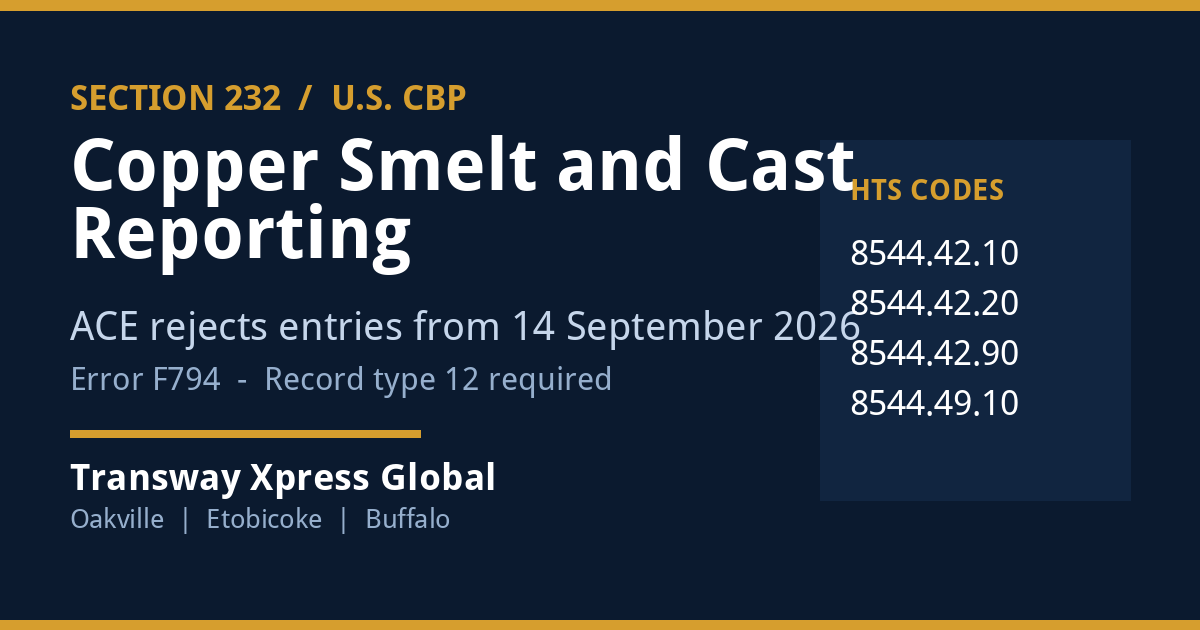
CSMS #69711865 removed that grace period. From 14 September 2026, ACE returns F794 ADDTNL DEC TYPE RQRD FOR ARTICLE as a fatal error whenever the required record type 12 declaration is missing from a line covered by copper smelt and cast reporting. A fatal error is not a warning that clears at the next query. The entry summary does not go on file, and nothing downstream, including release and duty payment, proceeds until the line is refiled with the country data present.
Which HTS codes require copper smelt and cast reporting?
CBP named four classifications. All of them sit inside heading 8544, which covers insulated wire, cable and other insulated electric conductors, whether or not fitted with connectors.
The four classifications CBP listed
| HTS code | Branch of heading 8544 | Common e-commerce goods filed here | Smelt and cast data required? |
|---|---|---|---|
| 8544.42.10 | Voltage not exceeding 1,000 V, fitted with connectors, of a kind used for telecommunications | Patch cords, data cable assemblies | Yes |
| 8544.42.20 | Voltage not exceeding 1,000 V, fitted with connectors, of a kind used for telecommunications | Telecom and networking cable assemblies | Yes |
| 8544.42.90 | Voltage not exceeding 1,000 V, fitted with connectors, other (extension cords sit at 8544.42.90.10) | USB and charging cables, extension cords, appliance and power cords | Yes |
| 8544.49.10 | Not fitted with connectors, of a kind used for telecommunications, voltage not exceeding 80 V | Bulk telecom and data cable sold by the spool | Yes |
Confirm the full ten-digit description in the Harmonized Tariff Schedule before you assume your SKU falls outside the list. Classification at the eight-digit level is where most sellers guess wrong, and a guess that lands on one of these four codes now carries a filing consequence rather than a footnote.
Why cable and cord sellers are unusually exposed
Cables are a high-velocity, low-margin, high-SKU-count category. A single Amazon or Shopify brand can carry forty variants of the same cord across lengths, colours and connector types, sourced from two or three contract factories that change copper suppliers between production runs. The copper smelt and cast reporting requirement asks for facts about the metal itself, not the finished cable, so a brand that has never asked its factory where the copper was smelted has no record to draw on. Sellers who moved production between vendors in the last year are the most exposed, because the answer is different per production lot.
What ACE will actually do on 14 September
Before and after the switch
| Filing condition | Before 14 September 2026 | From 14 September 2026 |
|---|---|---|
| Record type 12 present with smelt and cast countries | Accepted | Accepted |
| Record type 12 absent on a covered line | Accepted | Rejected with fatal error F794 |
| Country of smelt genuinely unknown | Field left blank in practice | Report “OTH” so the declaration is present |
| Secondary country of smelt | Optional | Optional |
| Goods of US origin | Not in scope | Not in scope |
What a rejected entry summary costs you
The direct cost is time. Your broker has to identify the failing line, obtain the missing country data, and refile. If the data is not on hand, that loop runs from broker to importer to factory to smelter, across time zones, while the container accrues demurrage at the port and per diem on the chassis. The indirect cost is worse for anyone running lean inventory into a fulfillment network: a week lost at the border in mid-September is a week lost against Q4 inbound receiving windows, and Amazon’s cut-off calendar does not move because your entry bounced.
How to file copper smelt and cast reporting data correctly
The record type 12 declaration
Copper smelt and cast reporting is transmitted through the Importer’s Additional Declaration, type code 12, on the entry summary line. Two values matter: primary country of smelt and country of cast. A secondary country of smelt may also be reported and remains optional. The requirement applies to covered copper articles from every country except the United States.
When you are allowed to report “OTH”
CBP’s guidance permits “OTH” for other when the country is genuinely unknown. Treat that as a release valve, not a default. Filing “OTH” across an entire product line is a visible pattern in CBP’s data, and reasonable care obligations still apply to the importer of record. If you are relying on “OTH” this month, open a supplier request in parallel so the real value is on file for your next shipment. Our guide to importer of record obligations under current CBP enforcement covers why that record matters.
Getting the data out of your factory
Send a written request to every cable vendor now, naming the four HTS codes and asking for primary country of smelt, country of cast, and the production lots each answer applies to. Ask for it as a standing field on the commercial invoice rather than a one-off email, because copper smelt and cast reporting is a per-entry obligation, not a one-time certification. Our field-by-field commercial invoice guide shows where to place supplementary metal data so brokers stop chasing it.
Your seven-day compliance checklist
- Pull your classification list. Export every active SKU with its HTS code and flag anything landing on 8544.42.10, 8544.42.20, 8544.42.90 or 8544.49.10.
- Check in-transit shipments. Any container arriving on or after 14 September needs the data before the entry summary is filed, not after it bounces.
- Email every cable vendor today. Request primary country of smelt and country of cast per production lot, in writing.
- Brief your customs broker. Confirm they are populating record type 12 and ask them to run a test on one line before the deadline.
- Add the fields to your product master. Store smelt and cast country alongside HTS code so the data is available at filing time.
- Decide your “OTH” policy. Document which SKUs use it, why, and when the real value is expected.
- Recheck your landed cost model. Section 232 duties on copper articles apply to full customs value under Proclamation 11021, so recalculate landed cost if your model still assumes metal-content valuation.
How Transway Xpress Global solves this
Transway Xpress Global runs D2C and B2B fulfillment out of warehouses in Oakville and Etobicoke, Ontario and Buffalo, New York, with an office in Pendleton, Indiana, backed by our trucking parent Transway Transport, operating out of Oakville since 2014. That footprint means we see cross-border cable and electronics accessory freight moving in both directions every week, and we see where the filing data breaks down.
For sellers caught by the 14 September deadline, the practical value is in the inbound workflow. We hold receiving specifications per SKU, so metal-origin data can travel with the goods instead of living in a broker’s inbox. When an entry does stall, having inventory positioned on both sides of the border means a delayed US clearance does not empty your Canadian shelf, and vice versa. Our US fulfillment service for Canadian brands and our Canadian eCommerce fulfillment centre network are built around that redundancy.
We also handle Amazon FBA prep, warehousing, order and inventory management, cross-border shipping, returns and custom packaging, so the same team that receives your cable cartons is the team that preps them to FBA specification and books the onward leg.
What else lands this month for cross-border sellers
Two other September dates worth diarising
Copper smelt and cast reporting is not the only deadline in play. Canada’s new counter-tariffs on US-origin goods take effect 8 September 2026, covered in our counter-tariff list update. On the US side, Section 232 continues to widen: our post on the 100% drone tariff live from 3 September shows how quickly a new product category gets pulled in. If you have paid IEEPA duties that were later disturbed, our guide to claiming an IEEPA tariff refund explains the mechanics.
Summary
The short version
From 14 September 2026, copper smelt and cast reporting is a filing gate, not a data-quality nice-to-have. Four HTS codes covering cables, cords and telecommunications conductors trigger a fatal F794 rejection in ACE if the record type 12 declaration is missing. The fix is procedural: identify affected SKUs, get country of smelt and country of cast from your factories in writing, confirm your broker is transmitting the declaration, and use “OTH” only where the answer is genuinely unavailable. Sellers who treat this as a supplier-data project rather than a customs-form project will be the ones still shipping on 15 September. For the wider picture, see our cross-border eCommerce fulfillment guide.
Frequently asked questions
What is copper smelt and cast reporting?
Copper smelt and cast reporting is a US entry-summary requirement to declare the primary country where the copper in a covered article was smelted and the country where it was cast. It is transmitted as Importer’s Additional Declaration type code 12 and applies to imports from every country except the United States. CBP introduced it under Presidential Proclamation 11021 of 2 April 2026 and deployed it in ACE on 30 July 2026. A secondary country of smelt may be reported but is optional.
Which products does copper smelt and cast reporting apply to right now?
CBP’s guidance names four Harmonized Tariff Schedule classifications: 8544.42.10, 8544.42.20, 8544.42.90 and 8544.49.10. These sit within heading 8544, covering insulated wire, cable and other insulated electric conductors. In practical terms that captures USB and charging cables, extension cords, appliance and power cords, patch cords, and bulk telecommunications cable. Check the ten-digit description for each SKU rather than assuming, because the difference between a covered and uncovered code is often a connector.
What happens if I file without the data after 14 September 2026?
ACE returns a fatal error, F794 ADDTNL DEC TYPE RQRD FOR ARTICLE, and the entry summary is rejected rather than flagged. Nothing downstream proceeds until the line is refiled with the smelt and cast countries present. Practically, that means your broker cannot complete the filing, the shipment sits, and demurrage and per diem start accruing. There is no informal grace period once the error code goes live on 14 September 2026.
Can I just report “OTH” if my factory will not answer?
CBP permits “OTH” for other where the country is genuinely unknown, so it will clear the filing gate. It is not a strategy. Reasonable care obligations sit with the importer of record, and a blanket “OTH” across a product line is easy to spot in CBP’s data. Use it for the shipment in front of you if you have run out of time, and open a written request to the supplier at the same time so the real values are on file for the next entry.
How long do I have to prepare for the copper smelt and cast reporting deadline?
As of publication on 7 September 2026, seven days. The requirement becomes a hard reject on Monday 14 September 2026 per CBP’s CSMS #69711865, issued 31 August 2026. Factory response times are the binding constraint, not broker configuration, so the supplier emails should go out first. If you have shipments already on the water arriving after the 14th, treat those as the priority, because the data has to exist before the entry summary is filed.
Primary sources: CBP CSMS #69711865, Copper Additional Smelt and Cast Country Detail Error Code Update and CBP’s Cargo Systems Messaging Service.
Facing the 14 September cut-off with cable or electronics SKUs in transit? Transway Xpress Global positions inventory on both sides of the Canada-US border so a stalled entry does not become a stockout. Book a free consultation and we will map your inbound flow against the deadline.