Canada surtax declaration codes are the first thing your broker needed on 8 September 2026, and until the day before, they did not exist. The Canada Border Services Agency published Customs Notice 26-23 on 7 September, roughly a day before the United States Surtax Order (2026) came into force at 12:01 a.m. on 8 September. That notice created three new surtax codes, told importers exactly where the money goes on a Commercial Accounting Declaration, and set out the narrow in-transit exception that decides whether a container already on the water pays 50 per cent or nothing. If you import anything of U.S. origin into Canada, the coding on your next declaration is now the difference between a clean entry and a correction.
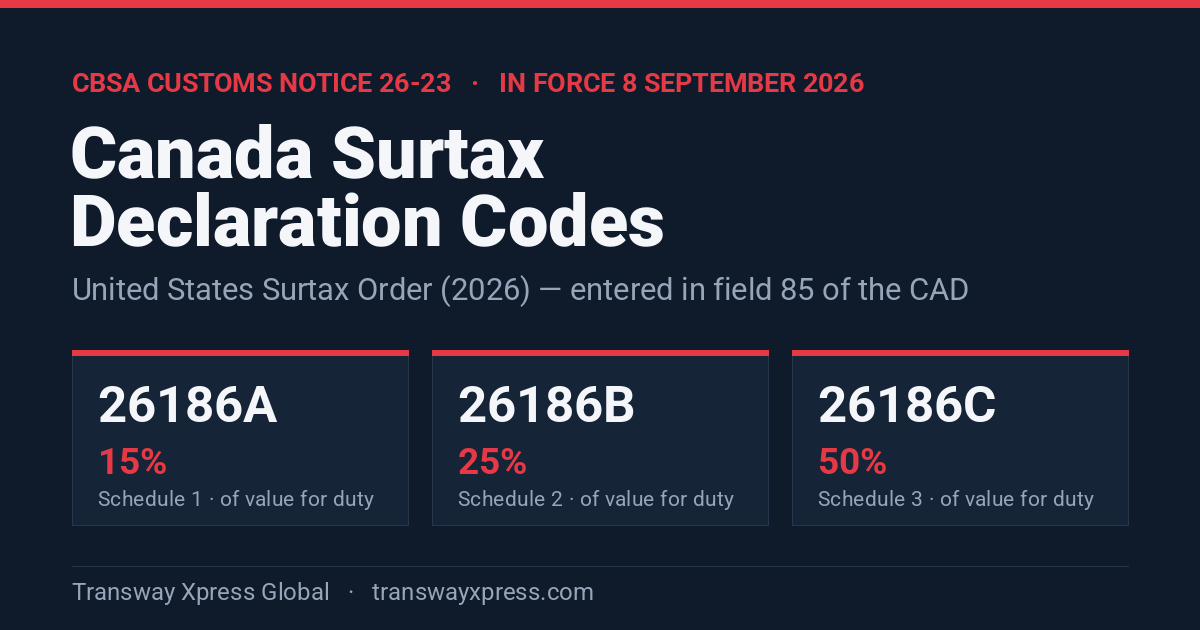
What are the Canada surtax declaration codes for the 2026 order?
The United States Surtax Order (2026) applies three rates, not one. Which rate you pay depends on which schedule of the Order your tariff item sits in, and each rate has its own declaration code. CBSA set them out in Customs Notice 26-23.
Canada surtax declaration codes at a glance
| Surtax code | Rate | Schedule of the Order | Basis of calculation |
|---|---|---|---|
| 26186A | 15 per cent | Schedule 1 | Percentage of the value for duty |
| 26186B | 25 per cent | Schedule 2 | Percentage of the value for duty |
| 26186C | 50 per cent | Schedule 3 | Percentage of the value for duty |
Do not guess the schedule from the product category. The schedules are written at the tariff-item level, and neighbouring items in the same chapter can fall in different tiers or be left off the list entirely. Read the classification you actually declare against the Order, then pick the code that matches.
Where the amount goes on the CAD
Customs Notice 26-23 is specific about placement: the amount of surtax owing is entered in field 85, “Surtax”, of the Commercial Accounting Declaration. Declarations go through the CARM Client Portal, EDI, or the API, which means the surtax lands inside the same statement of account cycle as your duties and GST. If you are still working through registration and Release Prior to Payment arrangements, read our guide to CARM requirements for non-resident importers before your next filing window, because the surtax is now riding on that account. Casual goods follow a separate accounting path under Memorandum D17-1-3.
Which goods does the United States Surtax Order (2026) actually catch?
Two filters decide exposure, and both surprise people. The first is origin, but not the origin most importers think of. The second is chapter classification.
The marking test, not the CUSMA preference test
Customs Notice 26-23 states that the goods caught are those “eligible to be marked as goods of the U.S. in accordance with the Determination of Country of Origin for the Purpose of Marking Goods (CUSMA Countries) Regulations“. That is a marking test. Claiming CUSMA preferential tariff treatment does not remove a good from the Order — if anything, a good that qualifies as U.S. under those marking rules is precisely the good the surtax is aimed at. Goods of Puerto Rico, Guam, the Northern Mariana Islands, American Samoa and the U.S. Virgin Islands are excluded.
Two consequences follow. Goods that merely ship from a U.S. warehouse but were made elsewhere are generally outside the Order, and goods finished in the United States are inside it no matter how good your CUSMA paperwork is. If your certification of origin work is loose, the surtax will find the gap. Our field-by-field commercial invoice guide covers the origin and classification detail that this now hinges on.
Chapters 98 and 99, and the Schedule 4 carve-out
Goods classified in Chapters 98 and 99 are exempted from the surtax, unless the applicable Chapter 98 or 99 tariff item is specifically listed in Schedule 4 of the Order. That matters for returned goods, repairs, samples and warranty replacements, which are the shipments e-commerce brands move most often without thinking about duty. Check Schedule 4 before you assume a Chapter 98 provision still protects you.
What happens to shipments that were already moving on 8 September?
The Order does not reach back. Customs Notice 26-23 provides that the surtax “will not apply to U.S. goods that are in transit to Canada on the day on which the surtax comes into force” — goods bound for Canada but not yet arrived, and under the control of a carrier as of 8 September 2026.
The in-transit exception and the documents that prove it
The exception is real, but it is a documentary claim, not an assertion. CBSA points to shipping documents, report of entry documents and cargo control documents as the evidence.
| Document | What it has to establish |
|---|---|
| Bill of lading or air waybill | The carrier took control of the goods before 8 September 2026 |
| Cargo control document | The shipment was moving toward Canada, consigned and identifiable |
| Report of entry documents | Arrival and reporting timeline for the same shipment |
| Commercial invoice and packing list | The goods reported match the goods claimed as in transit |
What “under the control of a carrier” means in practice
Inventory sitting in your own U.S. fulfillment centre on 8 September was not in transit. Freight tendered to a carrier and moving toward the border was. The distinction is the moment control passed, which is why the bill of lading date is the document everyone will ask for first. Keep the full set filed against the entry — an in-transit claim that cannot be reconstructed six months from now is a correction waiting to happen.
Do courier and postal e-commerce parcels escape the surtax?
No, and this is the paragraph most direct-to-consumer brands will wish they had read earlier.
The remission orders that do not help here
Customs Notice 26-23 states the surtax applies to goods including those that may be eligible for the remission of customs duties under the Postal Imports Remission Order or the Courier Imports Remission Order. Those two orders are the low-value relief that ordinary parcel traffic has always leaned on. They relieve customs duties. They do not relieve this surtax. A low-value parcel of U.S.-origin goods can now carry a surtax it would never have carried a duty on.
Why D2C brands feel this before B2B importers do
A wholesale importer sees the surtax once per container and can price it in at the purchase order. A D2C brand sees it on thousands of individual parcels, after the customer has already paid a checkout total that was calculated without it. That is a margin problem and a customer-experience problem at the same time. If you are quoting delivered prices, rebuild your landed cost model against the new rates before your next campaign, and revisit the incoterm you are shipping on — our breakdown of DDP versus DAP explains who absorbs a surprise like this under each.
What else changed on 8 September for steel, aluminum and autos?
The 2026 Order did not arrive alone. Canada also amended the earlier steel and aluminum surtax order on the same date.
Steel and aluminum counter-tariffs move to 50 per cent
The Department of Finance states that in certain sectors, such as steel and aluminum, existing counter-tariffs increase from 25 per cent to 50 per cent to match U.S. rates, and that other existing counter-tariffs, including those against U.S. autos, continue to apply. If you have been budgeting steel or aluminum inputs at 25 per cent, that number is stale.
| Measure | Before 8 September 2026 | On and after 8 September 2026 |
|---|---|---|
| United States Surtax Order (2026) | Not in force | 15, 25 or 50 per cent by schedule |
| Steel and aluminum counter-tariffs | 25 per cent | 50 per cent |
| Counter-tariffs on U.S. autos | In force | Continue to apply |
| Declaration coding | Existing surtax codes only | 26186A / 26186B / 26186C in field 85 |
The U.S. side: Section 338 at 50 per cent since 22 August
Canada’s measures are a response, not the opening move. Presidential Proclamation 11047, signed 20 July 2026 under Section 338 of the Tariff Act of 1930, imposed a 50 per cent ad valorem duty on covered Canadian goods, and CBP’s guidance in CSMS # 69606660 set entry at 12:01 a.m. eastern time on 22 August 2026, under headings 9903.03.12 through 9903.03.14. Neither the proclamation nor CBP’s implementing guidance carves out USMCA-originating goods, so a CUSMA claim is not a shield on either side of the border. The Department of Finance describes the Canadian response as covering $27.6 billion in U.S. imports, matching the U.S. action dollar for dollar; the full product list is published on the Department of Finance site. For the wider picture, see our overview of US–Canada tariffs in 2026 and what changed on the counter-tariff list in the run-up to 8 September.
Your filing checklist for the first CAD after 8 September
Eight checks before you transmit
- Pull the tariff item you actually declare, not the product category, and locate it in Schedules 1, 2 or 3 of the Order.
- Confirm the good is eligible to be marked as a good of the U.S. under the CUSMA marking regulations before you apply any surtax at all.
- Apply the matching code — 26186A, 26186B or 26186C — and enter the calculated amount in field 85 of the CAD.
- Check Chapter 98 and 99 classifications against Schedule 4 rather than assuming an exemption.
- For anything that crossed while the Order came into force, assemble the bill of lading, cargo control and report of entry documents and file them against the entry.
- Re-rate courier and postal flows: the low-value remission orders do not relieve the surtax.
- Reprice steel and aluminum inputs at 50 per cent, not 25.
- Review whether duty deferral, drawback or surtax remission applies — CBSA confirms the Duties Relief and Duty Drawback Programs are available for surtax paid or payable.
How Transway Xpress Global Solves This
Most brands do not fail this on the law. They fail it on the operational join between what their warehouse ships, what their invoice says, and what their broker transmits. When those three drift apart, the wrong code goes in field 85 and the correction arrives months later.
One inventory picture across both sides of the border
Transway Xpress Global runs warehouses in Oakville and Etobicoke in Ontario and in Buffalo, New York, with an office in Pendleton, Indiana, backed by our trucking parent Transway Transport, operating out of Oakville since 2014. That footprint lets us hold Canadian demand in Canada and U.S. demand in the U.S., so the goods crossing the border are the ones that have to cross. We handle D2C and B2B fulfillment in Canada, Amazon FBA prep, warehousing, order and inventory management, cross-border shipping and returns — and the document discipline behind them, so origin, classification and shipping records line up when a surtax claim or an in-transit exception has to be defended.
Summary
Three things to remember
The Canada surtax declaration codes 26186A, 26186B and 26186C are live and belong in field 85 of the CAD, with the rate set by the schedule your tariff item sits in. Exposure turns on the CUSMA marking rules, not on whether you claim CUSMA preference, so a preference claim protects nothing here. And the in-transit exception is generous only if you can prove it: without the carrier documents, a shipment that genuinely left before 8 September will be assessed as though it did not.
If you are unsure how the 2026 order lands on your product mix, or whether your U.S. and Canadian inventory is split the right way to reduce what crosses at all, book a consultation and we will work through your tariff items and flows with you.
Frequently Asked Questions
What are the Canada surtax declaration codes for the 2026 order?
CBSA created three codes in Customs Notice 26-23: 26186A for the 15 per cent rate under Schedule 1, 26186B for 25 per cent under Schedule 2, and 26186C for 50 per cent under Schedule 3. Each is calculated as a percentage of the value for duty, and the resulting amount is entered in field 85, “Surtax”, of the Commercial Accounting Declaration. The code you use is determined by the schedule your specific tariff item falls into, not by the general product category.
When did the United States Surtax Order (2026) take effect?
It came into force on 8 September 2026 at 12:01 a.m. The Department of Finance announced the list on 25 August 2026, and CBSA published the implementing guidance in Customs Notice 26-23 on 7 September, leaving importers roughly one day between published coding instructions and the in-force date. That compressed window is why so many first declarations under the Order are being corrected.
Does a CUSMA claim exempt my goods from the surtax?
No. The Order applies to goods eligible to be marked as goods of the United States under the Determination of Country of Origin for the Purpose of Marking Goods (CUSMA Countries) Regulations. Preferential tariff treatment under CUSMA reduces or removes customs duty; it does not remove a surtax that is targeted at U.S.-origin goods. The same holds in reverse: neither Proclamation 11047 nor CBP’s implementing guidance exempts USMCA-originating Canadian goods from the 50 per cent Section 338 duty.
Are low-value courier and postal parcels exempt?
No. Customs Notice 26-23 confirms the surtax applies to goods that may otherwise be eligible for remission of customs duties under the Postal Imports Remission Order or the Courier Imports Remission Order. Those orders relieve duty, not surtax. For direct-to-consumer brands shipping U.S.-origin goods into Canada in individual parcels, this is the single most expensive detail in the notice, because it applies per shipment at consumer volumes.
Can I recover surtax I have already paid?
Possibly. CBSA confirms that Canada’s Duties Relief and Duty Drawback Programs are available for surtax paid or payable, and the government has established a remission framework for transitional relief. Which route fits depends on what happens to the goods — re-export, further manufacture, or a case for remission on the specific product. Corrections for a misapplied code follow the normal CAD correction process, so the sooner an error is caught, the cheaper it is.