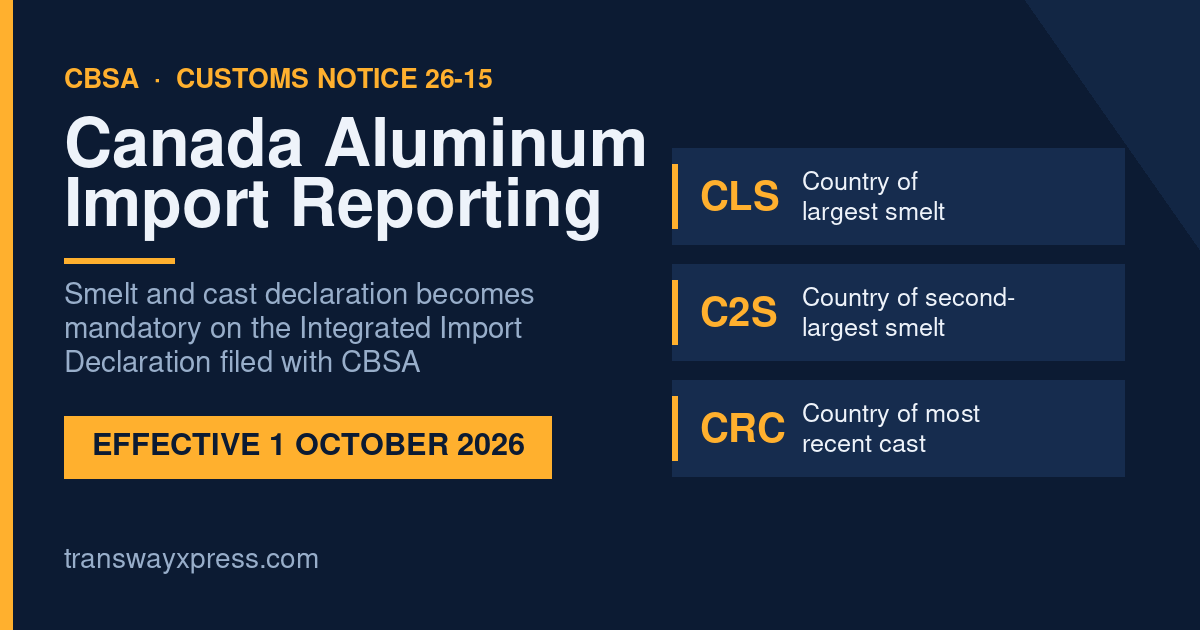
Canada aluminum import reporting changes on 1 October 2026, and it is the kind of change most e-commerce importers meet at the border rather than in their inbox. From that date, the Order Amending the General Import Permit No. 83 — Aluminum Products makes three country fields mandatory on the Integrated Import Declaration: the country of largest smelt, the country of second-largest smelt, and the country of most recent cast. Until 30 September those fields are optional. After it, they are part of a complete declaration. That is 21 days from today. If you bring aluminum bottles, tumblers, cookware, furniture components, bike parts or aluminum packaging into Canada, the answers sit with your supplier’s mill — not on your commercial invoice, and not in your product spec sheet.
What is Canada aluminum import reporting under GIP 83?
Certain aluminum products have been on Canada’s Import Control List for years under the Export and Import Permits Act. General Import Permit No. 83 (GIP 83) is the standing permit that lets you import them without applying for an individual permit each time. Nothing about that structure changes. What changes is how much you have to say about where the metal came from.
Global Affairs Canada proposed the amendment in Canada Gazette, Part I on 4 April 2026, describing it as a response to “requests from Canadian industry stakeholders as well as requests from the United States to continue to improve aluminum import monitoring.” CBSA then published the operational detail in Customs Notice 26-15. The order comes into force on 1 October 2026.
The three data elements CBSA will require
Two of the three apply only when a good contains primary aluminum. The third applies to everything GIP 83 covers.
| Data element | Code | When it is required | Where the answer comes from |
|---|---|---|---|
| Country of largest smelt | CLS | Goods containing primary aluminum | The smelter that produced the largest share of primary metal in the good |
| Country of second-largest smelt | C2S | Goods containing primary aluminum, where a second smelt country applies | The next-largest primary source; left blank if there is only one |
| Country of most recent cast | CRC | All goods covered by GIP 83 | The mill or foundry that last liquefied and solidified the metal |
What “smelt” and “cast” actually mean
The Gazette text defines these precisely, and the definitions matter because they are not intuitive. The country of largest smelt is “the country where the largest quantity of primary aluminum contained in a good was produced.” The country of second-largest smelt is the same test applied to the next-largest quantity. The country of most recent cast is “the country where the aluminum contained in a good was most recently liquefied and cast into a solid state.”
Read that last one twice. Casting is a physical event in a specific building. A tumbler extruded in Vietnam from a billet cast in Malaysia out of metal smelted in the United Arab Emirates has three different countries in play, and none of them has to be the country you write in the origin field.
Which shipments does Canada aluminum import reporting cover?
Scope sits in a matching-criteria table, not a tariff chapter
CBSA does not publish a short list of headings for this. The covered classifications are the aluminum HS codes listed in Global Affairs Canada’s Single Window Initiative Integrated Import Declaration Regulated Commodities Data Element Matching Criteria Table. Practically, that means the check belongs in your classification workflow: for each SKU, confirm whether its HS code is flagged for GIP 83 in the SWI matching table, and mark the SKU accordingly in your item master. Do not assume that “it is a finished consumer good, so it is out of scope” — the control attaches to the classification, not to how retail the product looks.
If your classifications are inherited from a supplier spreadsheet rather than reviewed line by line, this is the moment that shows. Our field-by-field commercial invoice guide covers the upstream discipline that makes this kind of check survivable.
The two exemptions, and why $5,000 is smaller than it sounds
Customs Notice 26-15 sets out two carve-outs. The requirements do not apply where the total value for duty is $5,000 or less, and they do not apply to Customs Self Assessment importers for goods released under paragraph 32(2)(b) of the Customs Act.
The $5,000 threshold reads generously until you look at how a replenishment programme actually moves. A single pallet of aluminum drinkware landed at a Canadian fulfillment centre clears $5,000 without difficulty, and consolidated ocean shipments clear it many times over. Treat the exemption as covering sample shipments and one-off replacements, not your production flow.
Why smelt and cast are not the same as country of origin
Four different questions, four possible answers
Most importers have one country in their head per SKU. This regime asks for as many as four, and they diverge more often than people expect.
| Question | What it identifies | Who normally knows it |
|---|---|---|
| Country of origin | Where the good was produced or substantially transformed | Your supplier |
| Country of export | Where the shipment was dispatched from | Your freight forwarder |
| Country of most recent cast (CRC) | Where the metal was last cast into solid form | Your supplier’s mill or billet vendor |
| Country of largest smelt (CLS) | Where the primary metal was smelted | The smelter, two or three tiers upstream |
The upstream problem this creates
CLS and C2S usually sit two or three tiers above your direct vendor. Your vendor buys extrusions; the extruder buys billet; the billet caster buys ingot or remelts scrap. Each handoff is a place where the answer can be lost. Asking your contract manufacturer in September and being told “we will check” is a normal outcome — which is exactly why the ask has to go out now rather than in the last week of the month.
Recycled content complicates it further. Goods made entirely from secondary aluminum contain no primary metal, so CLS and C2S do not arise; CRC still does, because every GIP 83 good was cast somewhere. Get your supplier to state which case applies, in writing, rather than inferring it.
What changes on 1 October 2026
Before and after, in one view
| Element | Until 30 September 2026 | From 1 October 2026 |
|---|---|---|
| CLS / C2S / CRC on the IID | Optional | Mandatory for covered goods |
| Permit basis | GIP 83 | GIP 83, as amended |
| Filing channel | Single Window Initiative IID | Unchanged |
| Low-value shipments | No requirement | Still exempt at or below $5,000 value for duty |
| Supplier data | Nice to have | A release dependency |
Customs Notice 26-15 does not publish a penalty schedule for a missing field, and it would be wrong to promise you one. The realistic exposure is simpler and more annoying than a penalty: an Integrated Import Declaration that omits a mandatory data element is an incomplete declaration, and incomplete declarations get queried before they get released. In a Q4 replenishment window, a two-day query on an inbound pallet is the difference between being in stock and being out of it.
The US has just run the same play with copper
If this pattern feels familiar, it should. CBP’s country-of-smelt-and-cast requirement for copper reaches its enforcement date on 14 September 2026, when ACE begins rejecting entry summaries that lack the data — we covered that in the copper smelt and cast reporting briefing. Two regulators, two metals, one direction of travel: origin declarations are being pushed back up the supply chain toward the furnace. Build the supplier-data process once and it will serve both.
Your 21-day Canada aluminum import reporting checklist
Week one: find out what you actually import
- Pull every SKU you ship into Canada and list its HS classification.
- Flag every classification that appears in the GAC SWI matching-criteria table for GIP 83.
- For each flagged SKU, record whether it contains primary aluminum, recycled aluminum, or a mix.
- Separate SKUs that only ever move in shipments at or below $5,000 value for duty — they are exempt, but confirm the pattern rather than assuming it.
Week two: get the data out of your suppliers
- Send one written request per vendor asking for CLS, C2S where applicable, and CRC per part number.
- Ask for the mill or foundry name alongside the country, so the answer can be checked later.
- Put the three fields into your purchase order template and your supplier onboarding pack, so new SKUs arrive with the data attached.
- Record the answers against the SKU in your item master, not in an email thread.
Week three: prove the filing works
- Give your customs broker the completed data set and ask them to transmit the fields on a live entry before 1 October, while they are still optional. A rehearsal that fails in September is free.
- Confirm the fields survive the trip from your system to the broker’s — a field that exists in your ERP but never reaches the IID is not compliance.
- Note which SKUs still have gaps and decide how to handle them: hold, re-source, or ship early.
- Check your CBSA account standing at the same time; our CARM guide for non-resident importers covers what has to be in place before any of this matters.
How Transway Xpress Global solves this
The failure here is rarely legal. It is that nobody owns the field. Your supplier knows the mill, your broker knows the declaration, and the two never meet inside one record. Transway Xpress Global sits in that gap. We run D2C and B2B fulfillment from warehouses in Oakville and Etobicoke, Ontario, and in Buffalo, New York, with an office in Pendleton, Indiana, and we are part of Transway Transport, an Oakville trucking company operating since 2014. Inbound receiving is where compliance data either gets captured or gets lost.
One record per SKU, carried into the declaration
When we receive your inbound freight, the SKU record we hold is the same record your broker draws on. Smelt and cast countries can live beside dimensions, case pack and HS code rather than in a separate compliance spreadsheet that ages badly. For brands running both sides of the border, that matters twice over: the same discipline that satisfies CBSA on aluminum satisfies CBP on copper, and it feeds the landed-cost work described in our landed cost guide.
It also connects to the tariff picture you are already managing. Surtax coding under Customs Notice 26-23 — covered in our surtax declaration codes briefing — and the relief routes in our duty deferral guide both depend on knowing exactly what is in a shipment and where it came from. This requirement is another instance of the same underlying job.
Summary
Three things to remember
First, the date is fixed: 1 October 2026, optional until 30 September, 21 days from the publication of this piece. Second, the data is upstream — CLS and C2S live with the smelter, not your vendor, and the lead time to get them is the real constraint. Third, the exemptions are narrower than they look; a $5,000 value-for-duty threshold does not cover a production replenishment programme.
Nothing here requires a new permit, a new account or a new fee. It requires three answers per SKU that most importers have never had to ask for. Start asking now, and 1 October is a non-event. Start on 29 September, and it is a release delay in the worst quarter of the year.
Frequently asked questions
What is Canada aluminum import reporting under GIP 83?
It is the requirement to declare where the aluminum in your goods was smelted and cast. Under the Order Amending the General Import Permit No. 83 — Aluminum Products, importers must state the country of largest smelt (CLS) and, where applicable, the country of second-largest smelt (C2S) for goods containing primary aluminum, plus the country of most recent cast (CRC) for every good the permit covers. The fields are submitted through the Single Window Initiative Integrated Import Declaration at the time of importation.
When does the requirement take effect?
1 October 2026. Submission of the smelt and cast fields is optional up to and including 30 September 2026, and mandatory from 1 October onward. As of the date of this article, that is 21 days away. CBSA set out the operational detail in Customs Notice 26-15, and Global Affairs Canada published the underlying order in Canada Gazette, Part I on 4 April 2026.
Are small shipments exempt from the new reporting?
Yes, within limits. Customs Notice 26-15 states that the requirements do not apply where the total value for duty is $5,000 or less, and they do not apply to Customs Self Assessment importers for goods released under paragraph 32(2)(b) of the Customs Act. That covers samples and small one-off replacements. A consolidated pallet of aluminum drinkware or cookware will normally sit well above the threshold, so most replenishment shipments are in scope.
Is country of cast the same as country of origin?
No, and treating them as interchangeable is the most common way to get this wrong. Country of origin identifies where the good was produced or substantially transformed. Country of most recent cast identifies where the metal itself was last liquefied and solidified, which can be several tiers and several countries upstream of your supplier. A product with Vietnamese origin can carry a Malaysian cast country and an entirely different smelt country. Ask for each field separately.
What happens if I file without the smelt and cast data?
Customs Notice 26-15 does not publish a penalty schedule. The practical consequence sits at release: from 1 October, a declaration missing a mandatory data element is incomplete, and incomplete declarations invite queries and holds rather than automatic release. In peak season, that delay costs more than the compliance work would have. The safe approach is to transmit the fields on a live entry in September, while they are still optional, and confirm the filing works end to end.
Bringing aluminum goods into Canada this quarter? We can review your inbound SKUs, tell you which ones fall under GIP 83, and set up the receiving record that carries smelt and cast data through to your broker. Book a consultation with Transway Xpress Global, or see how our Canadian e-commerce fulfillment and India-to-Canada customs clearance services fit together.