A commercial invoice for customs is the single document that decides whether your shipment clears the border in hours or sits in a bonded warehouse for a week. Border officers at the Canada Border Services Agency (CBSA) and U.S. Customs and Border Protection (CBP) do not open your cartons first — they read the commercial invoice for customs and compare it against the electronic declaration your broker filed. Every duty rate, tax calculation and origin claim traces back to what you wrote on that one page. The stakes rose sharply in 2026: the United States indefinitely suspended its US$800 de minimis exemption on 24 June 2026, so parcels that once crossed on a manifest now need a formal or informal entry — and a properly completed invoice behind it. This guide covers every required field for both borders, the Canada-specific CI1 rules, and the mistakes that most often trigger a hold.
What Is a Commercial Invoice for Customs?
A commercial invoice is the seller’s record of an international sale. Customs authorities use it as the primary evidence of what is in the shipment, what it is worth, where it was made and who is responsible for paying duty. It is a customs document first and an accounting document second.
The Document Customs Officers Actually Read
When a broker files an entry, the data on that entry has to be supportable. If CBSA or CBP asks for backup, the commercial invoice is what gets produced. CBSA can request the documentation and expects it within seven days of the request, per Memorandum D1-4-1. An invoice that contradicts the entry is not a paperwork problem — it is a valuation or origin discrepancy, and those carry penalties.
Commercial Invoice vs. Packing List vs. Bill of Lading
These three documents travel together and are routinely confused. They answer different questions, and customs reads them for different reasons.
| Document | What it establishes | Issued by | Customs uses it to |
|---|---|---|---|
| Commercial invoice | Value, description, origin, terms of sale | Seller / exporter | Assess duty, tax and admissibility |
| Packing list | Carton count, weights, dimensions, contents per box | Seller or fulfillment centre | Verify the physical shipment on examination |
| Bill of lading / air waybill | Contract of carriage and title to the goods | Carrier or freight forwarder | Confirm the mode, route and consignee |
| Certification of origin | Preferential tariff eligibility (e.g. CUSMA) | Exporter, producer or importer | Grant or deny a preferential duty rate |
What Fields Must a Commercial Invoice for Customs Contain?
Both borders publish explicit field lists. They overlap heavily, but they are not identical, and a template built only for one border will eventually fail at the other.
CBSA Field Requirements for Imports into Canada
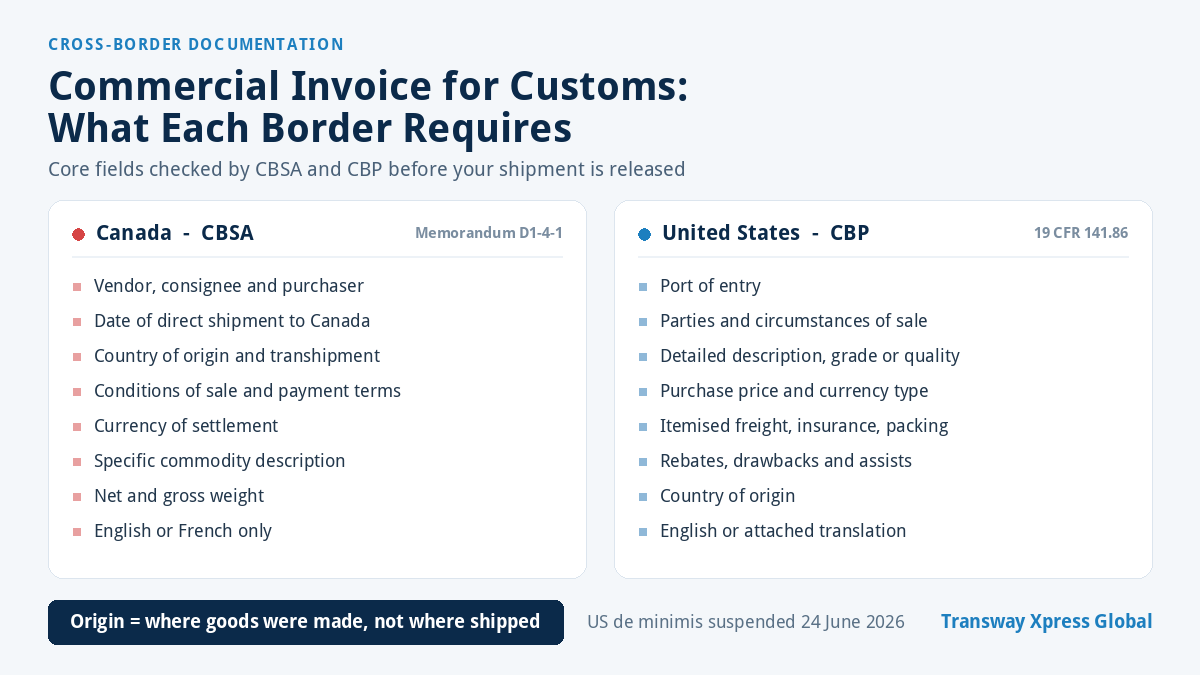
CBSA’s Memorandum D1-4-1 sets out 25 required data fields in its Appendix A. The essentials are the vendor, the consignee, the purchaser, the date of direct shipment to Canada, the country of origin, the country of transhipment, the mode of transport, conditions of sale and payment terms, currency of settlement, number of packages, a specific description of the commodities, quantity, unit price, total price per line, net and gross weight, and the invoice total. Invoices submitted to CBSA must be in English or French.
CBP Field Requirements for Imports into the United States
The U.S. list lives in 19 CFR 141.86. It requires the port of entry, the parties and circumstances of the sale, a detailed description of the merchandise including the name by which each item is known and its grade or quality, quantities, purchase price per item in the currency of sale, the currency type, itemised charges such as freight, insurance, commission and packing, any rebates or drawbacks, the country of origin, and the value of any assists furnished to production. The invoice must be in English or carry an accurate English translation, and it must name an employee of the exporter with knowledge of the transaction.
| Field | CBSA (Canada) | CBP (United States) |
|---|---|---|
| Governing rule | Memorandum D1-4-1, Appendix A | 19 CFR 141.86 |
| Number of prescribed fields | 25 | 11 lettered items plus general rules |
| Language | English or French | English, or an attached accurate translation |
| Country of origin | Required — where grown, produced or manufactured | Required |
| Itemised freight and insurance | Required as pricing adjustments | Required, itemised separately |
| Terms of sale / payment | Required (conditions of sale and terms of payment) | Required (circumstances of the sale) |
| Named responsible person | Not prescribed as a separate field | Required — an exporter employee with transaction knowledge |
| Port of entry | Not a prescribed invoice field | Required |
Canada Customs Invoice (CI1) vs. Commercial Invoice
Importers into Canada frequently ask whether they need the government’s own form. The answer depends on how complete your own invoice is.
The Three Accepted Documentation Options
CBSA accepts any one of three approaches for commercial shipments. First, a commercial invoice on its own, provided it carries all of the Appendix A information. Second, a commercial invoice showing the buyer, seller, price and description, paired with a Form CI1 Canada Customs Invoice supplying whatever the commercial invoice omits. Third, a fully completed CI1 on its own. Most established sellers choose option one and build the missing fields into their invoice template, because it removes a document from every shipment.
When the CAD $2,500 Exemption Applies
CBSA allows a commercial invoice or other supporting document to stand in for a fully completed CI1 in a defined set of cases: where the value for duty does not exceed CAD $2,500, for Canadian goods returned where the value has increased but stays under that threshold, for goods that are unconditionally duty free regardless of price, and for goods classified under tariff item 9810.00.00.00. Note that this is a documentation concession, not a duty or tax exemption — the goods are still assessed normally, and the underlying data still has to be accurate.
How Do Origin, HS Codes and CUSMA Claims Fit on the Invoice?
Origin is where most preventable duty overpayments and most origin penalties both originate. It is also the field where cross-border sellers most often guess.
Country of Origin Is Not the Country You Shipped From
CBSA defines country of origin as where the goods were grown, produced or manufactured — not where they were warehoused, consolidated or last handled. Goods manufactured in India and shipped to a Canadian buyer out of a U.S. warehouse are still Indian-origin goods. This distinction matters directly: North American preferential rates under CUSMA apply only to goods that originate in Canada, the United States or Mexico under the agreement’s rules of origin. Moving inventory through a North American warehouse does not confer North American origin, and claiming otherwise on a commercial invoice for customs is a misdeclaration. Our guide to CUSMA rules of origin covers how the qualifying tests actually work.
Putting a CUSMA Certification of Origin on Your Invoice
A CUSMA certification of origin does not require a prescribed government form. CBSA confirms it may be provided on an invoice or any other document, and may be completed and submitted electronically, including with an electronic or digital signature. It must carry nine minimum data elements: the certifier’s role (exporter, producer or importer); the certifier’s name, title, address, telephone and email; the exporter’s details; the producer’s details; the importer’s details; a description of the good with its six-digit HS classification; the applicable origin criterion; a blanket period if it covers multiple shipments over up to twelve months; and an authorised signature with date. See CBSA’s guidance on certifying the origin of goods.
For commercial importations into Canada valued below CAD $3,300, CBSA waives the requirement for proof of origin. At or above that value, proof of origin must be provided to claim the preferential rate.
What Changed in 2026 for Low-Value Shipments?
The documentation floor moved in the United States this year, and it moved in a direction that puts more shipments in scope for a full commercial invoice.
The U.S. De Minimis Suspension
CBP’s interim final rule, effective 24 June 2026, indefinitely suspends the US$800 de minimis exemption for merchandise arriving through all modes other than the international postal network, implementing Executive Order 14324. Shipments that previously moved under de minimis now use standard entry procedures — informal entry for merchandise valued at US$2,500 or less, with Entry Type 11 identified as the main appropriate informal method, or formal entry. The statutory termination of the exemption is scheduled for 1 July 2027 under the One Big Beautiful Bill Act. The practical effect for direct-to-consumer brands is that parcel-level invoice data now has to be correct at scale, not just on pallet shipments. We covered the commercial fallout in our analysis of the end of de minimis.
Canada’s Low-Value Thresholds
Canada’s courier low-value thresholds under CUSMA are unchanged and remain considerably lower than the old U.S. figure.
| Shipment value (CAD) | Duty | Tax (GST/HST) | Practical implication |
|---|---|---|---|
| Up to $40 (courier, US/Mexico origin) | None | None | Simplified courier release |
| $40 to $150 (courier, US/Mexico origin) | None | Applies | Tax collected at import |
| Above $150 | Applies | Applies | Full assessment; accurate invoice essential |
| Below $3,300 | As assessed | As assessed | Proof of origin requirement waived |
| $3,300 and above | As assessed | As assessed | Proof of origin required for preferential claims |
If you are modelling what any of this costs before you ship, our walkthrough on how to calculate landed cost shows where invoice values feed into the duty and tax calculation, and stopping surprise customs fees covers who absorbs them.
Commercial Invoice Compliance Checklist
Run this before the shipment leaves. Nearly every hold we see traces back to one of these lines.
Before Every Shipment
| Check | Requirement | Why it matters |
|---|---|---|
| Goods description | Specific commodity name, grade or quality, not a category | “Apparel” invites an exam; “women’s knitted cotton cardigan” does not |
| HS classification | Six-digit minimum per line, consistent across shipments | Drives the duty rate and any preferential claim |
| Country of origin | Where manufactured, stated per line item | Origin errors are penalty exposure, not clerical errors |
| Declared value | Actual transaction price, in the currency of settlement | Under-valuation is the most penalised invoice error |
| Incoterms | Stated explicitly (DDP, DAP, FOB and so on) | Determines who is the importer of record and who pays duty |
| Freight and insurance | Itemised separately from goods value | Affects value for duty; bundling can inflate the assessment |
| Parties | Vendor, consignee and purchaser all named with full addresses | A missing purchaser is a common CBSA rejection |
| Weights and counts | Net and gross weight, package count matching the packing list | Mismatches with the manifest trigger examination |
Errors That Trigger Customs Holds
- Vague descriptions. “Samples”, “gifts”, “parts” and “assorted goods” are not classifiable descriptions.
- Zero or nominal values on samples. Free-of-charge goods still need a fair market value and a note explaining the basis.
- Origin stated as the shipping country. The most common error among brands using a third-country warehouse.
- Currency omitted. “1,200” without a currency code is unusable for valuation.
- Invoice totals that do not add up. Line totals must reconcile to the invoice total exactly.
- Terms of sale left blank. Without them, the broker cannot determine who is responsible for duty. Our comparison of DDP vs DAP explains the downstream consequences.
How Transway Xpress Global Handles Commercial Invoice Documentation
Most invoice failures are not knowledge failures — they are volume failures. A brand that gets the paperwork right on a single pallet gets it wrong on the two-hundredth parcel because the data was re-keyed by hand somewhere in the chain.
Documentation Prepared at the Fulfillment Centre
Transway Xpress Global operates warehouses in Oakville and Etobicoke, Ontario and in Buffalo, New York, with an office in Pendleton, Indiana, backed by trucking parent Transway Transport, which has run cross-border freight out of Oakville since 2014. Because order data, inventory records and shipping documentation sit in the same system, the description, value, origin and weight that appear on a commercial invoice for customs are the same values held against the SKU in the warehouse — not a separate set typed later.
That matters most for brands running both directions. Serving Canadian and U.S. customers from Ontario and Buffalo means goods cross the border on your terms, in planned consolidated movements with consistent documentation, rather than parcel by parcel with whatever the checkout captured. If you are still deciding where inventory should sit, our comparison of US vs Canada warehousing and the wider cross-border e-commerce fulfillment guide are the places to start. International brands entering North America should also review foreign brand compliance requirements for selling in Canada, since labelling and origin marking obligations sit alongside the invoice ones.
Key Takeaways
What to Fix First
If you change only three things, change these. Put a specific, classifiable description and a six-digit HS code on every line. State the true country of manufacture per line, independent of where the goods shipped from. Itemise freight, insurance and any discounts separately from the goods value. Those three fields account for the large majority of border holds and the large majority of valuation disputes.
Beyond that, treat your invoice template as a compliance artefact rather than a billing document. Build the full CBSA Appendix A field set into it once, add the 19 CFR 141.86 items that CBSA does not require, and you have one template that works in both directions. With the U.S. de minimis exemption suspended, that template now applies to a far larger share of your volume than it did a year ago.
Frequently Asked Questions
What is a commercial invoice for customs?
A commercial invoice for customs is the seller’s document describing an international sale, used by border agencies as the primary evidence of what is being imported, its value, its country of origin and who is responsible for duty. It supports the electronic entry your broker files. CBSA requires 25 data fields under Memorandum D1-4-1, and CBP requires the items listed in 19 CFR 141.86. It is not the same as a packing list or a bill of lading, though all three usually travel together.
Is a commercial invoice for customs the same as a Canada Customs Invoice?
No. The Canada Customs Invoice, Form CI1, is a CBSA form. A commercial invoice is your own document. CBSA accepts a commercial invoice on its own if it contains all the information in Appendix A of Memorandum D1-4-1, or a commercial invoice paired with a CI1 that fills in the gaps, or a completed CI1 alone. Most regular importers extend their own invoice template to cover the full field list and skip the CI1 entirely.
Do I need a CUSMA certification of origin on my invoice?
Only if you are claiming a preferential CUSMA rate, and only if the goods actually originate in Canada, the United States or Mexico under the agreement’s rules of origin. There is no prescribed form — CBSA accepts the certification on an invoice or any other document, including electronically, provided it carries the nine minimum data elements. For commercial importations into Canada below CAD $3,300, the proof of origin requirement is waived.
What happens if the value on my commercial invoice is wrong?
An incorrect value is a valuation error, and both CBSA and CBP treat it as substantive rather than clerical. In practice the shipment is held, the broker requests corrected documentation, and the entry is re-filed — adding days and storage costs. Repeated or material understatement can lead to reassessment of past entries and administrative monetary penalties. If you discover an error after release, the correct route is a voluntary correction through your broker, not a silent fix on the next shipment.
How long does customs clearance take with a correct invoice?
Clearance times vary by mode, port and whether the shipment is selected for examination, so no provider can promise a fixed figure. What a complete commercial invoice for customs does is remove the largest controllable source of delay: the document request. When the entry data is fully supported on first submission, the shipment moves on the carrier’s normal schedule instead of waiting for a corrected invoice to be sourced, translated or re-issued.
Shipping into Canada or the United States and want your customs documentation handled at the same place your inventory sits? Book a consultation with Transway Xpress Global and we will review your current invoice template, origin data and cross-border flow against what CBSA and CBP actually require.