The Section 338 comment period opened on 9 September 2026, and most cross-border shippers have not noticed it. That is a mistake. Section 338 is the same statute Washington used to put an additional 50 percent duty on certain Canadian products in August, and to bar another set of Canadian goods from entering the United States at all from 29 September 2026. The U.S. International Trade Commission is now writing the procedures it will use to decide which foreign practices reach the President next, and it is asking importers to tell it how. Comments close at 5:15 p.m. on 9 November 2026 — 55 days from the date of this post. If your supply chain crosses the Canada–U.S. border, this docket is the cheapest influence you will buy all year.
What is the Section 338 comment period, and what did the USITC ask?
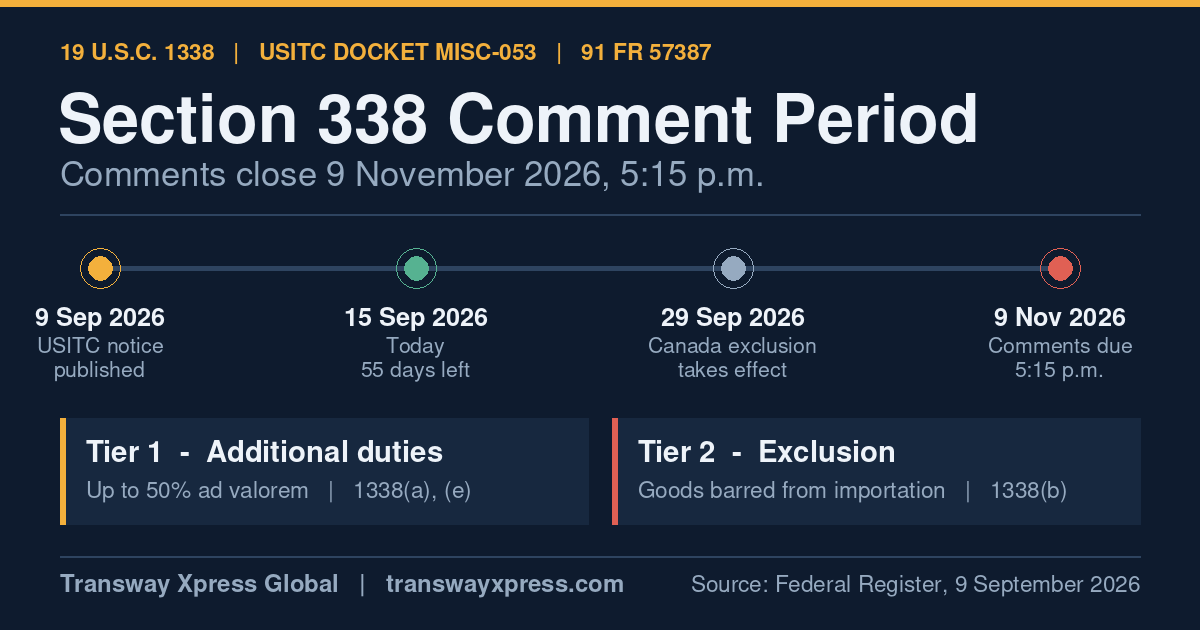
On 9 September 2026 the U.S. International Trade Commission published a Request for Comments Regarding Implementation of 19 U.S.C. 1338(g) at 91 FR 57387. The notice carries docket number MISC-053. The Section 338 comment period runs until 5:15 p.m. on 9 November 2026. Submissions go through the Commission’s Electronic Document Information System (EDIS) or by email to [email protected] with MISC-053 in the subject line.
The subsection at the centre of this comment period is short. Under 19 U.S.C. 1338(g), it is “the duty of the commission to ascertain and at all times to be informed whether any of the discriminations against the commerce of the United States … are practiced by any country; and if and when such discriminatory acts are disclosed, it shall be the duty of the commission to bring the matter to the attention of the President, together with recommendations.” That is a standing monitoring obligation with no filing window and no petitioner. The Commission is now deciding how to discharge it in practice, and the comment period is where that gets decided.
The questions the Commission put on the record
The notice asks for input across five areas. Each one is a lever, and each one is worth a paragraph of your comment:
- How the Commission should define “unreasonable” and “discriminatory” conduct in international commerce.
- The methods foreign governments actually use to burden or restrict U.S. commerce.
- How the Commission should gather relevant information from the public — the mechanics of who it hears from and how often.
- How it should analyze what it finds and communicate findings and recommendations to the President.
- Whether its reports under this authority should be made public. Historically they were not.
The Commission also flags confidentiality directly. It wants comment on disclosure risks that could discourage businesses from coming forward with what they know. If you have ever declined to describe a foreign barrier because a named filing would expose you to a supplier or a customs administration, that is exactly the input this comment period is soliciting.
Why a procedural notice matters more than it looks
Trade teams triage by urgency, and a request for comments looks like the opposite of urgent. It is not. Section 338 has moved from a dormant 1930 provision to an active instrument inside a single year, and the machinery being built during this comment period is what feeds the next round. A definition of “discriminatory” written narrowly produces one set of future proclamations. Written broadly, it produces another. Importers who ship under the resulting duties get no vote at the proclamation stage — only at this one.
Why Section 338 already affects your Canadian shipments
This is not a hypothetical statute. It is live against Canada right now, which is why the Section 338 comment period should matter to any brand moving goods across the border.
Tier one — additional duties up to 50 percent
Subsection (a) directs the President, on finding that the public interest will be served, to “specify and declare new or additional duties” on articles from a country that discriminates against U.S. commerce. Subsection (e) caps those duties at “50 per centum ad valorem or its equivalent.” In July 2026 the President invoked that authority against certain Canadian products in a motor-vehicle proclamation, imposing an additional 50 percent ad valorem duty effective 12:01 a.m. eastern time on 19 August 2026. The proclamation is explicit that these duties “are in addition to any other duties, taxes, fees, exactions, and charges applicable to such products.” A parallel proclamation addressed alcoholic beverages under the same statute.
Tier two — exclusion from importation
Subsection (b) is the escalation. Where discrimination continues after the first proclamation, the President may direct that products of that country “shall be excluded from importation into the United States.” That is not a duty you can price in. It is a closed door. A September 2026 proclamation applied it to certain Canadian products effective 12:01 a.m. eastern time on 29 September 2026, with goods already imported but not yet entered for consumption before that moment remaining subject to the 50 percent duty rate instead. We covered the operational detail in our breakdown of the Section 338 import ban taking effect 29 September.
A CUSMA claim is not a shield
This is the single most expensive misreading we see. CUSMA preference reduces the ordinary customs duty on goods that qualify as originating in Canada, the United States or Mexico. It does not switch off a Section 338 duty, because that duty is imposed on products of a country found to discriminate and sits on top of ordinary duty treatment. Filing a valid CUSMA certification of origin is still correct and still saves money on the ordinary rate — it is simply not a defence against this statute.
Two related traps are worth naming in the same breath. Goods of Indian origin never qualify for CUSMA preference, whatever route they take into North America; routing through an Ontario warehouse does not create Canadian origin. And a country-of-origin marking is not an origin determination — the substantive rules are what govern. If you are unsure which duties actually land on a shipment, our guide to calculating landed cost for cross-border e-commerce walks the stack from ordinary duty through surtaxes and additional duties.
Section 338 at a glance
The table below sets out the three stages of the mechanism and where each one stands as of 15 September 2026.
| Stage | Statutory basis | What it authorizes | Status as of 15 September 2026 |
|---|---|---|---|
| Commission monitoring | 19 U.S.C. 1338(g) | USITC must ascertain and at all times be informed of discriminations against U.S. commerce, and bring them to the President with recommendations | Implementation procedures open for public comment — docket MISC-053, closing 9 November 2026 |
| First proclamation — additional duties | 19 U.S.C. 1338(a) and (e) | New or additional duties, capped at 50 per centum ad valorem or its equivalent, in addition to all other duties | In force against certain Canadian products; additional 50 percent duty effective 12:01 a.m. ET, 19 August 2026 |
| Second proclamation — exclusion | 19 U.S.C. 1338(b) | Products of the country may be excluded from importation into the United States entirely | Proclaimed; exclusion effective 12:01 a.m. ET, 29 September 2026 |
How to file during the Section 338 comment period
Filing is free, it does not require counsel, and the record is thin enough that a specific operational comment carries real weight. Here is what the comment period requires.
| Item | Detail |
|---|---|
| Docket number | MISC-053 |
| Federal Register citation | 91 FR 57387, published 9 September 2026 |
| Deadline | 9 November 2026, 5:15 p.m. |
| Days remaining from 15 September 2026 | 55 |
| How to file | EDIS, or email [email protected] with MISC-053 in the subject line |
| Cost to file | None |
| Who the Commission is asking | The public — importers, exporters, carriers, brokers and trade associations |
Evidence that carries weight
Agencies discount adjectives and credit specifics. A comment that says foreign barriers are burdensome adds nothing. A comment that describes a documented charge, a named administrative practice, the tariff lines it touches and the dollar effect on a defined volume of trade is evidence the Commission can use. Where you can, tie the practice to an entry, a customs ruling or a published fee schedule rather than to a recollection.
What to say about confidentiality
Because the Commission asked about it explicitly, say something. If you would only describe a foreign practice under a business-confidential designation, write that down and explain the commercial exposure. If public reporting would help you — because it puts a barrier on the record your competitors also face — write that down too. This is the one part of the comment period where a short, honest paragraph from an operating business is more useful than a legal brief.
Your action list before the Section 338 comment period closes
In the next two weeks
- Pull every HTS line you imported from Canada in the last twelve months and flag any that appear in the August duty proclamation or the September exclusion annex.
- Confirm with your broker which of your Canadian-origin entries after 29 September 2026 are affected by the exclusion rather than the 50 percent duty, and reroute or re-source where they are.
- Check that goods already on the water are classified against the right date. Entry timing, not shipment timing, controls which treatment applies.
- Separate your U.S.-inbound and Canada-inbound duty exposure. They now move under different statutes and different clocks — see our note on Canada surtax declaration codes for the northbound side.
Before 9 November 2026
- Draft a comment of one to three pages. Address the definition question first, the information-gathering question second, and confidentiality third.
- Quantify. One table of tariff lines, volumes and duty paid is worth ten paragraphs of narrative.
- Decide your confidentiality position before you write, not after.
- File through EDIS with MISC-053 in the subject line, and keep the filing receipt with your compliance records.
- Diarize the closing date. The Commission set a clock time as well as a date, and 5:15 p.m. on the deadline is a hard stop.
While the comment period runs, keep the relief channels you already have open. Importers on the Canadian side should review our summaries of Canada counter-tariff relief and of duty deferral programs in Canada and the US, and non-resident importers should confirm their standing under CARM requirements. The wider picture is in our overview of US–Canada tariffs in 2026.
How Transway Xpress Global helps you plan around this
Transway Xpress Global runs cross-border fulfillment out of warehouses in Oakville and Etobicoke, Ontario, and in Buffalo, New York, with an office in Pendleton, Indiana. The company grew out of Transway Transport, an Oakville trucking business operating since 2014, which is why the border sits at the centre of how we think about inventory rather than at the edge of it.
The practical value during a period like this one is positioning. When a statute can move a product from a duty to an outright exclusion on a fixed date, where your inventory is sitting on that date decides what it costs you. Holding U.S.-bound stock in Buffalo and Canada-bound stock in Ontario means a change on one side of the border does not strand the other side’s demand. We handle D2C and B2B fulfillment, Amazon FBA prep, warehousing, order and inventory management, cross-border shipping, returns and custom packaging — so the inventory split is an operating decision, not a new vendor search.
We do not file comments for clients or give legal advice on classification. What we do is make sure the physical answer to a regulatory question is already in place: stock on the right side of the line, entries timed against the right date, and a fulfillment footprint that does not depend on any single border treatment holding still.
Summary
What to take away
The Section 338 comment period is a rare open door into a statute that is currently being used against Canadian goods in both of its forms — a 50 percent additional duty and an outright exclusion from importation. The USITC is deciding how it will identify discriminatory foreign practices and what it will tell the President, and it has asked the public how to do it. Comments are due by 5:15 p.m. on 9 November 2026 under docket MISC-053, which leaves 55 days from 15 September 2026. Filing costs nothing. Meanwhile, treat the 29 September exclusion date as a hard operational deadline, confirm which of your entries fall on which side of it, and remember that a CUSMA claim reduces ordinary duty without touching a Section 338 duty at all.
Frequently asked questions
What is the Section 338 comment period?
It is a public comment docket opened by the U.S. International Trade Commission on 9 September 2026, published at 91 FR 57387 under docket MISC-053. The Commission is asking how it should implement 19 U.S.C. 1338(g), the provision requiring it to stay informed of foreign discrimination against U.S. commerce and to report findings and recommendations to the President. Comments close at 5:15 p.m. on 9 November 2026 and can be filed through EDIS or by email to [email protected].
How long is left in the Section 338 comment period?
As of 15 September 2026, 55 days remain. The deadline is 9 November 2026 at 5:15 p.m. The Commission specified a clock time as well as a date, so a filing that lands late in the evening on the closing day is out of time. Build in a day of margin, particularly if you are filing through EDIS for the first time and need to register.
Does Section 338 apply to goods that qualify under CUSMA?
Yes. CUSMA preference lowers the ordinary customs duty on goods originating in Canada, the United States or Mexico. A Section 338 duty is imposed separately on products of a country found to discriminate against U.S. commerce, and the July 2026 proclamation states plainly that its duties apply in addition to any other duties, taxes, fees, exactions and charges. Continue filing valid CUSMA claims for the ordinary rate, but do not model them as protection against this statute.
What can the President actually do under Section 338?
Two things, in sequence. Subsections (a) and (e) allow new or additional duties capped at 50 per centum ad valorem or its equivalent. If the discrimination continues, subsection (b) allows a further proclamation excluding those products from importation into the United States altogether. Both have now been used against certain Canadian products, with the duty effective 19 August 2026 and the exclusion effective 29 September 2026.
Should a small importer bother filing a comment?
Yes, and small filers are often the most useful. The Commission asked how it should gather information from the public and what discourages businesses from providing it — questions a small importer can answer from direct experience better than a trade association can. A focused two-page comment describing one documented barrier, the tariff lines it affects and its cost to your business is a complete and credible submission.
If you are weighing where to hold inventory while the Section 338 comment period runs and the 29 September exclusion takes effect, we can map your U.S. and Canadian volumes against both dates and show you what a split footprint would cost. Book a consultation with Transway Xpress Global and bring your HTS lines — that conversation is far more useful with the numbers in front of us.