The US China tariff reduction list landed on 27 September 2026, and it is already reshaping how brands plan first-quarter sourcing. Published alongside the new U.S.-China Board of Trade, the US China tariff reduction list names 77 numbered tariff lines — household textiles, small kitchen appliances, toys, glass Christmas ornaments and children’s furniture — that Washington has recommended for reduced duty treatment when the goods originate in China. No rate has been published. No effective date exists. That gap between a published recommendation and a filed customs entry is precisely where importers lose money, either by repricing too early or by missing relief they will eventually qualify for. Here is what the framework actually says, which categories made the cut, and what belongs on your desk this week.
What Happened on 27 September 2026
The White House released four documents together: working procedures for a new U.S.-China Board of Trade, terms of reference for a framework the two governments are calling “30-for-30”, and two product lists. The Board of Trade release describes a government-to-government body for managing bilateral trade, with Principals who approve decisions and Deputies who monitor beneath them.
What the US China Tariff Reduction List Actually Is
The US China tariff reduction list is a recommendation, not a rate schedule. The terms of reference state that reductions “will be determined and implemented in accordance with each side’s domestic legal processes.” In plain language: the two governments have agreed on which goods deserve lower duties, and each will now run that through its own rulemaking machinery. For the United States, that means a Federal Register process has to happen before any broker can key a reduced rate into an entry summary.
This distinction matters more than it sounds. A tariff reduction list carries no legal effect at the border on its own, so your duty liability on a container arriving next week is exactly what it was in August.
Why “30-for-30” Means $30 Billion on Each Side
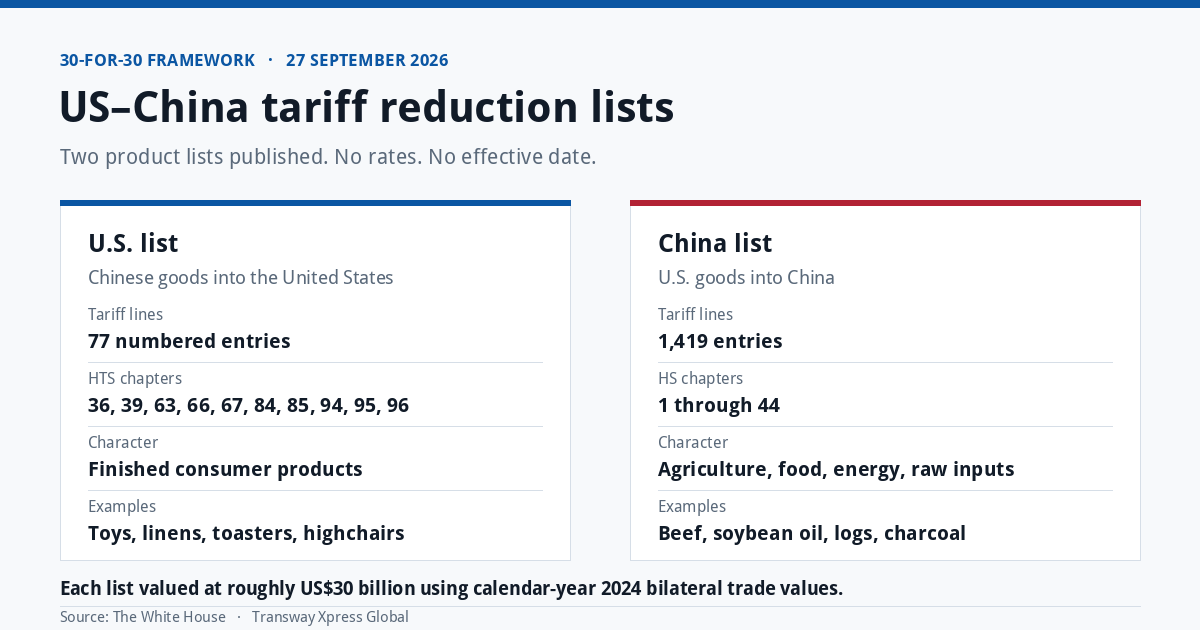
The framework takes its name from its scale. The terms of reference describe “lists of mutually agreed upon imported goods totaling roughly $30 billion on each side,” with those values calculated from annual bilateral trade values for calendar year 2024. The Principals approved two comparably valued lists; the Deputies will monitor bilateral trade and may propose adjustments on at least an annual basis, and may put additional products forward for consideration later.
Two things follow. First, the dollar figure describes trade volume covered, not duty savings. Second, because adjustments are explicitly annual, this tariff reduction list is a living document — a SKU excluded today is not excluded permanently.
Which Product Categories Made the US Tariff Reduction List?
This is where the news stops being macroeconomics and starts being your catalogue. The 77 entries on the US tariff reduction list sit in HTS chapters 36, 39, 63, 66, 67, 84, 85, 94, 95 and 96 — a consumer-goods footprint that maps directly onto what most Amazon and direct-to-consumer sellers import.
Home, Kitchen and Small Appliance Lines
Chapter 63 covers the soft goods: bed and table linens, toilet and kitchen textiles, curtains, wall hangings and pillow covers. Electric blankets appear here too, classified as textiles rather than appliances — a detail that trips up sellers who assume anything with a cord lives in chapter 85.
The appliance entries are narrower than the chapter headings suggest. The list names electromechanical food grinders, processors, mixers and juice extractors (85094000), microwave ovens of a kind used for domestic purposes (85165000), electrothermic coffee or tea makers and toasters (85167100 through 85167900), shavers with a self-contained electric motor (85101000), and personal weighing machines including baby scales (84231000). “Domestic purposes” is doing real work in that microwave entry; a commercial unit is a different classification question.
Toys, Holiday Goods and Children’s Furniture
Toys under 95030000 — tricycles, scooters, pedal cars, dolls and puzzles — are on the tariff reduction list, with an exclusion that will catch a lot of sellers: wireless-enabled items are carved out, including anything using radio frequency, Wi-Fi, Ethernet or Bluetooth. A plush toy qualifies. The same plush toy with a Bluetooth speaker sewn into it does not.
Holiday goods appear through articles for Christmas festivities and ornaments of glass (95051010), where the material is specified. Children’s furniture in chapter 94 is restricted to defined subsets: highchairs and booster seats, infant walkers, and play yards and other enclosures for confining children (94037040 through 94037080).
| Category | Chapter or code | On the list | What to watch |
|---|---|---|---|
| Household textiles | 63 | Bed and table linens, toilet and kitchen textiles, curtains, wall hangings, pillow covers | Fibre content and made-up status drive the classification |
| Electric blankets | 63 | Electric blankets | Sits with textiles, not appliances |
| Small kitchen appliances | 8509, 8516 | Food grinders, processors, mixers, juice extractors; microwave ovens; coffee and tea makers; toasters | “Domestic purposes” wording excludes commercial units |
| Personal care and scales | 8423, 8510 | Personal weighing machines including baby scales; shavers with self-contained motor | Battery vs mains construction affects classification |
| Toys | 9503 | Tricycles, scooters, pedal cars, dolls, puzzles | Wireless-enabled toys excluded (RF, Wi-Fi, Ethernet, Bluetooth) |
| Holiday goods | 9505 | Articles for Christmas festivities, ornaments of glass | Material is specified — glass is called out |
| Children’s furniture | 9403 | Highchairs, booster seats, infant walkers, play yards and child enclosures | Narrow subsets, not the whole heading |
| Sports and leisure | 95 | Billiards equipment, playing cards, sports balls and rackets, fishing gear | Check the specific entry, not the chapter |
| Other consumer goods | 36, 39, 66, 67, 96 | Plastics articles, umbrellas, artificial flowers, vacuum flasks, artist brushes | Subset entries throughout |
How the Two Lists Compare
The two sides did not build symmetrical lists, and the asymmetry tells you something about what each government was protecting.
Breadth Versus Depth
The US list is short and deep: 77 entries, almost all finished consumer products, drilled down to eight- and ten-digit specificity. The China Import List runs to 1,419 entries across HS chapters 1 through 44 — agriculture, food, oils, fuels and raw materials, including improved breeding horses, fresh and chilled deboned beef, sea cucumber, virgin soybean and peanut oil, coniferous logs and charcoal.
For a brand importing into North America, only the US tariff reduction list matters operationally. The shape of the Chinese column is still a useful signal: it is weighted toward commodities, which are easier to adjust quickly than manufactured goods.
| Dimension | US list (Chinese goods into the US) | China list (US goods into China) |
|---|---|---|
| Tariff lines | 77 numbered entries | 1,419 entries |
| Chapters covered | 36, 39, 63, 66, 67, 84, 85, 94, 95, 96 | 1 through 44 |
| Character of goods | Finished consumer products | Agricultural, food, energy and raw inputs |
| Representative items | Toys, linens, toasters, highchairs, glass ornaments | Breeding horses, deboned beef, soybean and peanut oil, logs, charcoal |
| Value basis | Roughly $30 billion, CY2024 trade values | Roughly $30 billion, CY2024 trade values |
| Rates published | None | None |
| Effective date | Not set — domestic legal process required | Not set — domestic legal process required |
| Review cadence | At least annual, per the terms of reference | At least annual, per the terms of reference |
What This Tariff Reduction List Does Not Change
Three misreadings are already circulating, and each one costs money.
No Published Rates, No Entry-Level Change Yet
You cannot file against this. There is no new HTS subheading, no reduced rate in the tariff schedule, and no CBP guidance message implementing one. Until the United States completes its own rulemaking, every entry is classified and dutied exactly as it was before the tariff reduction list appeared on 27 September. If your broker tells you otherwise, ask which Federal Register notice they are relying on.
Canada’s Treatment of Chinese-Origin Goods Is Untouched
This is the point most relevant to our Canadian clients, and the easiest to get wrong. The 30-for-30 framework is bilateral between the United States and China. Canada is not a party to it, and the terms of reference commit only the two signatories to act through their own legal processes. Nothing in this tariff reduction list alters what the Canada Border Services Agency assesses on Chinese-origin goods entering Canada. If you run a dual-market operation out of an Ontario fulfillment centre and a US warehouse, your two duty pictures just diverged a little further — and your landed cost model needs to treat them as separate calculations, not one blended rate.
The same caution applies in the other direction. The ongoing US–Canada tariff measures run on an entirely separate track from anything in the China framework, and relief in one does not imply relief in the other.
Origin, Valuation and Marking Rules Still Govern
A reduced rate, when it arrives, will be claimed on goods of Chinese origin — which means origin substantiation becomes more valuable, not less. The same applies to declared value: the duty saving is a percentage of value for duty, so a sloppy valuation practice quietly eats the benefit. If your files are thin on either front, our guides to country of origin marking and customs valuation rules are the right place to tighten up before rates land.
Your Action Checklist Before Rates Land
The window between a published tariff reduction list and an implemented rate is preparation time. Brands that use it capture the benefit on the first eligible entry; brands that do not spend the following quarter filing corrections.
Seven Steps to Take This Month
- Pull your China-origin SKU list. Export every active SKU with Chinese origin, its HTS classification, and last twelve months of import value. Volume tells you where to spend your attention.
- Match against the 77 entries line by line. Compare each SKU to the China tariff reduction list at full code length, never at chapter or heading level. Many entries cover only a subset of a heading, so a four-digit match proves nothing.
- Flag every connected product. Any toy with radio frequency, Wi-Fi, Ethernet or Bluetooth capability is outside the toy entry. Build that flag into your product data now rather than discovering it at entry.
- Verify your classifications are actually correct. A place on the tariff reduction list is worth nothing on a misclassified SKU, and a review that surfaces an error before a claim is cheaper than one that surfaces after.
- Document origin properly. Mill certificates, supplier declarations and production records should be on file per SKU, not reconstructed under pressure.
- Keep current duty rates in your forecasts. Model relief as a separate upside scenario. Repricing a catalogue against an unpublished rate is how margin disappears.
- Do not delay shipments speculatively. There is no announced date to wait for, and holding inventory through Q4 to chase an unquantified saving costs more than the saving is likely to be worth.
Sellers importing toys and children’s products have a second reason to get classification clean this month: those categories carry their own filing obligations at entry, covered in our guide to CPSC eFiling requirements. A tariff reduction claim and a consumer-product certificate are evaluated by different agencies reading the same entry.
How Transway Xpress Global Solves This
Classification and origin discipline are warehouse problems, not paperwork problems. The data that substantiates a tariff claim is captured at receiving, carried through prep, and printed on the commercial invoice — and when those three steps sit with three vendors, the data drifts.
One Operation Across Oakville, Etobicoke and Buffalo
Transway Xpress Global runs warehouses in Oakville and Etobicoke, Ontario and in Buffalo, New York, with an office in Pendleton, Indiana, backed by our trucking parent Transway Transport, which has operated out of Oakville since 2014. That footprint exists for exactly the scenario this framework creates: a brand whose US duty picture and Canadian duty picture are moving independently, and which needs inventory positioned on both sides of the border without duplicating its operations team.
We handle D2C and B2B fulfillment, Amazon FBA prep, warehousing, order and inventory management, cross-border shipping, returns and custom packaging under one roof. Practically, that means your SKU-level classification and origin data live in one system — so when a reduced rate is finally published, matching your catalogue to the tariff reduction list is a query, not a quarter-long project. Brands running both markets can read how we structure that in our US fulfillment for Canadian brands and eCommerce fulfillment in Canada overviews.
Where This Leaves Importers
The Preparation Is the Opportunity
The US China tariff reduction list is the first formal bilateral mechanism for walking China duties back, and the categories it covers are squarely consumer: toys, linens, kitchen appliances, holiday goods, children’s furniture. That is genuinely good news for a large share of Amazon and D2C sellers. But it is news about a process, not a price. The honest summary is that nothing changed at the border on 27 September, something probably will, and the brands that come out ahead are the ones whose classification and origin files are already in order when it does.
For context on the broader shift in how low-value and consumer imports are treated, our analysis of the end of de minimis and our commercial invoice field guide cover the documentation habits that make any future claim defensible.
Frequently Asked Questions
What is the US China tariff reduction list?
It is a list of 77 numbered US tariff lines, published by the White House on 27 September 2026, identifying Chinese-origin products recommended for reduced duty treatment under the “30-for-30” framework. It sits alongside a Chinese list of 1,419 entries covering US goods. Both lists were approved by the framework’s Principals and valued at roughly $30 billion per side using 2024 bilateral trade data. The list is a recommendation: it carries no rate and no effective date until each government completes its own legal process.
When do the lower rates take effect?
No date has been announced. The terms of reference state that reductions will be determined and implemented in accordance with each side’s domestic legal processes, which for the United States means a rulemaking step that has not yet happened. Until a Federal Register notice and corresponding CBP guidance exist, there is no reduced rate to claim. Treat any specific date or percentage you see quoted elsewhere as unsourced until you can trace it to a government document.
Does the US China tariff reduction list change what I pay on Chinese goods imported into Canada?
No. The framework is bilateral between the United States and China, and Canada is not a party to it. Duties and surtaxes assessed by the Canada Border Services Agency on Chinese-origin goods entering Canada are set under Canadian law and are unaffected by this tariff reduction list. If you import the same SKU into both countries, you now have two independent duty calculations and should model them separately.
Are all toys included on the list?
No. The toy entry covers goods under 95030000 such as tricycles, scooters, pedal cars, dolls and puzzles, but it explicitly excludes wireless-enabled items — anything incorporating radio frequency, Wi-Fi, Ethernet or Bluetooth functionality. Connected toys, app-paired products and Bluetooth-equipped plush are outside the entry as written. Several other categories are similarly narrowed to subsets of a heading, so verifying your exact classification against the published entry matters more than matching at chapter level.
Should I delay shipments or reprice my catalogue now?
Neither. There is no announced implementation date to wait for, so holding inventory means carrying cost and stockout risk against an unquantified benefit — a poor trade heading into Q4. Equally, repricing against an unpublished rate exposes you to margin loss if the China tariff reduction list reads narrower than you assumed or your SKU turns out to be excluded. Keep current duties in your forecasts and add relief as a separate scenario once eligibility is confirmed.
If you are importing from China into the United States, Canada or both and want your SKU classification, origin documentation and duty exposure mapped before rates are published, book a consultation with Transway Xpress Global and we will walk through your catalogue against the published tariff reduction list with you.