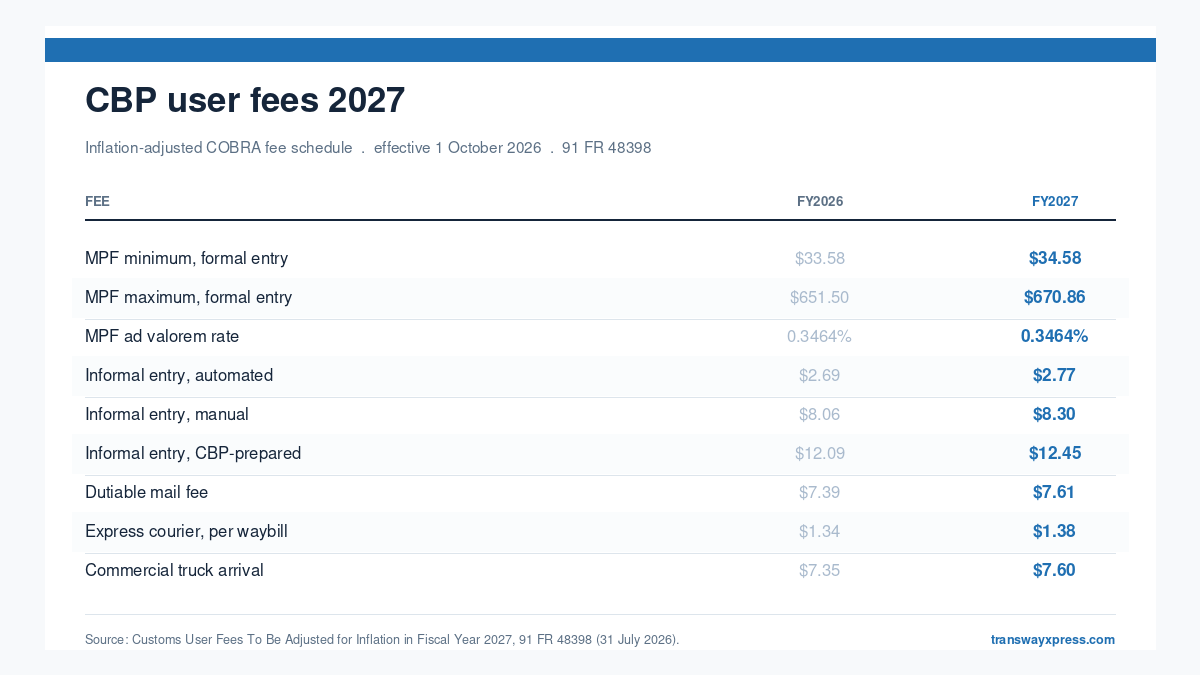
CBP user fees 2027 took effect on 1 October 2026, and every formal entry you file into the United States now carries a higher floor than it did a week ago. The change comes from Customs User Fees To Be Adjusted for Inflation in Fiscal Year 2027, published at 91 FR 48398 on 31 July 2026. The headline is not the rate, because the merchandise processing fee stayed exactly where it was at 0.3464 percent ad valorem. The headline is the minimum. A low-value formal entry that cost you $33.58 last month costs $34.58 now, and for brands moving small, frequent consignments in a post-de-minimis world, that minimum is the number that actually decides your landed cost.
What changed in the CBP user fees 2027 schedule
The FAST Act requires CBP to adjust its COBRA user fees for inflation each fiscal year. For FY2027 the agency applied an adjustment factor of 38.322 percent to the statutory base amounts set out in 19 CFR 24.23 and 19 CFR 24.22. Year over year, that works out to roughly a three percent lift on every fee in the table below.
The numbers that moved
Nine line items changed. If you file entries, clear mail, or run trucks across the border, at least one of these 2027 fees already applies to you.
| Fee | FY2026 | FY2027 | Regulation |
|---|---|---|---|
| MPF minimum, formal entry | $33.58 | $34.58 | 19 CFR 24.23(b)(1) |
| MPF maximum, formal entry | $651.50 | $670.86 | 19 CFR 24.23(b)(1) |
| MPF ad valorem rate | 0.3464% | 0.3464% | 19 CFR 24.23(b)(1) |
| Informal entry, automated, not prepared by CBP | $2.69 | $2.77 | 19 CFR 24.23(b)(2) |
| Informal entry, manual, not prepared by CBP | $8.06 | $8.30 | 19 CFR 24.23(b)(2) |
| Informal entry, prepared by CBP | $12.09 | $12.45 | 19 CFR 24.23(b)(2) |
| Dutiable mail fee | $7.39 | $7.61 | 19 CFR 24.22 |
| Express consignment courier, per individual waybill | $1.34 | $1.38 | 19 CFR 24.23(b)(4) |
| Commercial truck arrival | $7.35 | $7.60 | 19 CFR 24.22(c) |
Why the ad valorem rate did not move
Importers often assume the whole schedule is indexed together, and that assumption costs them accuracy in their forecasts. It is not indexed together. The 0.3464 percent rate is fixed in the regulation itself, so inflation does not touch it. What inflation touches are the dollar bookends around that rate, and the informal and specific fees. You can see the mechanism clearly if you work backwards: the regulation sets a base minimum of $25 and a base maximum of $485 per entry, and applying the 38.322 percent factor to those base amounts produces exactly the published 2027 fees of $34.58 and $670.86. The same factor applied to the base informal amounts of $2, $6 and $9 produces $2.77, $8.30 and $12.45.
Who actually pays the merchandise processing fee minimum
Most importers never think about the minimum because their entries clear it comfortably. Ecommerce brands are the exception, and the exception is getting larger every quarter.
The break-even sits near $9,983
Divide the minimum by the rate and you get the entered value at which the ad valorem calculation finally overtakes the floor. At the 2027 fees, $34.58 divided by 0.003464 is about $9,983. Below that entered value, your merchandise processing fee is a flat $34.58 no matter how small the shipment. A $200 consignment and a $9,000 consignment pay the identical fee. If you are modelling duty and fee exposure per SKU, this is the single most distorting line in the calculation, and our guide to calculating landed cost for cross-border ecommerce walks through where it belongs in the stack.
Where the ceiling starts
At the other end, $670.86 divided by 0.003464 is about $193,666. Any single formal entry above that entered value pays the capped fee and nothing more. That is why consolidation is not merely a freight tactic, it is a fee tactic, and we will come back to the arithmetic below. Getting entered value right in the first place matters just as much, which is why declared value discipline sits at the centre of customs valuation rules and of the commercial invoice fields customs officers actually read.
What the 2027 fees do to parcel economics after de minimis
For most of the last decade the minimum was irrelevant to direct-to-consumer brands, because parcels under the Section 321 threshold entered free of duty and free of the merchandise processing fee. That shelter is gone, and the end of de minimis changed the arithmetic permanently.
One parcel, one entry, one minimum
When each parcel becomes its own entry, each parcel attracts its own fee. The 2027 fees therefore multiply by shipment count rather than by value, which is the opposite of how most finance teams model customs cost. A brand sending two hundred individual parcels a week is not paying a rounding error. It is paying the minimum two hundred times.
Consolidation changes the arithmetic
The table below models 200 parcels with a declared value of $120 each, $24,000 in total, under three handling routes. The figures are an illustration built from the published 2027 fees, not a quoted rate.
| Route | Fee calculation | Total MPF |
|---|---|---|
| 200 separate formal entries | Each parcel is below the break-even, so each pays the $34.58 minimum | $6,916.00 |
| 200 separate informal entries, automated | Flat $2.77 per informal entry | $554.00 |
| One consolidated formal entry | 0.3464% of $24,000, above the minimum and below the cap | $83.14 |
The spread between the first and third routes is $6,832.86 on a single week of volume. Informal entry is not available to everyone, because eligibility turns on entered value, commodity and whether the goods are subject to particular trade remedies, so confirm your position with your broker rather than assuming it. But the direction of travel is unambiguous: under the 2027 fees, the number of entries you file matters more than the value you ship. That is an argument for holding inventory inside the destination market, which is the core of US fulfillment for Canadian brands.
Fees and duties this adjustment did not touch
Harbor maintenance, Section 232 and Section 338
The Harbor Maintenance Fee is not part of the COBRA inflation adjustment and did not change on 1 October. Neither did any trade remedy duty. This matters because the user fees are the smallest line on most entries right now, and importers who fixate on them can miss the larger exposure sitting beside them. If you move goods between Canada and the United States, the Section 338 import ban and the wider US and Canada tariff picture will move your landed cost by multiples of what a one dollar fee adjustment does. Treat the 2027 fees as a housekeeping update to your entry templates, and keep your real attention on classification and origin.
Your CBP user fees 2027 action checklist
None of this requires a filing. It requires your systems to carry the right numbers, and it requires someone to confirm they do.
Seven checks to run this week
- Update the fee constants in your landed cost calculator and your checkout duty estimator to the 2027 fees.
- Ask your broker to confirm in writing that entries filed on or after 1 October reflect the new minimum and maximum.
- Reconcile any entry summary filed in the first week of October against the published 2027 amounts.
- Re-run your per-parcel margin model using the $34.58 floor rather than an averaged fee.
- Count how many separate entries your current flow generates each month, then price the consolidated alternative.
- Check whether any of your SKUs qualify as USMCA originating, because the merchandise processing fee exemption for qualifying goods is worth more than the adjustment itself.
- Confirm mail and express courier flows are costed correctly, including the entry type 13 mail changes landing later this month.
If you are also waiting on money moving the other direction, the CAPE Phase 3 refund window opens on 6 October, and duty deferral programs remain the more durable lever on working capital.
How Transway Xpress Global Solves This
Consolidation and entry planning across Oakville and Buffalo
The practical answer to a per-entry fee is fewer, larger entries, and that depends on having inventory positioned on the right side of the border before the order is placed. Transway Xpress Global operates warehouses in Oakville and Etobicoke in Ontario and in Buffalo, New York, with an office in Pendleton, Indiana. Freight moves into those buildings as consolidated shipments rather than as a stream of individual parcels, clears as a single entry, and then ships domestically to the customer. The fee you would have paid two hundred times you pay once.
Around that core we handle D2C and B2B fulfillment, Amazon FBA prep, warehousing, order and inventory management, cross-border shipping, returns and custom packaging. The trucking side runs through our parent company Transway Transport, based in Oakville and operating since 2014, which is what lets us control the linehaul into the consolidation point instead of handing it to a third party. For Amazon sellers, the same consolidation logic applies to inbound FBA freight, and the Q4 FBA deadlines make the timing of those consolidated shipments unusually consequential this quarter.
Summary
What to take away from the 2027 fees
The CBP user fees 2027 adjustment is small in absolute terms and large in structural terms. The rate held at 0.3464 percent. The formal entry minimum rose to $34.58 and the maximum to $670.86, both effective 1 October 2026. Informal, mail, courier and truck fees each moved by roughly three percent. For a brand shipping full containers the adjustment is noise. For a brand shipping parcels one at a time it is a per-shipment tax that scales with order count, and the only structural answer is to file fewer entries. Update your fee constants, then go look at how many entries your network actually generates.
Frequently Asked Questions
What are the CBP user fees 2027 amounts?
Effective 1 October 2026, the formal entry merchandise processing fee is 0.3464 percent ad valorem with a minimum of $34.58 and a maximum of $670.86 per entry. Informal entry fees are $2.77 automated, $8.30 manual, and $12.45 when CBP prepares the documentation. The dutiable mail fee is $7.61, the express consignment courier fee is $1.38 per individual waybill, and the commercial truck arrival fee is $7.60. All amounts come from the inflation adjustment notice published at 91 FR 48398.
Did the merchandise processing fee rate change for 2027?
No. The ad valorem rate remains 0.3464 percent, unchanged from the prior year. Only the dollar amounts moved, because the rate is fixed in 19 CFR 24.23 while the minimum, maximum and specific fees are adjusted annually for inflation under the FAST Act. For FY2027 CBP applied a 38.322 percent adjustment factor to the statutory base amounts, which produced an increase of roughly three percent over the FY2026 figures.
When did the CBP user fees 2027 schedule take effect?
The new amounts apply to entries made on or after 1 October 2026, the start of the federal fiscal year. CBP published the notice on 31 July 2026, which gave importers two months of lead time. Entries filed before that date remain at the FY2026 amounts, so if you are reconciling statements that straddle the end of September, expect to see both schedules represented and check the entry date rather than the invoice date.
Do CUSMA originating goods pay the merchandise processing fee?
No. Under 19 CFR 24.23(c), goods that originate within the meaning of General Note 11 of the HTSUS, which covers the Agreement between the United States, Mexico and Canada, are exempt from the ad valorem, surcharge and specific merchandise processing fees when entered for consumption on or after 1 July 2020. The exemption depends on the goods actually qualifying as originating and on a valid certification of origin, not on where the shipment was last stored.
Do goods made in India qualify for the CUSMA exemption if they ship from Canada?
No. CUSMA applies only to goods that originate in Canada, the United States or Mexico under the agreement’s rules of origin. Goods manufactured in India do not become North American originating by being warehoused in Ontario or trucked across the border, so they pay the merchandise processing fee in full and remain subject to whatever duty their classification and origin attract. Separately, a CUSMA claim is not a shield against Section 338 duties, which apply even to goods that do qualify as USMCA originating.
If you are weighing whether consolidation would cut your per-entry fee exposure, we will model it against your actual order profile. Book a consultation and bring a month of shipment data, or run the numbers yourself first with our shipping rate calculator.