The US Canada tariffs 2026 escalation moved twice in four days, and both moves land on anyone moving goods across the border this quarter. On August 22, 2026 the United States applied an additional 50% duty to a long list of Canadian-origin goods under Section 338 of the Tariff Act of 1930. On August 25 Canada answered with surtaxes of 15%, 25% and 50% on roughly $27.6 billion of US imports, effective 12:01 a.m. on September 8, 2026. If you sell cross-border, you have a short window before the Canadian side takes effect, and the US side is already live. This guide sets out exactly what changed, which goods are caught, why a CUSMA claim does not rescue you, and what to do before September 8. Read together, the two measures make the US Canada tariffs 2026 picture the defining cost variable for cross-border sellers this quarter.
What Changed in the US Canada Tariffs 2026 Escalation?
The US move: 50% Section 338 duties from August 22
Three presidential proclamations signed July 20, 2026 invoked Section 338 of the Tariff Act of 1930, a rarely used authority that lets the President impose duties where he finds another country discriminates against US commerce. The findings covered three sectors: dairy, alcoholic beverages, and motor vehicles. The duties were set for August 19, suspended for three days during talks, and took effect at 12:01 a.m. Eastern on August 22, 2026 for goods entered or withdrawn from warehouse on or after that time.
The rate is an additional 50% ad valorem, on top of the ordinary duty rate and on top of any antidumping or countervailing duties already in place. Entries are filed against Chapter 99 headings 9903.03.12 through 9903.03.16, with the first three carrying the 50% duty and the last two identifying excluded goods at 0%. The measure covers roughly $20 billion in annual imports from Canada.
Canada’s response: 15%, 25% and 50% surtaxes from September 8
On August 25, 2026 the Department of Finance announced targeted countermeasures covering about $27.6 billion in US imports, with surtax rates of 15%, 25% and 50% set to mirror the corresponding US Section 338 and Section 232 rates. They come into force at 12:01 a.m. on September 8, 2026. Canada also announced a $7.5 billion support package, including a $1.5 billion Regional Tariff Response Initiative, a $2 billion Canada Strong Diversification Fund, a $500 million BDC liquidity stream and $3.5 billion in rapid response supports for workers.
Two administrative details matter more than the headline rate. First, Canada’s countermeasures do not apply to US goods already in transit to Canada on the day the surtax comes into force. Second, Canada’s existing tariff remission framework stays open for exceptional relief requests, and existing counter-tariffs such as those on autos continue alongside the new list.
| Dimension | US measure | Canadian countermeasure |
|---|---|---|
| Announced | Proclamations signed July 20, 2026 | August 25, 2026 |
| In force | 12:01 a.m. ET, August 22, 2026 | 12:01 a.m., September 8, 2026 |
| Rate | 50% additional ad valorem | 15%, 25% or 50% surtax by line |
| Legal basis | Section 338, Tariff Act of 1930 | Order under the Customs Tariff |
| Trade value | About $20 billion per year | About $27.6 billion |
| CUSMA and USMCA relief | None, origin does not exempt | Origin determines whether goods are caught |
| In-transit grandfathering | No | Yes, for goods in transit on September 8 |
| Relief route | Exclusions listed in the annexes | Existing remission framework |
Which Goods Are Actually Covered?
The motor-vehicle proclamation reaches far beyond vehicles
This is the part most sellers get wrong. The three proclamations are named for dairy, alcoholic beverages and motor vehicles, but the annexes attached to them list goods at the eight-digit HTS level and extend well past those three sectors. Published summaries of the annexes include furniture, textiles and apparel, cosmetics, jewellery, toys, plywood, wigs, cement and hockey equipment. A consumer-goods brand with nothing to do with cars or cheese can be squarely inside the motor-vehicle annex.
The practical rule: match the first eight digits of your classification against the annex lists. A ten-digit code that does not appear verbatim is not proof of exemption, because coverage is defined at eight digits. Coverage also follows actual origin rather than shipping route, so Canadian-origin goods routed through a third country remain exposed.
What is excluded on the US side
Goods already subject to Section 232 duties are carved out, which covers steel, aluminum and copper. Energy products, potash, fish, critical minerals and goods under the WTO Agreement on Trade in Civil Aircraft are also excluded. Those exclusions are filed under the 0% Chapter 99 headings rather than simply omitted, so your broker still needs the correct secondary classification on the entry. Under the 2026 Canada tariffs regime, an exclusion you cannot document on the entry is an exclusion you do not get.
What Canada is taxing
The Canadian list runs to hundreds of tariff lines. The categories called out by Finance Canada include steel and aluminum products, furniture, clothing and apparel, appliances, dairy products including cheese, pulp and paper, electronics, and agricultural equipment. Update, 29 August 2026: Finance Canada revised this list on 27 August 2026, removing fish and seafood entirely and adding wood charcoal, printed pictures, plaster board and glass containers at 50 per cent. See our breakdown of the revised counter-tariff list. For a D2C brand importing US-made apparel, furniture or consumer electronics into Canada, this is a direct hit on landed cost.
| Category | Direction of exposure | What to check first |
|---|---|---|
| Apparel and textiles | Both directions | Eight-digit HTS against the US motor-vehicle annex, plus Canadian clothing lines |
| Furniture and home goods | Both directions | Annex coverage plus the Canadian furniture surtax rate |
| Cosmetics and personal care | Canada to US | Whether your eight-digit code appears in the annex |
| Consumer electronics | US to Canada | Canadian electronics lines and the applicable rate |
| Appliances | US to Canada | Canadian appliance lines, typically 25% or 50% |
| Toys and sporting goods | Canada to US | Annex coverage, including hockey equipment |
| Dairy, alcohol, seafood | Both directions | Headline sectors on both lists |
| Steel, aluminum, copper | Canada to US, excluded | Already under Section 232, do not double-file |
Why a CUSMA Claim Will Not Save You This Time
Origin still matters, but not for exemption
Under normal conditions, a valid CUSMA certification is how North American goods move duty free. Section 338 is different. The proclamations apply the additional 50% duty even to goods that qualify as originating under USMCA, so preferential origin reduces the ordinary duty rate but does nothing about the 50% overlay. Anyone who read the last two years of trade policy as CUSMA protecting them needs to re-model this quarter.
Origin still governs the Canadian side, where goods must qualify as US-originating under the CUSMA-country marking regulations before the surtax applies. If you have been casual about origin documentation, now is the moment to tighten it. Our guides to building a customs-ready commercial invoice and CARM requirements for non-resident importers cover the paperwork that determines how your entries are treated.
What the US Canada Tariffs 2026 Changes Mean for E-commerce Brands
Landed cost and pricing
A 50% ad valorem overlay is not a margin problem you absorb quietly. On a $40 declared unit it adds $20 before freight, brokerage or fulfillment. Rebuild your landed cost model per SKU rather than applying an average, because the 2026 Canada tariffs are line-specific and two products in the same catalogue can now carry very different duty. Our walkthrough on how to calculate landed cost gives the formula, and the end of de minimis post explains why low-value parcels no longer slip past this arithmetic.
DDP shipments and chargebacks
If you ship DDP, you own the new duty and your customer sees no change until you reprice. If you ship DAP, your customer gets a surprise bill at the door, and cross-border refusal rates climb fast when that happens. Neither is automatically right, but drifting into the wrong one is expensive. Compare the two in DDP vs DAP shipping explained before you change your checkout.
Inventory positioning
The strategic answer for many brands is to stop shipping the tariff line at all. If your US customers are served from a US warehouse holding US-cleared stock, and your Canadian customers from a Canadian warehouse, each border crossing happens once in bulk instead of once per order. That does not remove the duty, but it removes per-parcel exposure, brokerage on every shipment, and the refusal risk that comes with surprise charges. Our guide to choosing a US fulfillment warehouse and the cross-border fulfillment guide lay out how the split works in practice.
Your Action Plan Before September 8
Thirteen days is enough to do this properly if you start now. Work the list in order, because the 2026 Canada tariffs exposure you find at step two determines everything after it.
- Pull your full SKU list with eight-digit HTS classifications. If you do not have them, that is the first job.
- Match every eight-digit code against the US proclamation annexes and the Canadian counter-tariff list. Do not rely on category names.
- Flag any SKU already under Section 232, since it is excluded from the US measure and must not be double-filed.
- Recalculate landed cost per affected SKU at the new rate, including brokerage and any AD/CVD already applying.
- Decide per SKU: absorb, reprice, re-source, or stop shipping that line cross-border.
- If you import US goods into Canada, check whether accelerating a shipment so it is in transit before September 8 is realistic. In-transit goods are exempt on the Canadian side.
- Confirm your incoterm with your 3PL and your checkout. Fix any mismatch between what you quote and what you file.
- Review whether a duty deferral, bonded warehouse or drawback program applies to your flow.
- Prepare a remission request if you have a genuine no-substitute-available case on the Canadian side.
- Brief your customer service team with a plain-language explanation before the first surprised customer emails.
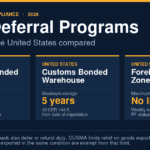
On step eight, our guide to duty deferral programs in Canada and the US covers which programs fit which flow, and freight forwarder vs customs broker clarifies who on your team should actually be filing.
Relief Options Worth Pursuing
Neither set of 2026 tariffs is absolute. Canada and the United States both left relief channels open, and they are worth pursuing before you write the cost into your prices permanently.
Canadian remission requests
Canada kept its remission framework open for exceptional relief. Remission is not a general hardship escape. The strongest cases involve inputs with no viable Canadian or non-US source, contractual commitments signed before the measure, or severe adverse impact where substitution is genuinely impossible. Document the sourcing search you actually ran, not just the conclusion.
Duty deferral and bonded storage
If goods enter Canada and later leave, or enter a bonded facility and are re-exported, deferral and drawback programs can materially change the cash position even where the tariff still technically applies. Brands running a US and Canadian split with returns flowing back across the border should model this before assuming the duty is sunk.
How Transway Xpress Global Solves This
Transway Xpress Global operates warehouses in Oakville and Etobicoke, Ontario and in Buffalo, New York, with an office in Pendleton, Indiana, under the same ownership as Transway Transport. That footprint is exactly the structure this tariff round rewards: bulk-clear once into the correct country, hold inventory on the side of the border where the customer is, and stop paying per-parcel duty and brokerage on every single order.
Practically, that means our team can classify your SKUs against both lists, tell you which of your products are actually caught, re-quote your landed cost at the new rates, and split your inventory between the Buffalo and Ontario facilities so each market is served domestically. Because customs documentation, warehousing and the trucking leg sit with one operator, there is a single point of accountability when a classification is questioned at the border rather than three vendors pointing at each other.
We cannot make the 2026 Canada tariffs disappear. What we can do is make sure you are not paying them on goods that were never covered, and that you are not paying them on every parcel when once per bulk shipment would do.
Summary
The US Canada tariffs 2026 escalation is live on the US side as of August 22 and lands on the Canadian side at 12:01 a.m. on September 8. The US measure is a 50% Section 338 overlay on roughly $20 billion of Canadian-origin goods, defined at eight-digit HTS level, reaching far beyond dairy, alcohol and vehicles, and not relieved by CUSMA origin. Canada’s answer is a 15%, 25% and 50% surtax on about $27.6 billion of US goods, with an in-transit exemption and an open remission framework. Classify at eight digits, re-model landed cost per SKU, fix your incoterm, and consider whether holding inventory on both sides of the border is now cheaper than crossing it per order.
Frequently Asked Questions
When do the US Canada tariffs 2026 changes take effect?
The US 50% Section 338 duties took effect at 12:01 a.m. Eastern on August 22, 2026, after a three-day suspension from the original August 19 date, and apply to goods entered or withdrawn from warehouse on or after that moment. Canada’s counter-tariffs come into force at 12:01 a.m. on September 8, 2026. The US measure has no in-transit grandfathering. Canada’s does exempt goods already in transit on the day its surtax takes effect. Both dates sit inside the same 2026 Canada tariffs escalation, so plan against the earlier one.
Does a CUSMA certificate exempt my goods from the 50% duty?
No. The proclamations apply the additional 50% duty even to goods that qualify as originating under USMCA, so a valid certification lowers your ordinary duty rate but does not remove the Section 338 overlay. Origin documentation still matters on the Canadian side, where goods must qualify as US-originating under the CUSMA-country marking regulations before the surtax applies. Keep your certifications current, but do not plan around them as a shield.
My product is not dairy, alcohol or a vehicle. Am I safe?
Not necessarily. The proclamations are named for those three sectors, but the annexes list goods at eight-digit HTS level and published summaries include furniture, textiles, apparel, cosmetics, jewellery, toys, plywood and sporting equipment. The only reliable test is matching the first eight digits of your classification against the annex lists. Category names and product descriptions are not a substitute for that check.
What can I do before September 8 to reduce exposure?
Classify every SKU at eight digits and confirm which are genuinely covered, since many brands over-estimate their exposure. If you import US goods into Canada, check whether a shipment can realistically be in transit before September 8, because in-transit goods are exempt. Recalculate landed cost per SKU, align your incoterm with what you quote at checkout, review duty deferral or bonded options, and prepare a remission request where no substitute source exists.
Should I move inventory to the other side of the border?
It depends on order volume rather than on the tariff alone. Holding stock in both countries means each unit crosses once in bulk instead of once per order, which removes per-parcel brokerage and the refusal risk that comes with surprise duty at the door. Below roughly a few hundred cross-border orders a month the extra warehouse overhead usually is not justified. Above that, a split US and Canadian inventory position typically pays for itself quickly under current rates.
Primary sources: the Department of Finance Canada announcement of targeted countermeasures and its complete list of US products subject to counter-tariffs, and the White House proclamation temporarily suspending the additional duties.
Need your SKUs classified against both lists before September 8? Book a free cross-border consultation and we will tell you which of your products are actually caught, what it costs at the new rates, and whether a split inventory position is cheaper than crossing per order.