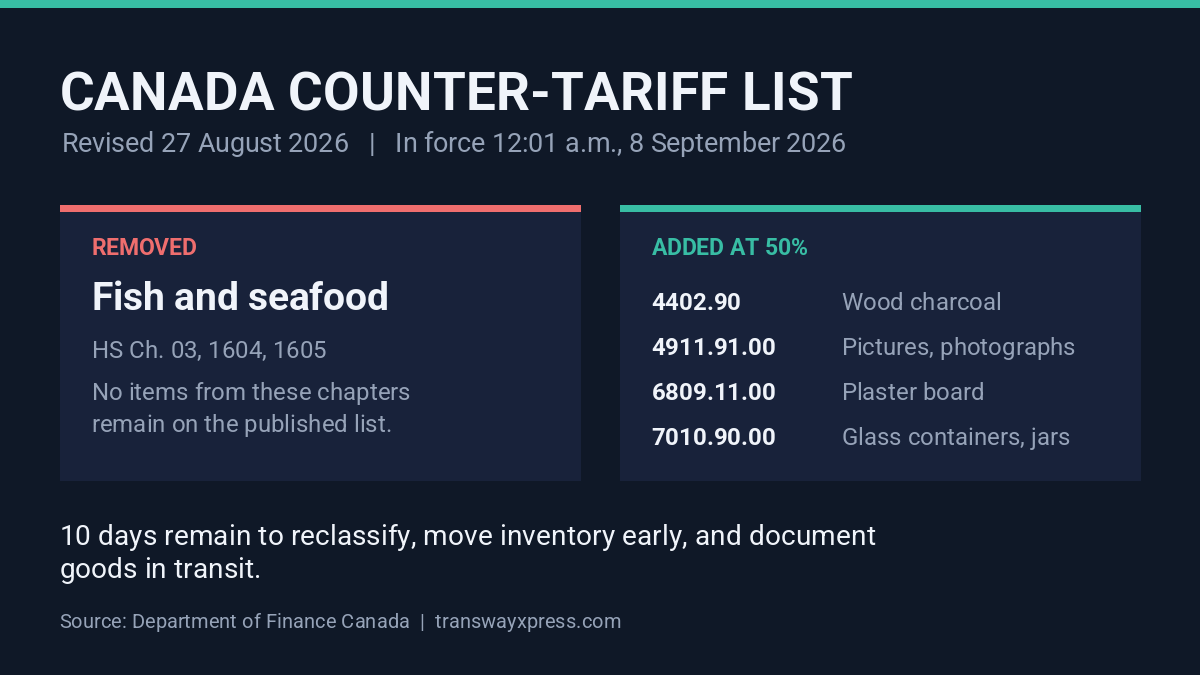
The Canada counter-tariff list changed again on 27 August 2026, eleven days before it takes effect. Finance Canada pulled fish and seafood off the Canada counter-tariff list entirely and replaced that trade value with new lines — among them wood charcoal, printed pictures and photographs, plaster board and glass containers — all at 50 per cent. If you import US-made goods into Canada, the version of the list you priced against last week is no longer the version that will be enforced. The surtaxes come into force at 12:01 a.m. on 8 September 2026, which leaves 10 days from today to reclassify, re-quote and decide what crosses early.
What Changed in the Canada Counter-Tariff List on 27 August?
Canada announced its countermeasures on 25 August 2026, covering roughly $27.6 billion in imports from the United States at surtax rates of 15, 25 and 50 per cent, each rate set to mirror the corresponding US Section 338 or Section 232 rate. That much has not changed. What changed is the composition of the list itself, revised after industry feedback in the days that followed.
Fish and seafood came off
The published Finance Canada list no longer contains any items from HS Chapter 03, 1604 or 1605. Seafood and fish products were on the 25 August version and are absent from the current one. Canadian processors that import US lobster, groundfish or shellfish for further processing were the constituency that pushed for the removal, and they got it. For fulfillment operators the practical point is narrower but sharper: any landed-cost model built on the 25 August list is now overstating duty on seafood lines and understating it elsewhere.
New goods went on at 50 per cent
The trade value removed was replaced. The additions confirmed on the published Canada counter-tariff list sit at 50 per cent and reach categories that were not obviously in scope a week ago — packaging glass, printed matter and building board among them. Press coverage of the revision also cited US copper wire; that heading did not appear in the tariff-item tables published on the Finance Canada page at the time of writing, so treat copper wire as reported but unconfirmed until it shows on the order text.
Which Tariff Items Are Confirmed on the Published List?
These are the newly added lines that appear verbatim in the Finance Canada tariff-item tables. Classify against the tariff item, not the product description in a news story.
| Tariff item | Description | Surtax rate | In force |
|---|---|---|---|
| 4402.90.10 | Wood charcoal, containing 10% or less by weight of binder | 50% | 12:01 a.m., 8 Sept 2026 |
| 4402.90.90 | Wood charcoal, other | 50% | 12:01 a.m., 8 Sept 2026 |
| 4911.91.00 | Pictures, designs and photographs | 50% | 12:01 a.m., 8 Sept 2026 |
| 6809.11.00 | Boards, sheets, panels and tiles of plaster, faced or reinforced with paper or paperboard only | 50% | 12:01 a.m., 8 Sept 2026 |
| 7010.90.00 | Carboys, bottles, flasks, jars, pots, phials and other glass containers | 50% | 12:01 a.m., 8 Sept 2026 |
What is not yet confirmed
Two things remain open. The first is copper wire, described above. The second is the operational customs notice: as of this writing CBSA had not published the customs notice that normally accompanies a surtax order and sets out entry coding, accounting treatment and the in-transit evidence importers must retain. Until that notice lands, build your plan from the Finance Canada tariff-item tables and expect the coding detail to follow. You can read the current list directly on the Department of Finance Canada page.
When Does the Revised Canada Counter-Tariff List Take Effect?
Ten days from today
The surtaxes apply to goods accounted for on or after 12:01 a.m. on 8 September 2026. Counting from 29 August, that is 10 days. Ten days is enough to reclassify a catalogue and re-cut a landed-cost model. It is not enough to re-source a packaging supplier, which is why the glass and print additions are the ones worth reading first.
Goods in transit on 8 September
Canada’s countermeasures do not apply to US goods that are in transit to Canada on the day the order comes into force. That grandfathering is the single most valuable provision in the package for anyone with inventory to move, and it is evidence-driven: you will need dated proof that the shipment was en route before the cut-off. Bills of lading, carrier manifests and pickup records should be captured now rather than reconstructed in October. Our commercial invoice guide covers the documentation standard that survives a CBSA verification.
Why Does This Hit E-commerce Packaging and Print?
Glass jars and bottles
Tariff item 7010.90.00 is not an industrial line. It is the heading that catches glass jars, bottles and containers — the physical packaging behind candles, sauces, supplements, skincare and beverages. A Canadian D2C brand that buys empty glass from a US supplier and fills in Ontario now faces a 50 per cent surtax on the packaging component of its cost of goods from 8 September. That is a cost-of-goods shock at the component level, and it does not show up in a duty model built around finished-goods HS codes.
Printed inserts and photo goods
Item 4911.91.00 covers pictures, designs and photographs. Brands that print marketing inserts, art prints, photo products or decorative panels in the United States for the Canadian market should classify carefully; the line between a printed insert and a printed picture is a classification question with a 50-point spread attached to it. Custom packaging and kitting programs that source printed components across the border are the ones most exposed.
Does CUSMA Protect You?
Marking rules decide who pays on the Canadian side
Canada’s surtaxes apply to goods eligible to be marked as a good of the United States under the Determination of Country of Origin for the Purpose of Marking Goods (CUSMA Countries) Regulations. Origin, not shipping route, is the test. Goods made outside North America and merely shipped from a US warehouse are assessed on their actual origin. For brands importing from India through a US consolidation point, this is a live question and not a technicality — our guide to shipping from India to Canada sets out how origin is evidenced. CUSMA preference applies only to North-American-origin goods; it never makes India-origin goods duty-free.
Section 338 ignores origin on the US side
Running the other direction, the US measure is harsher. The additional 50 per cent duty took effect at 12:01 a.m. Eastern on 22 August 2026 under Chapter 99 headings 9903.03.12 through 9903.03.14, with 9903.03.15 and 9903.03.16 carrying the 0 per cent excluded-goods rate, per CBP’s CSMS guidance. A valid USMCA claim does not exempt goods from Section 338 duties. CBP’s guidance does confirm the additional duty is subject to drawback, which matters if you import into the US and re-export. Our full breakdown of the 2026 tariff escalation covers the US side in depth.
Your Dated Action List Before 8 September
- By 31 August — pull your US-sourced SKU list and match the first eight digits of each classification against the current Finance Canada tariff-item tables. Re-run any model built on the 25 August version.
- By 31 August — isolate packaging and print components separately from finished goods. Glass containers and printed pictures are bought as inputs and are easy to miss in a finished-goods duty model.
- By 2 September — decide what ships early. Anything that can be accounted for before 12:01 a.m. on 8 September avoids the surtax outright.
- By 5 September — for shipments that will be en route on 8 September, capture dated bills of lading, carrier manifests and pickup confirmations to support the in-transit exception.
- By 5 September — re-quote landed cost and reset customer-facing pricing or DDP terms. See how to calculate landed cost and DDP vs DAP.
- From 8 September — monitor CBSA for the implementing customs notice and confirm your broker is coding entries to it. Non-resident importers should confirm their CARM account is ready to carry the additional assessment.
- Ongoing — if a surtax line is commercially untenable, Canada’s remission framework remains open for exceptional-relief requests. Review duty deferral options in parallel.
How Transway Xpress Global Solves This
A ten-day window is an operations problem before it is a customs problem. Transway Xpress Global runs warehouses in Oakville and Etobicoke, Ontario, and in Buffalo, New York, with an office in Pendleton, Indiana, which means inventory can be positioned on either side of the border and released against whichever duty position is cheaper on the day. For brands staring at a 50 per cent surtax on US-sourced packaging, holding the Canadian-market buffer in Ontario before 8 September is a decision that has to be made this week, not next.
Our cross-border shipping and Canadian e-commerce fulfillment teams handle D2C and B2B order flow, Amazon FBA prep, warehousing, inventory management, returns and custom packaging out of the same footprint. Because we operate the trucking side through Transway Transport, our Oakville parent company operating since 2014, the in-transit evidence trail that the 8 September grandfathering depends on is captured as part of normal dispatch rather than reconstructed afterwards.
What we do not do is guess at your classification. The right sequence is to confirm the tariff items against the published Finance Canada list, then decide what moves early and what waits — and that sequencing is the conversation worth having before the end of this week.
Summary
The Canada counter-tariff list was revised on 27 August 2026: fish and seafood removed, and wood charcoal, printed pictures, plaster board and glass containers added at 50 per cent, confirmed on the Finance Canada tariff-item tables. The order comes into force at 12:01 a.m. on 8 September 2026, 10 days from today, and does not apply to US goods already in transit on that day. The exposure that will surprise most brands is not finished goods — it is packaging and printed components bought as inputs. Reclassify this week, move what you can before the cut-off, and document everything that will be on the water.
Frequently Asked Questions
What changed on the Canada counter-tariff list in August 2026?
Finance Canada revised the list on 27 August 2026, after the original 25 August announcement. Fish and seafood products were removed entirely — no HS Chapter 03, 1604 or 1605 items remain on the published list. New lines were added at 50 per cent, including wood charcoal (4402.90.10 and 4402.90.90), pictures, designs and photographs (4911.91.00), plaster board (6809.11.00) and glass containers (7010.90.00). The headline scope of roughly $27.6 billion in US imports and the 15, 25 and 50 per cent rate structure did not change.
When do Canada’s new counter-tariffs take effect?
The surtaxes come into force at 12:01 a.m. on 8 September 2026 and apply to goods accounted for on or after that time. From 29 August 2026 that is 10 days. Goods already in transit to Canada on the day the order comes into force are not caught, so shipments that leave the United States before the cut-off and can be evidenced as en route stay outside the surtax even if they arrive later.
Does a CUSMA claim exempt my goods from these tariffs?
Not in the way most sellers assume. On the Canadian side, the surtax applies to goods eligible to be marked as a good of the United States under the CUSMA-country marking regulations, so origin determines exposure. On the US side, a valid USMCA claim does not exempt goods from Section 338 duties at all. CUSMA preference is available only to North-American-origin goods; goods of Indian or other non-North-American origin never qualify, regardless of where they were warehoused before shipment.
Are glass jars and packaging really covered?
Yes. Tariff item 7010.90.00 covers carboys, bottles, flasks, jars, pots, phials and other glass containers, and it appears on the published list at 50 per cent. Brands that buy empty US-made glass to fill in Canada face the surtax on that packaging component from 8 September 2026. This exposure is easy to miss because duty models are usually built around finished-goods classifications rather than the components purchased separately as inputs.
What should I do in the next ten days?
Reclassify your US-sourced SKUs and components against the current Finance Canada tariff-item tables, treating packaging and print as separate lines. Decide what can be accounted for before 12:01 a.m. on 8 September and move it. For anything that will be en route on the cut-off date, capture dated bills of lading and carrier manifests to support the in-transit exception. Then re-quote landed cost, reset DDP pricing, and confirm your broker and CARM account are ready for the new assessments.
Ten days is a workable window if you start this week. Book a consultation and we will map your US-sourced SKUs against the current list, identify what should cross before 8 September, and set up the in-transit documentation trail so the exception actually holds.