Country of origin marking is the cheapest compliance step in cross-border trade and the one that now carries the largest duty consequences. In a year when a product’s origin decides whether it faces a surtax, a Section 232 duty, an import ban or nothing at all, country of origin marking is what a border officer looks for when the carton is opened. Get it wrong and the goods can be held, re-marked at your cost, hit with an extra duty, exported or abandoned. Most sellers treat the “Made in” line as a printing detail handled by the factory; customs treats it as a legal declaration by the importer. This guide sets out what each country requires and the checks to run before your next purchase order ships.
What Country of Origin Marking Is, and Why It Matters More in 2026
Marking is the physical statement on a product or its container telling the final buyer where the good was made. It is separate from, but built on top of, the origin you declare on your customs paperwork. Both sides of the border require it, both put the obligation on the importer rather than the factory, and both have remedies that cost money when the marking is missing.
Marking Origin and Duty Origin Are Not the Same Test
The country of origin for marking purposes is the country of manufacture, production or growth of the article. Under 19 CFR 134.1, where a good is made from materials of more than one country, origin follows the last country in which the article was substantially transformed into a new and different article of commerce with a new name, character or use. Goods of Canada and Mexico are a special case: their marking origin is determined under the tariff-shift rules in 19 CFR Part 102 rather than by a general substantial transformation test.
Preferential origin, which decides whether a good qualifies for a trade agreement rate, is a separate test again: a good can be correctly marked “Made in Vietnam” and still fail a preference claim.
Country of Origin Marking Rules in the United States
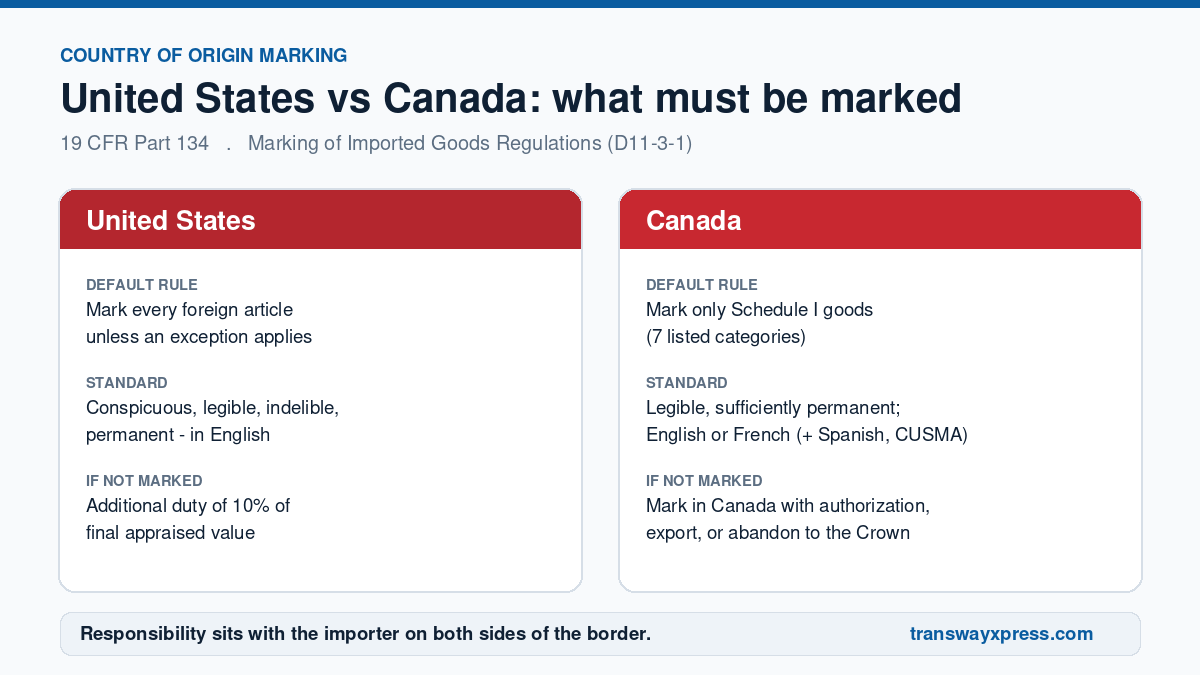
The United States takes the broad approach: mark everything unless an exception applies.
What 19 CFR Part 134 Requires
Section 134.11 requires that every article of foreign origin imported into the United States be marked in a conspicuous place, as legibly, indelibly and permanently as the nature of the article or its container will permit, with the English name of the country of origin. Conspicuous means the ultimate purchaser can find it without hunting; legible means readable at normal handling distance. Permanent is defined further in section 134.41: the marking should survive any reasonably foreseeable circumstance and remain until the good reaches the ultimate purchaser unless deliberately removed. Where practical, the regulation prefers marking worked into the article at manufacture over a sticker that peels in a warehouse.
The 10 Percent Marking Duty
The enforcement tool is financial. Under 19 U.S.C. 1304, reflected in 19 CFR 134.2, articles not legally marked at the time of importation are subject to an additional duty of 10 percent of the final appraised value, unless the goods are exported or destroyed before liquidation. That 10 percent sits on top of every other duty the shipment owes, which is why origin belongs in your landed cost model, not a quality checklist.
Exceptions: the J-List and Container Marking
Section 134.33 sets out the J-list, a schedule of article classes excepted from individual marking, including natural products, raw metals, buttons, lumber and wire. The exception is narrower than it looks: where the article is excepted, section 134.22 requires the outermost container in which it ordinarily reaches the ultimate purchaser to be marked instead. The obligation moves to the box; it does not disappear.
How Canada’s Marking of Imported Goods Regulations Differ
Canada inverts the default. Instead of marking everything unless excepted, Canada requires marking only for listed classes of goods.
Only Schedule I Goods Must Be Marked
Under the Marking of Imported Goods Regulations, described in CBSA Memorandum D11-3-1, seven categories in Schedule I must carry a country of origin marking:
- Goods for personal or household use, such as bakeware, blankets, clocks, cutlery, dishes and towels
- Hardware, such as copper tubing, glass panes, files and iron or steel pipe
- Novelties and sporting goods, such as toys, games, bicycles and athletic equipment
- Paper products, including lithographed or printed materials and shipping containers
- Apparel, such as boots, gloves, hats, knitted garments and textile clothing
- Horticultural products, including tubers, rhizomes, corms and crowns
- Goods of steel or aluminum falling within the specified tariff classifications
This list is less forgiving than it sounds, because apparel, housewares and novelty goods are what most catalogues are made of. If you sell into Canada through an ecommerce fulfillment centre, assume your assortment is in scope until you have confirmed otherwise line by line.
Language, Legibility and Permanence
Canada’s requirements differ from the American ones in one practical respect: language. Markings on goods of a CUSMA country may be in English, French or Spanish, while goods of any other country must be marked in English or French. The marking must be legible, sufficiently permanent, and easily seen during normal handling. CBSA accepts labels, stamping, embossing, engraving, printing, stencilling and anodizing, on the same condition the United States applies: the marking must survive until the good reaches the ultimate purchaser.
What Happens When Goods Arrive Unmarked
Canadian importers are responsible for ensuring imported goods comply with marking requirements at the time they import them, even though the exporter usually applies the marking. When goods turn up unmarked there are three options and no fourth: mark them in Canada, provided the conditions for authorization are met; export them; or abandon them to the Crown. Only the first preserves the season’s inventory, and it depends on a warehouse able to re-label at volume.
Country of Origin Marking in the US and Canada Compared
The table below sets the two regimes side by side on the dimensions that change how you operate.
| Dimension | United States | Canada |
|---|---|---|
| Default rule | All articles of foreign origin must be marked unless excepted | Only goods listed in Schedule I must be marked |
| Governing rules | 19 U.S.C. 1304; 19 CFR Part 134 | Marking of Imported Goods Regulations; CBSA Memorandum D11-3-1 |
| Language of marking | English name of the country of origin | English or French; English, French or Spanish for goods of a CUSMA country |
| Manner standard | Conspicuous, legible, indelible and permanent as the article permits (134.11, 134.41) | Legible, sufficiently permanent, easily seen during normal handling |
| Who is responsible | The importer of record | The Canadian importer, at the time of import |
| Penalty for failure | Additional duty of 10 percent of final appraised value (19 CFR 134.2) | No fixed marking duty; mark in Canada with authorization, export, or abandon to the Crown |
| When the article is excepted | Outermost container must be marked instead (134.22) | Container marking permitted where the regulations allow it |
| Origin rules for CUSMA-country goods | Tariff-shift rules in 19 CFR Part 102 | CUSMA marking rules in CBSA Memorandum D11-3-3 |
How to Read the Table
A single SKU sold into both markets should be marked to the stricter American standard, because a permanent, conspicuous, English-language marking satisfies Canada as well. The penalty asymmetry matters too: the American exposure is a predictable percentage, while the Canadian exposure is the operational cost of a shipment that cannot legally be released.
How CUSMA Changes the Country of Origin Marking Analysis
For goods of Canada, Mexico and the United States, marking origin is decided by a rule hierarchy set out in the CUSMA marking rules, explained in CBSA Memorandum D11-3-3, rather than by a general substantial transformation test.
The Tariff-Shift Hierarchy
Section 4 assigns a single country where the goods are wholly obtained there, made exclusively from domestic materials, or where every foreign material undergoes the tariff classification change required by Schedule III. Where that does not resolve it, section 5 looks to the country of the single material that imparts the essential character of the goods. Section 6 covers sets and composite goods, and section 7 handles minor processing and simple assembly, falling back to the last country in which production occurred. Foreign materials below 10 percent may be disregarded, measured by weight for textiles and by value for other goods.
A CUSMA Claim Is Not a Tariff Shield
This is where the most expensive misunderstanding lives. CUSMA applies to North-American-origin goods only. Goods manufactured in India, China or anywhere else do not become CUSMA goods by being warehoused in Ontario, prepped in Buffalo or shipped from a Canadian address. For Indian-made product the relevant analysis is the ordinary duty and customs clearance path for India-origin goods, not a preference claim.
Even where goods genuinely originate in North America, a CUSMA claim does not neutralise every trade measure. Section 338 duties apply even to USMCA-originating goods, so a valid certification is not a defence against them. Read our coverage of the Section 338 import ban and the broader US-Canada tariff picture alongside this guide, because origin is the input to all of them.
Your Country of Origin Marking Compliance Checklist
The first items happen before goods move; the rest happen at and after the border.
Before the Purchase Order Ships
- Confirm the country of manufacture for every SKU in writing from the supplier, and re-confirm whenever a component source changes.
- Choose a marking method worked into the article in preference to an adhesive label.
- Check the marking survives prep. If origin appears only on a polybag that prep removes, it has already failed.
- Confirm the language: English for the United States; English or French for Canada, or English, French or Spanish for goods of a CUSMA country.
- Check whether the article is J-listed for the United States or falls in a Schedule I category for Canada, and mark the outer container where required.
- Make sure the origin on the label matches your commercial invoice. A mismatch is the fastest route to an examination.
At the Border and After
- Confirm your importer of record is registered on both sides, including CARM registration if you are a non-resident importer into Canada.
- Photograph the marking on a sample unit from each production run and keep it with the entry records.
- If goods arrive unmarked in Canada, request authorization to mark in Canada before considering export or abandonment.
- Re-audit after any packaging redesign. New artwork is the most common way a compliant SKU quietly becomes non-compliant.
How Transway Xpress Global Solves This
Marking problems are warehouse problems. The regulation is short; the difficulty is having hands and space at the right point in the lane to inspect, re-label and re-pack before goods reach an examination or a customer.
Prep, Labelling and Warehousing on Both Sides of the Border
Transway Xpress Global operates warehouses in Oakville and Etobicoke, Ontario, and in Buffalo, New York, with an office in Pendleton, Indiana, backed by our trucking parent Transway Transport, which has run Oakville-based operations since 2014. A shipment with a marking gap can be inspected and corrected on the side of the border where it sits, rather than returned to origin.
Our D2C and B2B fulfillment, Amazon FBA prep, warehousing, cross-border shipping, returns and custom packaging services all touch the same physical step: opening the carton and checking what is printed on the unit. We build marking checks into receiving, so origin is verified against the commercial invoice when inventory is booked in.
Summary
Country of origin marking is a small line of text governed by two different philosophies. The United States marks everything unless excepted and enforces with a 10 percent duty; Canada marks only listed classes of goods but leaves an unmarked shipment with three unattractive outcomes.
The Three Rules to Remember
Mark to the stricter standard and use one specification for both markets. Keep marking origin, invoice origin and preference claims aligned, because customs will compare them. And never treat a CUSMA claim as protection from a trade measure that applies regardless of preferential origin. If you want a single partner handling the receiving, inspection and re-labelling that makes this routine, book a consultation with Transway Xpress Global.
Frequently Asked Questions
What is country of origin marking?
Country of origin marking is the requirement to mark an imported good, or its container, with the country where it was manufactured, produced or grown, so the final buyer can see it. In the United States the rule sits in 19 U.S.C. 1304 and 19 CFR Part 134, which require a conspicuous, legible, indelible and permanent marking in English. In Canada it sits in the Marking of Imported Goods Regulations, which apply only to listed classes of goods. Responsibility rests with the importer, not the supplier.
Does every product imported into Canada need a country of origin marking?
No. Canada requires marking only for the seven categories listed in Schedule I to the Marking of Imported Goods Regulations: goods for personal or household use, hardware, novelties and sporting goods, paper products, apparel, horticultural products, and specified goods of steel or aluminum. In practice most consumer ecommerce assortments fall inside those categories, so treat your catalogue as in scope until you have checked each line against the schedule. The marking must be legible, sufficiently permanent, and easily seen during normal handling.
What is the penalty for incorrect country of origin marking in the United States?
Articles not legally marked at the time of importation are subject to an additional duty of 10 percent of the final appraised value under 19 U.S.C. 1304, as reflected in 19 CFR 134.2. That duty is avoided only if the goods are exported or destroyed before liquidation. The 10 percent applies on top of any other duties the shipment already owes, so where other measures also apply the cost compounds. Repeated violations after written notice can attract further penalties.
Can I mark goods after they arrive at the border?
Often yes, but not automatically. In Canada an importer whose goods arrive unmarked has three routes: mark the goods in Canada where the conditions for authorization are met, export the goods, or abandon them to the Crown. In the United States CBP may allow marking after arrival where it is administratively practicable, though that option narrows for importers who have repeatedly violated the requirements after written notification. Either way you need a warehouse capable of re-labelling at volume.
Does a CUSMA claim mean my goods avoid tariffs?
No. CUSMA applies to North-American-origin goods only, so goods manufactured elsewhere do not qualify simply because they were warehoused or prepped in Canada or the United States. Even for goods that genuinely originate in North America, a CUSMA claim is not a shield against every trade measure: Section 338 duties apply even to USMCA-originating goods. Determine origin first under the applicable rules, then test separately whether a preference is available and whether any other measure applies regardless of it.
Book a consultation to review your marking setup, or see how our US fulfillment for Canadian brands works alongside our Ontario warehouses.
Primary sources: 19 CFR Part 134, Country of Origin Marking (eCFR); CBSA Memorandum D11-3-1, Marking of imported goods; CBSA Memorandum D11-3-3, CUSMA Countries of Origin Marking Rules.