On 15 September 2026, in a declaration filed with the U.S. Court of International Trade, Customs and Border Protection put a date on something importers had been waiting months for: the CAPE Phase 3 refund window opens on 6 October 2026. That is 15 days from today. If you have been watching your IEEPA duties sit in a queue with no movement, this is the first hard date CBP has given since it paused Phase 3 to build additional validations. It is also narrower than most of the coverage suggests. Phase 3 is not the moment every importer gets paid. It is a door built for one specific group, and if you are not in that group, the 6 October launch changes nothing about your position — but the clocks running against you keep running.
What the CAPE Phase 3 Refund Launch on 6 October Actually Is
CAPE — Consolidated Administration and Processing of Entries — is the mechanism CBP built to return duties collected under the International Emergency Economic Powers Act. Those duties became refundable after the Supreme Court held in Learning Resources, Inc. v. Trump, Nos. 24–1287 and 25–250, decided 20 February 2026, that IEEPA does not grant the President authority to impose tariffs. Executive Order 14389 terminated the tariffs the same day, effective 12:00 a.m. Eastern on 24 February 2026, and CBP stopped collecting on goods entered for consumption on or after that moment.
Why the 6 October date matters now
The Court did not design a refund system. It decided a question of statutory authority and left the remedy to the lower courts, which is why the money moves through an administrative queue rather than a court order for most importers. CBP has been working that queue in phases. Phase 3 was the piece that stalled. Now it has a launch date, and the 15 days between today and 6 October are the last clean window to fix anything in your file before the system starts reading it. A CAPE refund does not arrive because you are owed one; it arrives because a phase exists that can read your entry.
What changed since CBP paused Phase 3
Earlier this month the position was simply that Phase 3 was delayed with no announced deployment date, while Phases 1 and 2 continued to run. That has now changed. Phases 1 and 2 have been paying refunds throughout, so an entry that fits either one should not be waiting on October at all. Our earlier guide to claiming an IEEPA tariff refund was written during that pause and covers the filing mechanics in detail; treat this post as the update that puts a date and a scope on the missing phase.
Which Entries Each CAPE Phase Accepts
The single most useful thing you can do this week is work out which row of the table below your entries fall into. The phase is determined by the status of the entry, not by the size of the importer or the value of the duty. Nothing about the CAPE timetable changes which phase your entries fall into, so this classification holds whether refunds move next week or next quarter.
| Entry status | Route | Available from | What you need |
|---|---|---|---|
| Unliquidated | CAPE Phases 1 and 2 | Already open | CAPE declaration plus current ACH banking details |
| Liquidated within 80 days | CAPE Phases 1 and 2 | Already open | CAPE declaration filed inside the 80-day window |
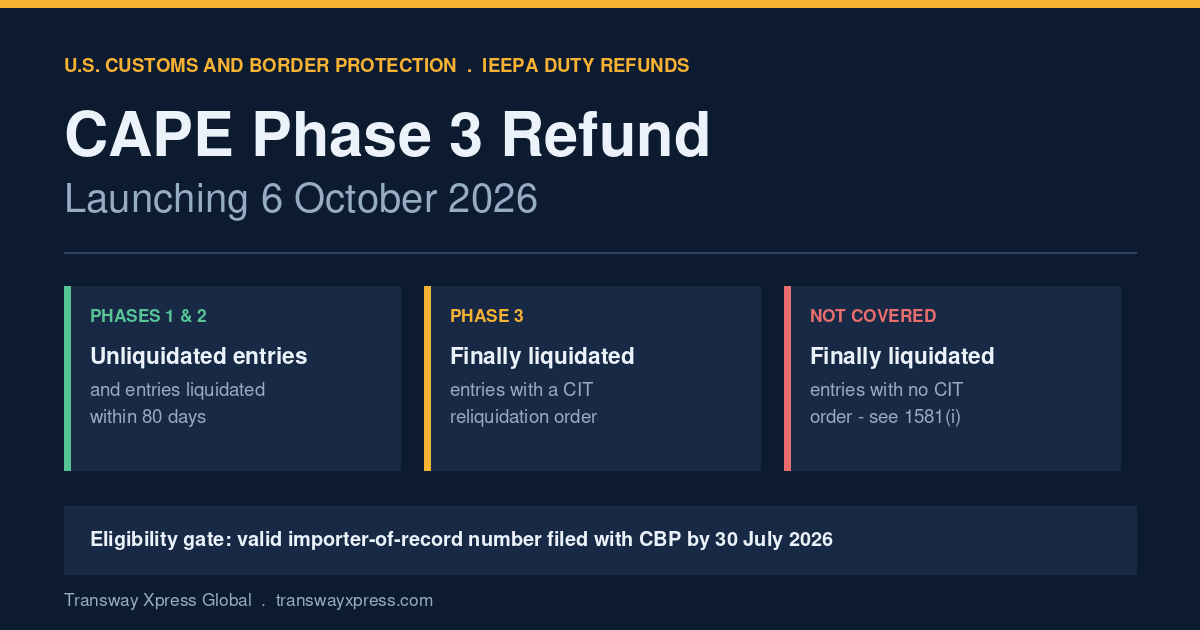
| Finally liquidated, with a CIT reliquidation order | CAPE Phase 3 | 6 October 2026 | Valid importer-of-record number filed with CBP by 30 July 2026 |
| Finally liquidated, with a CIT order but a late IOR number | CAPE Phase 3, on separate instructions | Not announced | Wait for CBP to issue direction to your filer |
| Finally liquidated, no suit filed | Not a CAPE route | Not applicable | Protest, a pending appeal, or an action under 28 U.S.C. § 1581(i) |
Reading the table against your own entries
The 80-day figure in row two is not arbitrary. It is an administrative margin CBP keeps inside the 90 days of voluntary reliquidation authority it holds under 19 U.S.C. § 1501. Once that authority lapses, the entry is finally liquidated, and CBP takes the position that it cannot reopen the assessment without a court order or a separate statutory hook. That is the wall Phase 3 was built to get around — for the importers who went to court and got the order.
Who Qualifies for a CAPE Phase 3 Refund, and Who Does Not
Phase 3 is for plaintiffs. Specifically, it is for importers whose finally liquidated entries are covered by a reliquidation order they obtained at the Court of International Trade. If you did not file suit, no order exists, and there is nothing for the system to read.
The 30 July importer-of-record gate
There is a second filter that catches people who did everything else right. To file from 6 October, a valid importer-of-record number had to reach CBP by 30 July 2026. Filers who missed that date are not permanently excluded, but they are pushed to a separate instruction track with no published timetable. If your IOR number has been suspended, voided or re-issued in the meantime, resolve it before the launch — we covered how CBP has been voiding importer-of-record numbers and what triggers it.
What it means if you never filed at the CIT
Most direct-to-consumer brands and marketplace sellers did not sue. That is the ordinary case, not a mistake. It does mean the 6 October launch is not your date, and it means the routes below are the ones that matter to you. It also means you should stop waiting for a universal payout announcement that has not been promised.
The Three Routes Left When Phase 3 Excludes You
Protest inside 180 days of liquidation
Under 19 U.S.C. § 1514, an importer has 180 days from liquidation to protest specified customs decisions. This is a real deadline and a short one relative to how long refund litigation has taken. Its limitation is equally real: a pure challenge to the President’s authority under IEEPA is not the kind of decision the ordinary protest process was built to resolve, so a protest preserves your position more reliably than it produces a cheque.
Section 1581(i) and the two-year clock
Importers without an individual reliquidation order are left depending on the broader appeals still moving through the courts, on class certification, or on their own action under 28 U.S.C. § 1581(i), where 28 U.S.C. § 2636(i) sets a two-year limitation period. Whether that is worth the cost is a judgement for your counsel and depends almost entirely on the duty amount at stake. We are a fulfillment provider, not a law firm, and this is the point where the decision stops being an operations question.
Keep the payment details current either way
Whatever route applies, CAPE pays electronically, and an approved amount with no usable banking record on file simply sits. Log into the ACE Portal and confirm the account details are current before 6 October rather than after. Both the earlier phases and the new one pay refunds the same way, so the banking record matters regardless of which route you are on. This is the cheapest item on the list and the one most often skipped.
Your CAPE Phase 3 Refund Checklist for the Next 15 Days
Do this week
- Pull a full entry list for the IEEPA period and mark each entry unliquidated, liquidated within 80 days, or finally liquidated.
- Confirm with your broker whether any of your entries sit under a CIT reliquidation order.
- Verify your importer-of-record number is active and matches what was filed with CBP.
- Check the banking details on the ACE Portal and correct anything stale.
- Diarise the 180-day protest date for every entry that has already liquidated.
Do before 6 October
- Decide, per entry, which route you are taking — and write the decision down so it survives staff turnover.
- Assemble entry summaries, commercial invoices and proof of duty paid in one place. Our commercial invoice guide covers the fields CBP checks first.
- Give your broker written authority to file on your behalf so nothing waits on an approval chain on launch day.
- Separate IEEPA duties from Section 232, Section 338 and surtax amounts in your ledger — only the IEEPA portion is in scope here.
That last point catches people out. Duties collected under other authorities are not part of this process at all. If you ship into the United States from Canada, the Section 338 measures and the wider US–Canada tariff picture run on entirely separate tracks, as do the changes that followed the end of de minimis.
How Transway Xpress Global Solves This
A claim is only as good as the import record behind it, and that record is created in a warehouse long before anyone thinks about claiming anything. Transway Xpress Global runs D2C and B2B fulfillment, Amazon FBA prep, warehousing and cross-border shipping from facilities in Oakville and Etobicoke, Ontario and Buffalo, New York, with an office in Pendleton, Indiana. We are part of Transway Transport, a trucking business operating out of Oakville since 2014.
Clean entry records start at the receiving door
Where we help is upstream. Accurate piece counts, consistent product descriptions, correct classification support and clean documentation at receiving mean your entry summaries reconcile to your commercial invoices when someone finally asks. Brands that cannot produce that reconciliation spend weeks rebuilding it under deadline pressure. If you are also weighing where inventory should sit to limit duty exposure, our notes on duty deferral programs and on US fulfillment for Canadian brands are the right starting points.
Key Takeaways
The short version
CBP has scheduled the CAPE Phase 3 refund launch for 6 October 2026. It covers finally liquidated entries held by importers who sued at the CIT and hold a reliquidation order, and it requires an importer-of-record number that reached CBP by 30 July 2026. Everyone else stays on Phases 1 and 2 for unliquidated entries and entries liquidated within 80 days, or falls back on protest, a pending appeal, or a § 1581(i) action. The work that pays off in the next 15 days is unglamorous: classify your entries, fix your IOR number, and make sure CBP can actually send you money.
Frequently Asked Questions
What is the CAPE Phase 3 refund process?
It is the third stage of CBP’s Consolidated Administration and Processing of Entries system for returning duties collected under IEEPA. Phases 1 and 2 already handle unliquidated entries and entries liquidated within 80 days. Stage three, scheduled to launch on 6 October 2026, extends the system to finally liquidated entries — but only where the importer filed suit at the Court of International Trade and obtained an order for reliquidation. CBP set the date in a declaration filed with that court on 15 September 2026.
Do I qualify for a CAPE Phase 3 refund if I never went to court?
No. The third stage reads court-ordered reliquidations, so without a Court of International Trade order covering your entries there is nothing for it to process. That does not mean you are out of options. Entries that are still unliquidated, or that liquidated within the past 80 days, go through the first two stages in the normal way. Finally liquidated entries with no order behind them depend on a protest, a broader appeal still in progress, or an individual action under 28 U.S.C. § 1581(i).
What was the 30 July 2026 deadline for?
It was the cut-off for submitting a valid importer-of-record number to CBP in order to file from day one. Plaintiffs who met it can file when the window opens on 6 October. Those who submitted later are not shut out permanently, but CBP has said it will issue separate instructions to them, and no timetable for that has been published. If your IOR number has changed, lapsed or been voided since July, sort it out before the launch date rather than after.
Why has CBP approved my money but not sent it?
The most common cause is banking information. Payment is electronic, and an approved amount with no usable account on file stays in the queue rather than failing loudly. Log into the ACE Portal, check the account details, and correct them. Other causes include an entry falling outside the 80-day window for the first two stages, an open protest or drawback claim blocking the entry, or the entry being finally liquidated and therefore dependent on the third.
Which duties are actually covered?
Only additional duties imposed under the International Emergency Economic Powers Act, on entries made while those tariffs were in force. The Supreme Court decided Learning Resources, Inc. v. Trump on 20 February 2026, Executive Order 14389 terminated the tariffs effective 12:00 a.m. Eastern on 24 February 2026, and CBP stopped collecting from that point. Amounts assessed under Section 232, Section 338, antidumping or countervailing orders, or Canadian surtaxes are separate and are not recoverable through this process. You can read CBP’s own material on the IEEPA duty refunds programme directly.
If you want a second pair of eyes on your entry file before 6 October, or you are rethinking where inventory sits to keep future duty exposure manageable, book a consultation with Transway Xpress Global and we will walk through it with you.