Your importer of record number is the single credential that lets your goods enter the United States, and on 18 September 2026 U.S. Customs and Border Protection begins voiding the ones with bad data behind them. A Federal Register notice published on 19 August 2026 confirms that CBP will void an importer of record number outright when the CBP Form 5106 information on file is incomplete or inaccurate. There is no penalty phase before it, no correction window after it, and no carve-out for shipments already on the water. That is 18 days from today. If the physical address CBP holds for you is your customs broker’s office, a registered agent, or a P.O. box, you are inside the group the notice names by example. This guide covers what the notice actually says, the six fields that decide it, who is most exposed, and what to fix before the date.
What Changed: CBP Will Void Any Importer of Record Number With Bad Form 5106 Data
The Federal Register notice in plain terms
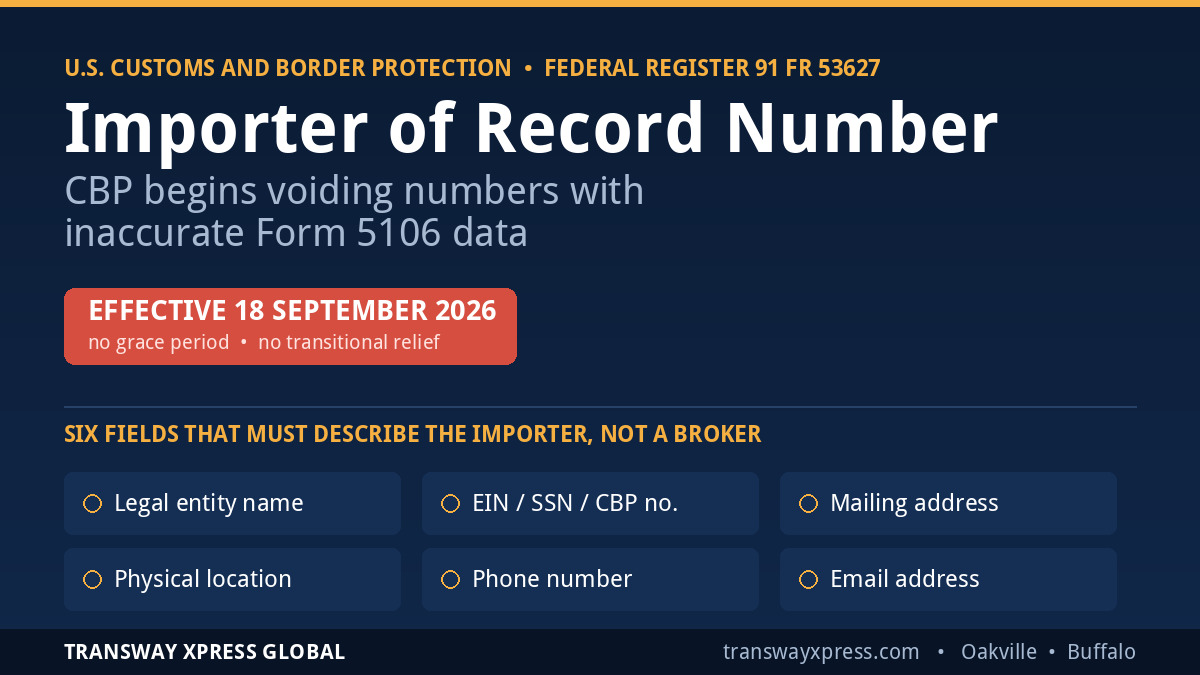
CBP published Accuracy of Importer of Record Data Submitted to CBP (91 FR 53627, document 2026-16911) on 19 August 2026, with an effective date of 18 September 2026. The operative sentence is short: if CBP determines that an importer of record, or a customs broker acting on behalf of one, has failed to provide complete and accurate information, CBP will void the importer of record number.
Read that as an enforcement change rather than a new rule. Form 5106 has always required truthful identity data. What is new is the consequence. Until now, thin or stale identity data produced a request for correction. From 18 September it produces a voided number, and a voided number is invalid for any purpose, including entering merchandise into the United States.
How many days you have left
Counting from publication of this post, 18 days remain. That window matters more than usual because it overlaps two other border events already in motion for cross-border sellers: the U.S. Section 338 duties that took effect on 22 August 2026 and Canada’s counter-tariffs arriving 8 September 2026, both covered in our breakdown of the 2026 US–Canada tariff escalation. A brand fighting a landed-cost problem in early September is exactly the brand that will not notice a quiet identity-data problem until a container is held.
Which Form 5106 Fields CBP Is Checking
The six data elements that must be right
The notice lists the information that must be complete and accurate. Every one of these has to describe the importer itself, not a service provider acting for it.
| Form 5106 field | What CBP requires | Failure pattern that puts you at risk |
|---|---|---|
| Importer name | The legal entity name that appears on the entry | Trade name or storefront brand filed instead of the legal entity |
| IRS EIN, SSN, or CBP-assigned number | A current, valid identifier tied to that entity | Identifier issued to a predecessor entity after a restructure or sale |
| Mailing address | An address CBP can reach the importer at | Address of a dissolved office or a former broker relationship |
| Physical location address | Where the importer actually operates, if different from mailing | Registered agent, P.O. box, or a third party’s premises |
| Phone number | A number associated with the importer | The broker’s or forwarder’s switchboard |
| Email address | An inbox the importer itself controls | The broker’s shared operations inbox |
The three patterns CBP calls out by name
The notice does not leave the failure modes to interpretation. It identifies three specifically:
- Physical addresses that are registered agents, P.O. boxes, or premises belonging to a third party.
- Email addresses belonging to a customs broker or another party rather than to the importer.
- Phone numbers not associated with the importer of record.
All three describe the normal shortcut taken when a broker completes the form during onboarding. That shortcut was convenient for years. It is now the defined trigger.
Why This Hits Non-Resident and Cross-Border Sellers Hardest
Brokers who filed the form with their own contact details
If you have never personally opened your Form 5106, someone else filled it in for you, and they filled it in with details they could answer. A broker fielding entry questions on your behalf had every operational reason to put their own phone number and inbox on the form. That is precisely the arrangement the notice now treats as incomplete data. The distinction between a broker and a forwarder matters here, because responsibility for the record sits differently in each relationship — our guide on freight forwarder vs customs broker sets out who is accountable for what.
Warehouse and prep-centre addresses used as a physical location
Foreign brands importing into the United States frequently list a fulfillment centre, prep centre, or 3PL warehouse as their physical location, because it is the only U.S. address they have. Under the notice that is a third party’s premises. Non-resident importers carry the same exposure on the Canadian side of their operations, where identity and account data have been under scrutiny since CARM — see our guide to CARM requirements for non-resident importers for the Canadian equivalent of this problem.
Sellers who restructured, rebranded, or changed entities
An EIN that belongs to the entity you traded under two years ago is inaccurate data today, even if entries have been clearing without incident. So is a legal name that no longer matches your incorporation documents. Brands that moved from a sole proprietorship to a corporation, or that set up a U.S. subsidiary after starting with a foreign parent, should assume the record is stale until they have looked at it.
What Happens If Your Importer of Record Number Is Voided
Your entries stop
A voided number cannot be used to enter merchandise. In practice that means entry filings fail, freight sits, and demurrage and storage begin accruing against cargo you cannot release. Anything already in transit at the moment of voiding is exposed, because the notice contains no transitional relief for shipments in motion.
The notice goes to the email address that may be the problem
CBP will issue written notice of the voiding to the email address the importer most recently submitted, explaining the basis for the action and how to request reestablishment. The circularity is the trap: if your email on file belongs to a broker you stopped working with, the warning that your number has been voided goes to them. You would learn about it from a stuck shipment instead.
Reestablishment
The notice states that the written notice will include what information must be submitted to corroborate the identity of the requesting importer so the number can be reestablished. CBP directs importer of record program enquiries to [email protected]. No processing time is committed to in the notice, which is the strongest argument for fixing the record now rather than testing the recovery path later.
Your 18-Day Form 5106 Audit Checklist
What to do before 18 September 2026
- Pull the record you actually have on file. Ask your broker for the Form 5106 currently submitted for your importer of record number, or retrieve it through your ACE Secure Data Portal account if you self-file. Do not audit from memory.
- Confirm the legal entity name matches your incorporation or registration documents character for character, not your storefront name.
- Verify the EIN, SSN, or CBP-assigned number belongs to that same entity and has not been carried over from a predecessor company.
- Replace any physical address that is a registered agent, a P.O. box, or a warehouse, prep centre, or office you do not operate.
- Replace any broker-owned email address with an inbox your own team monitors daily. This is the single field that determines whether you ever see a void notice.
- Replace any phone number routed to a broker, forwarder, or answering service rather than to you.
- File the update through your customs broker using ABI, or directly through the ACE Secure Data Portal. Ask for written confirmation that the update transmitted.
- Diarize a recheck for the week of 21 September and confirm entries are clearing normally.
Who should own this internally
This is not a warehouse task and it is not a marketing task. It belongs to whoever signs your customs power of attorney — a founder, finance lead, or operations director with access to the corporate records. That same person should own your commercial invoice standards, because entry data and identity data get audited together; our field-by-field commercial invoice guide covers the document side. Brands with regulated consumer products should run this alongside their CPSC eFiling readiness, since both failures stop the same entry.
How Transway Xpress Global Solves This
Fulfillment that does not put your compliance record at risk
Transway Xpress Global operates warehouses in Oakville and Etobicoke, Ontario and in Buffalo, New York, with an office in Pendleton, Indiana, backed by trucking parent Transway Transport, which has run Oakville-based operations since 2014. That footprint exists so brands entering North America can hold inventory on both sides of the border without inventing a U.S. or Canadian presence they do not have.
The relevant point for this deadline is what a fulfillment partner should not be. Our warehouse is where your inventory lives; it is not your corporate physical location for Form 5106, and we will tell you so. When we onboard a brand for U.S. fulfillment or cross-border shipping, the identity record stays in the brand’s name, with the brand’s own contact details, and the brand’s own inbox receiving CBP correspondence. Brokerage coordination sits alongside that record rather than replacing it.
Alongside D2C and B2B fulfillment, Amazon FBA prep, warehousing, order and inventory management, cross-border shipping, returns and custom packaging, we work with clients on the operational side of entry readiness — landed-cost modelling, documentation standards, and the sequencing questions that decide whether a September shipment clears or waits. If you are already reworking numbers because of the tariff changes, our guide to calculating landed cost pairs with this one.
Key Takeaways
The short version
From 18 September 2026, an inaccurate or incomplete Form 5106 can cost you your importer of record number, and with it your ability to enter goods into the United States. The failure modes CBP named — broker email addresses, registered-agent or P.O. box physical addresses, phone numbers that ring somewhere other than your own office — are ordinary industry practice rather than exotic non-compliance, which is why the exposure is so broad. The audit takes an afternoon. The recovery, if you skip it, takes as long as CBP takes. Brands still absorbing the end of de minimis should treat this as the same project: the U.S. border is verifying who you are before it decides what you owe.
Frequently Asked Questions
What is an importer of record number?
An importer of record number is the identifier CBP uses to link a customs entry to the legal party responsible for it. For most U.S. companies it is the IRS Employer Identification Number; individuals may use a Social Security Number, and parties without either can be issued a CBP-assigned number. It is established and maintained through CBP Form 5106, the Create/Update Importer Identity Form. Without a valid one, no formal entry can be filed in your name, which is why voiding it stops imports rather than merely penalizing them.
How do I know if my importer of record number is at risk?
Ask for a copy of the Form 5106 currently on file and check six fields: legal name, EIN or equivalent identifier, mailing address, physical location address, phone number and email address. You are at risk if any of them describe someone other than your company. The most common single failure is an email address belonging to a customs broker, because it was the practical choice at onboarding and nobody revisited it once entries started clearing.
Does using a 3PL or prep centre address break the rules?
Listing a third party’s premises as your physical location is one of the patterns the notice identifies. A fulfillment centre, prep centre or warehouse you do not operate is a third party’s premises, however long you have stored inventory there. Use an address your business actually occupies. A 3PL relationship is entirely compatible with a clean Form 5106; the two records simply describe different things, and conflating them is what creates the exposure.
What happens to shipments already in transit if my number is voided?
The Federal Register notice provides no transitional relief for goods in motion, so the safe assumption is that entry filings against a voided number will fail and cargo will be held. Storage, demurrage and detention accrue against you while the record is corrected. This is the main reason to audit before 18 September rather than after: a preventable data error becomes a freight problem measured in days, and peak season leaves very little slack.
How do I update CBP Form 5106?
Two routes are available. Most importers file the update through their customs broker, who transmits it via ABI, which is usually the fastest path. Self-filers can submit directly through the ACE Secure Data Portal. Either way, ask for written confirmation the update transmitted, and keep it. CBP directs importer of record program enquiries to [email protected], and the agency maintains guidance on the Create/Update Importer Identity Form.
Eighteen days is enough time to fix this, and not much more. If you import into the United States and you are not certain what CBP holds on file for you, book a consultation with Transway Xpress Global and we will walk through your Form 5106 exposure, your entry documentation and your cross-border fulfillment setup before the deadline lands.